
Convoy
Strategy Game: War · ZX-Spectrum 48K · 2 players · English
Budgie Budget Software · 1985 · Pound sterling 2.99

Discussion
Nobody has started a thread about this yet.
Play
- Convoy.tzx.zipTape image English17 KB
- Convoy.tap.zipTape image English16 KB
Documents
- Convoy(EN).txtInstructions English13 KB
Files and rights
No permission is on record either way. Screens and pictures are copied here on a take-down basis: if you hold the rights and want something removed, say so and it goes.
Credits
- F. David ThorpeCode
- F. David ThorpeIn-game Graphics
- F. David ThorpeLoad Screen
Sign in to credit somebody, or say what these people did.
Scores
In the magazines
- Crash #211985 · Overall25%
Elsewhere on the web
- WorldOfSpectrum 11 votes5.18
In the magazines 6
C&VG (Computer & Video Games) #51Jan 1986 · p.374/104/103/104/10
Graphics 4/10
Sound 4/10
Value 3/10
Playability 4/10
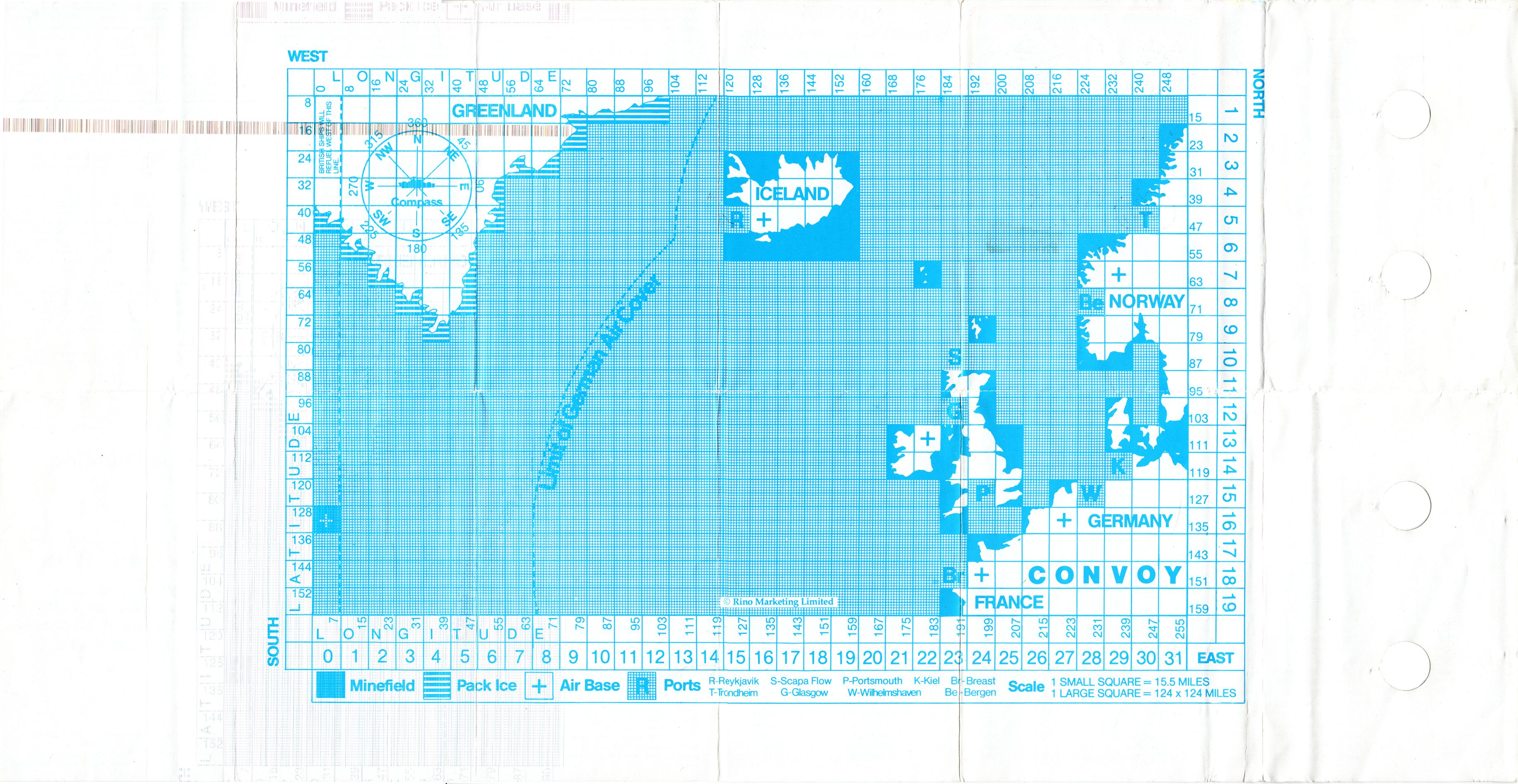
MACHINE: Spectrum SUPPLIER: Budgie PRICE: £2.50 Naval warfare during World War Two forms the back drop for this two-player game. Each player - British or German - takes his turn to enter his orders into the computer after which all ships move and their positions are plotted on the map. Any ship-to-ship contact is advised to the players. If appropriate, orders can then be given to aircraft which go on scouting missions, again, any contact with enemy ships being advised accordingly. Engagements between ships are then displayed graphically, although in a fairly rudimentary fashion. When any aircraft have spotted enemy ships, the player has the chance to decide at what point to drop his bomb as the aircraft "flies" over the ship in question. Again the graphics here are somewhat rudimentary. While there are some quite nice illustrations in this game, particularly of some of the ships, they do not, unfortunately, make up for what is basically a good idea very poorly implemented and about 12 months out of date. The fact that the game - is mainly written in basic does not help, certain parts being extremely slow, tedious and boring. On several occasions I waited over two minutes for the positions of the ships to be plotted. Orders for each ship (speed, direction) have to be laboriously entered via the keyboard and, before each player enters his orders, we have yet another wait while the positions of his ships are plotted. Navigation is very difficult. In summing up, I can do little more than say that this is a real bummer. Nice idea, pity about product. then what can you expect for £2.50. Best save your pennies for a worthwhile game.
Your Spectrum #20Nov 1985 · p.546/107/104/10
Dougie Bern 6/10
Rick Robson 7/10
Ross Holman 4/10
JOYSTICK JURY Are you ready for a software siege? It's time for our trusty panel of joystick jurors to line up all the latest and greatest games and put them through their paces! Let Ross Holman, Rick Robson and Dougie Bern lead you to the hottest arcade action around! CONVOY Budgie £2.50 Dougie: Zis iz a very interezting simulation game. Lizten, you wargaming fanaticz out zere. Ze scenario is WW II, ze location, the North Atlantic. You and your partner play ze parts of ze commanders in the British and German Naval forces. Your mission? to destroy ze enemy convoy and sink their flagship - zats all. Ze fleet under your command haz ze full complement of Aircraft carriers, Battleships, Cruisers, Destroyers and Submarines. Occasionally, you have ze benefit of ze air reconaissanze too. Ze game starts with ze British Player being given ze option to review his fleets' status or begin moving it around. He iz allowed to set the speed and course of each vessel independently, so he haz full control over zair movements. Power, huh! Convoy iz a very interezting game if you like ze wars, but it's written in ze Basic vhich makes it very slow and difficult to play. At two and a half poundz, it's not a winner, but itz very good practice for vinning ze wars and ruling ze vurld ... Ha, Ha, Ha!!
Crash #21Oct 1985 · p.12130%10%40%50%50%12%25%25%
Presentation 30%
Rules 10%
Playability 40%
Graphics 50%
Authenticity 50%
Value 12%
Overall 25%
Martin Lester 25%
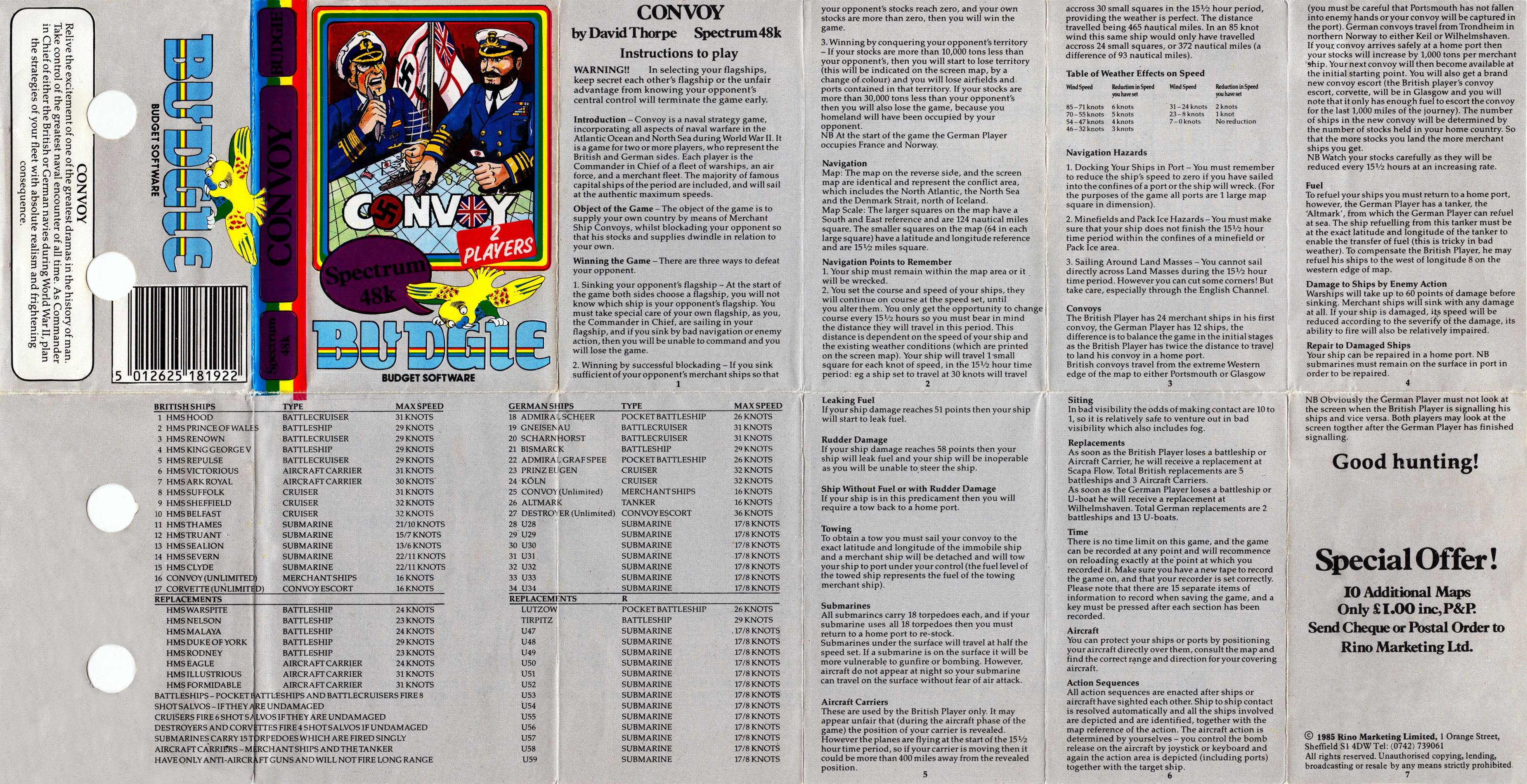
FRONTLINE As regular readers of Crash will be aware, Angus Ryall of Games Workshop has been our strategy reviewer for a goodly chunk of time. However, Angus is now interested in developing other areas of his life and is relinquishing his regular column. This doesn't mean that Angus is never going to write for us again expect to see the occasional vituperative contribution from Angus between the Crash covers from time to time. Sean Masterson will be occupying the Frontline from now on - two days after he started work in Crash Towers, we found he was a keen strategist, and so we gave him a desk, and told him he was editor of the Frontline column over to you, Sean. ...OF STRATEGIC IMPORTANCE AND THE IMPORTANCE OF STRATEGY... The purpose of this column, as I see it, is not just to review wargames, although they are almost bound to take up the largest proportion of space, but to have a look at strategy software in general. There is something in the subtlety of a good strategy game which appeals to many people more than arcade or adventure games. Arcade games require great manual dexterity. Adventures require a good deal of lateral thought, but the player can still have trouble deciphering a game's input format long after the clues have been solved, because of the restrictions of computer memory. With a strategy game, there is no guaranteed method of success. Only a guideline - a strategy - which may bring you closer to your goal. Strategy games have more potential for variety than any other type of game. Every time you load a game -like D-Day into your trusty machine, you know that no matter how many times you've played it, you're going to have to put a great deal of thought and intricate analysis of case problems into the gameplay if you are to stop the enemy from hammering you into the ground! There isn't the smug certainty of success that comes with experience on your average arcade game. Of course, many people are not directly attracted to wargames anyway, feeling that they are somehow morbid. Whilst I cannot agree with that assumption, I fully appreciate the sentiment. Still, software houses have responded to this in quite an exciting way - more fantasy and science-fiction games are appearing. One only has to consider the success of something like Lords of Midnight to see that the market does exist. Strategy games seem to have an interesting future ahead of them. Before moving on to this month's reviews, it's appropriate to give a rundown on the new rating system that will be used in these pages. Herewith a quick rundown of what they are and what they mean: Presentation: from packaging to loading and options screen. A friendliness factor. Rules: How well written and logical they are. Also takes into account complexity and clarity. Playability: How easily and smooth flowing the game's structure is, once you have digested the rules. Graphics: Rated relative to other games of the genre, not a comparison with arcade game graphics. Authenticity: Degree of realism achieved. Value: Is it worth the money? Overall: Our impressions. In conclusion, I would be keen to hear from any keen strategists or wargamers who have views or opinions they'd like to put across. Drop me a note at FRONTLINE, CRASH MAGAZINE, [redacted] - and who knows, we might be able to start a Strategy Forum. If I get enough response, they might even decide to keep me on (please guys...)! Hang on, Graeme sounds in a good mood; things are getting better. On with the reviews.... CONVOY Producer: Budgie Software Author: David Thorpe Retail Price: £2.50 First impressions of Convoy were very good indeed. The packaging was superb, especially for a budget game. So, interest already aroused, it was hastily loaded and that was where disillusionment set in. The game displays a very impressive loading screen - somewhat reminiscent of Beach Head, which has clearly been designed by professional graphic artists: unusual for budget software and certainly for wargames of this type. Unfortunately, the good impressions end once the game has loaded. The two players required must choose their respective flagships and it's time to read the instructions. One problem with many strategy games, and in particular wargames, is that it's usually necessary to digest masses of highly detailed rules before play may commence. Sometimes this proves to be worthwhile, sometimes not. This was one game where reading rules hardly made any difference at all - they were simply appallingly vague. The so-called instructions are, in fact, just an information sheet about the various ships and submarines with additional information regarding navigational techniques. The only other item covered is how one actually wins (or indeed loses) the game. Actually how to play is not even mentioned once. It is precisely this sort of oversight which can render games of this type totally useless. Before contemplating victory in Convoy, you need to spend a long time working out how to make your moves. Playing the game is a tiresome and laborious task. First you have to opt to signal, then type in which unit you wish to signal to, go the the process of actually telling the unit what to do, which is yet another series of entries, each needing a fair amount of consideration. One interesting touch is that requesting a report on a particular unit causes a picture of the ship to appear on the screen. However, once the same picture has appeared several times but referred to under different names, the effect soon wears off. The graphics for these little symbols are quite nicely done, like the title screen but don't expect anything like the quality of graphics involved in an arcade or adventure game. The object of the game is to get supplies to your own country, while simultaneously trying prevent supplies reaching your opponent's country. Surprisingly, there is no option to play against the computer. Convoy is a strictly two-player game, with Germany and Britain to choose from, and secrecy of plans and routes is so vital to interesting play that one person cannot play both sides successfully - you need a friend as an enemy! Furthermore, it is essential that each player looks away from the screen at various points in the game, which might prove difficult under some circumstances. You try to achieve your aim by setting courses for your ships, pointing them in the direction of your country. This task is made very tricky by periodic weather changes, and allowances must be made accordingly (this is easier said than done). You can also try to set courses to block off enemy ports or shipping routes, though during play, absolutely no success was gained attempting this. An action sequence is mentioned in the 'instructions', but again, we couldn't find it! What you do have to watch out for, is encounters with aircraft. Any damage to merchant vessels from planes sinks them, meaning you land less cargo when you reach port. One annoyance was dealing with petty details such as calculating exactly the speed of ships as they entered port so that they didn't crash straight into the harbour - that is probably going further than actual ships do in practice! It also means you waste a good deal of time for very little reason. The game inevitably takes a long time to play to its conclusion and it becomes immensely boring long before then. There is a save game option for masochists, though. Convoy is a very strange mixture - some very good graphics (spoiled by vast overuse) combined with the potential of a reasonable wargame are ruined by poor game play. There is a redefined character set but as only three of the characters are redefined, there seems to be little logic to this self defeating feature. In fact, the game is riddled with so many petty annoyances that the game probably takes more time to play than the average gamer will be prepared to devote to it. All in all, this is the sort of game which will quite likely put you off wargames for life and gives strategy games a bad name. Even at £2.50 Convoy is not value for money, despite its professional packaging. It's quite simply a disappointment from start to finish leave well alone.
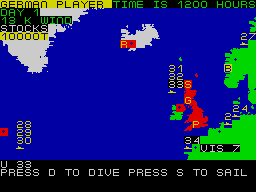
A Status screen during the sea-nic game, CONVOY. Personally we prefer playing with our rubber ducks in the bath - more fun and safer.
Advert1
- Computer Gamer #6Sep 1985 · p.33
Review1
- Home Computing Weekly #129Sep 1985 · p.13
News/Note1
- Home Computing Weekly #126Aug 1985 · p.9
Related
- Tags
- Turn based
- Same entry at
- Spectrum ComputingZXInfo
Reviews from people here
Sign in to write about this, or make an account. It takes a minute and lets you correct the catalogue too.
No description recorded.
Sign in to correct or add to this.
Hold the rights to this and want it taken down?