
Reichswald
Strategy Game: War · ZX-Spectrum 48K · 1 players · English
Scorpio Gamesworld Ltd · 1984 · Pound sterling 5.50
Also known as Crossing the Rhine, 1945 (English)
Discussion
Nobody has started a thread about this yet.
Play
- Reichswald.tzx.zipTape image 13 KB
Documents
- Reichswald(EN).pdfInstructions English258 KB
Files and rights
No permission is on record either way. Screens and pictures are copied here on a take-down basis: if you hold the rights and want something removed, say so and it goes.
Credits
- MW Gamesworldcredited
Sign in to credit somebody, or say what these people did.
Scores
In the magazines
- Personal Computer Games #101984 · Overall3/10
- Sinclair User #301984 · Gilbert Factor3/10
In the magazines 10
Crash #9Oct 1984 · p.77
Angus Ryall
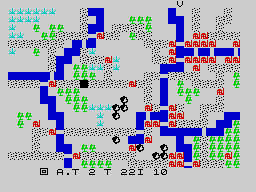
FRONTLINES From our correspondent at the front Angus Ryall. We have been conscious for some time that CRASH has had two weaknesses and these have been in the areas of adventure games and war/strategy games. The former problem was solved when Derek Brewster kindly agreed to write an adventure column and review the games. We are now able to overcome the second weakness - and this issue sees the start of our wargamers column put together for us by ANGUS RYALL. Angus is the Software Marketing Manager for Games Workshop Ltd. As such he brings with him his experience not only of software but also the over view of strategy games in general. OVERVIEW OF STRATEGY GAMES Everyone knows that wargamers thrive on 'complexity', and this is what has kept the hobby so elitist for so long. Traditional wargames/strategy games have been virtually impossible for mere mortals such as you or I to crack, and the small number of people playing them has also kept their prices ridiculously high. The arrival of home computers should have changed all that, by getting rid of the number-crunching and all those fiddly little card counters that always end up down the back of the settee. There should by now be as many decent strategy games available as adventures - but there aren't. Having just gone through a pile of strategy games I think I'm beginning to understand why. The people writing them for the Spectrum are giving the sector a bad name - it's the same old idea, of making the players bust a gut to play the game, that has kept traditional wargaming such a minority pastime. Most of these games have abominable graphics, laughable points systems, and unintelligible instructions. They tend to be long winded and very slow, and one or two are just plain idiotic. Only a couple here were actually enjoyable to play. DODOS These were the real pits - don't even waste your tape on copying them. BISMARK (ASP) You are in the South Atlantic in WWII. You have 12 battleship groups of varying strengths. You have to find and destroy the Bismark in a grid about 1 units square. It took me three minutes. Lucky maybe, but I'm not going back for another go - I've got too much sleeping to do. This comes, incidentally, from Argus Press, who publish all sorts of really naff computer magazines; but even they should know better than this. INVASION (ASP) Another one from Argus. This one raised my hackles before it even started - You are the commander of the Western Alliance' it says, the Reds are attacking'. Then it says Reds are stupid' - I think this kind of thing is insulting the intelligence of the audience, like those badges which say Nuke 'em till they glow' - it's not really funny, just childish. Anyway, the game is played on the same sort of grid as BISMARK, and the evil Reds come creeping down towards you. Each turn you are given so many resource points, depending on how many cities you control, which you then use to buy units and attack points. The Reds are given overwhelming force by the program, which tends to make the game more an exercise in headbanging than a game of strategy and skill. Argus run away with this month's mouldy cheeseburger; and I run like hell in the opposite direction. DIEHARDS Slightly better but still terrible. CONFRONTATION (MC LOTHLORIEN) A couple of months ago we ran a feature on Lothlorien, who produce this turkey; in the piece they complained bitterly about the fact that they always had bad reviews. Frankly, looking at this, I'm not surprised. Confrontation is supposedly their classic wargame, and is the master program for a whole series of wargame scenarios. The game is above the Argus level at any rate: but it suffers from a problem which typifies virtually all strategy games - the presentation of the map and units is diabolical. In the Lothlorien interview, one of the directors, Roger Lees, said "you have to make sure that the graphics don't get in the way of playing the game". Or lack of them, Roger? The only way to gain any kind of overall view of what's happening is to make a note of where everything is each turn, because an enemy unit only appears as itself once you've moved right up next to it - which can be a little bit late, Otherwise it's all guesswork, which doesn't sound much like strategy to me. Despite a fair variety of unit types, a reasonable terrain system, and a generous scenario-builder program, the game still fails because of this 'guesswork or paperwork' problem. REICHSWALD (MW GAMESWORLD) The map supplied with CONFRONTATION, Twin River, is in fact amazingly similar to that in REICHSWALD - only the Reichswald one is even more primitive. The only feature on this map which bears any resemblance to what it's supposed to be is the river. Merry & Wallis Gamesworld is only a small firm, so I can almost forgive them for that; but Big John Merry is a wargamer who goes back years and years (and outwards yards and yards, my spies tell me) and it certainly shows. They've managed to turn what could have been a nice, compact little exercise into a sprawling numeric animal that keeps tripping over its fifteen legs. Each unit has three strength values, for tank, anti-tank and infantry, which are determined by the computer and awarded randomly at the beginning of the game. There don't seem to be any set movement values (I may be wrong about this but this was one aspect of the game which proved impenetrable). There are terrain differences and victory points, but again, you can't see the enemy (computer controlled this time, by the way) and the combat just sort of happens when you move too close to the invisible huns. Definitely another pencil and paper job, and very ssssslllllooooowwwww so only really recommended for those about to embark on a term of life imprisonment. Generally about as action-packed as a bowl of semolina. DIAMONDS Well, having trashed everyone so far, I feel honour-bound to give a bit of praise to someone, and the only people I can think of that really deserve it are Red Shift whose two games Apocalypse and Rebelstar Raiders are still far and away the best strategy games for the Spectrum, even though Apocalypse is now over a year old. Unfortunately, a series of problems at Red Shift earlier this year led to the departure of most of the programmers to form the SLUG co-op; this means that there is an improved version of Apocalypse which will probably never see the light of day. But even the old Apocalypse is great if you can get hold of it. Before I say anything about it, I'd better make it clear that it is an anti-war game (in view of what I said earlier!) but its subtle in its methods - it really works by forcing the players to think about the consequences of aggression. The game comes with four maps, and the distribution of cities can be done either manually or automatically. In addition to the main map to the chosen area, say Europe, there is a close-up of the cursor position giving unit strengths in each square. As the game plays through, the players (up to four) make decisions as to whether they are going to use aggression, whether to use conventional forces to expand their empires, or whether to use the ultimate sanction of nuclear weapons. There's a lot more to this game than simply blasting away at your opponents, yet you don't have to sit up all night with a calculator in order to know what's going on. REBELSTAR RAIDERS (RED SHIFT) Even better than Apocalypse is REBELSTAR RAIDERS, where one player commands a team of space pirates in an attempt to destroy the control centres of three different installations (each loaded separately). The other player, naturally, has to defend the installations. The graphics are quite superb, and the installations, which appear as plans or cross sections are designed for maximum game flexibility. Cursor movement is fast and smooth, although the keyboard layout takes a bit of getting used to. The wide variety of weapons available and the manual deployment of the characters create a great mix of strategic thinking and general blasting power. The only things I really dislike about RAIDERS are the irritating sound effects (which seem to be something of a Red Shift trademark) and the packaging - which is so amateurish it could have come from Merry and Wallis. REBELSTAR RAIDERS and APOCALYPSE prove that it is possible to write good strategy games for the Spectrum: but they also highlight the great gulf that there is between strategy games, and arcade and adventure games. Whey you consider that state-of-the-art in arcade and adventure changes almost month by month (look at the GREAT SPACE RACE) it is incredible that one of the two best strategy games is over a year old. This is one of the few areas where American software, for Ataris and Commodores, wipes the floor with us. Perhaps it's about time that some of the software houses renowned for their arcade and adventure work took a long hard look at the strategy games desert - the demand is there, when the right game arrives.
Only the river is recognisable...
Micro Adventurer #11Sep 1984 · p.38
John Fraser
RHINE TEST MICRO: Spectrum 48K PRICE: £4.95 FORMAT: Cassette SUPPLIER: Merry & Wallace, [redacted] Reichswald is a simulation of the American attempt to secure a bridgehead over the Rhine in 1945. As the American commander, you must capture the city areas within a certain time to win the game. During loading you are presented with the symbols for the various units and the terrain. When ready, you type in 'y' if you want a saved game or 'n' if you want a new game. Then you sit back and wait. It takes a while for the cursor to appear, so don't unplug thinking you've got a dud cassette; just be patient. The game is fairly simple to play, though you need to read the documentation beforehand, so that you know what you are looking at, and how to input commands and move units. I found it difficult to become enthusiastic about this game, despite its interesting features, because of the slow responses. This is its one major drawback, and is likely to deter the novice wargamer. Once you have positioned the units on the map, there is nothing more you can do except grin and bear it. The computer moves the Germans about, and then goes into the combat phase. Eventually, you get a status report which indicates your strengths and weaknesses. Then the results of the combat appear. If it wasn't for the excruciatingly long delay in presenting these feedbacks, I think I could have found this game quite addictive. As it is I've not made more than a few moves in one session, and I'm not sure whether I have the inclination to see the battle through to the bitter end. Those who are chess fanatics, or enjoy similar games which require strategic planning rather than quick reactions, may well disagree. Personally, I'd rather play this sort of game with people, who don't always have the cold logic of a computer.
Personal Computer Games #10Sep 1984 · p.504/10None2/103/103/103/10
Graphics 4/10
Sound None
Originality 2/10
Lasting Interest 3/10
Overall 3/10
Peter Connor 3/10
MACHINE: Spectrum 48K CONTROL: Keys FROM: MW Gamesworld, £5.95 A strategy game in which you command the forces of the American 9th Army as they attempt to capture a bridgehead over the Rhine. You control tanks and infantry, reconnaissance, units and engineers. Unfortunately for the allies, the graphics display is very dull and it's not at all clear where the strategy lies. Play this game and WWII is likely to have a slightly different result.
Sinclair User #30Sep 1984 · p.93/103/10
Gilbert Factor 3/10
Chris Bourne 3/10
Memory: 48K Price: £5.95 Reichswald simulates the crossing of the Rhine by the allied armies in 1945 and you are in control of units of the American Ninth Army. Your task is to capture one of the bridges or, alternatively, inflict serious damage on the enemy. You have a number of armoured and infantry regiments, engineers and reconnaissance units; they move across a map laid out in squares; speed of movement depends on terrain. The fastest type of movement is what non-wargamers would call very slow. Once the pieces have been moved you must wait for the computer to move the German forces and then conduct any battles. The computer takes several minutes to go through its moves and the resulting battle becomes a tedious war of attrition. The surprise is that dedicated wargamers may enjoy the masochistic experience. We for our part cannot understand why M W Gamesworld has managed to transfer all the disadvantages of simulation wargaming to the Spectrum when computers are so clearly suited to writing complex games which can be played at speed.
Advert3
- Micro Adventurer #11Sep 1984 · p.24
- Personal Computer Games #10Sep 1984 · p.61
- Personal Computer Games #8Jul 1984 · p.116
Feature2
- Sinclair User1985 · p.55
- Crash #9Oct 1984 · p.76
Review1
- Games ComputingNov 1984 · p.58
Related
- Same entry at
- Spectrum ComputingZXInfo
Reviews from people here
Sign in to write about this, or make an account. It takes a minute and lets you correct the catalogue too.
No description recorded.
Sign in to correct or add to this.
Hold the rights to this and want it taken down?