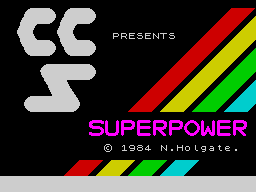
Superpower
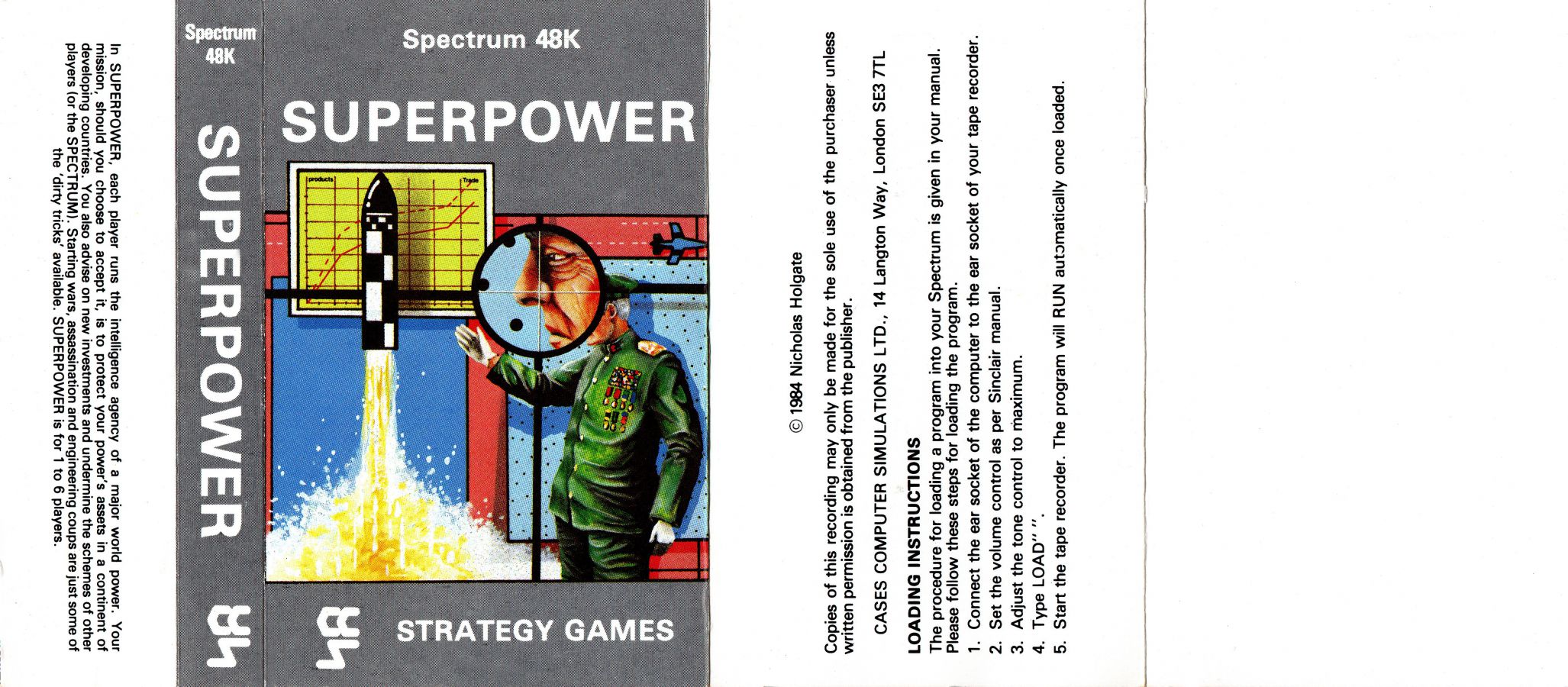
Strategy Game: War · ZX-Spectrum 48K · 2 players · English
CCS · 1984 · Pound sterling 5.95
Discussion
Nobody has started a thread about this yet.
Play
- Superpower.tzx.zipTape image English18 KB
Documents
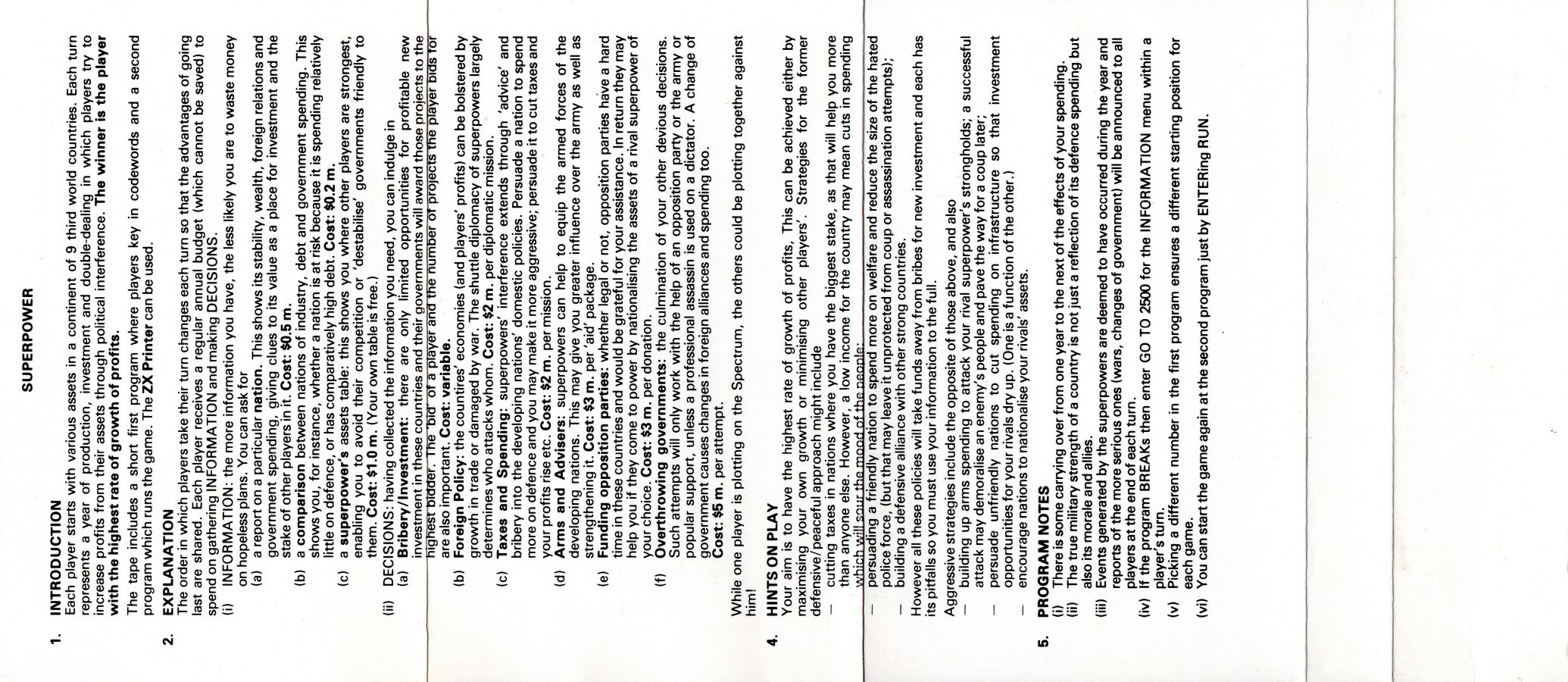
- Superpower.txtInstructions English6 KB
Files and rights
Distribution permission is on record, granted to another archive rather than to this one. Screens and pictures are copied here; everything else links to the archive that holds it.
- AllowedCCS → WorldOfSpectrum
Credits
- Nicholas Holgatecredited
Sign in to credit somebody, or say what these people did.
Scores
In the magazines
- Big K #111985 · Overall3/3
Elsewhere on the web
- WorldOfSpectrum 6 votes7.17
In the magazines 6
Crash #40May 1987 · p.105
Rosetta McLeod
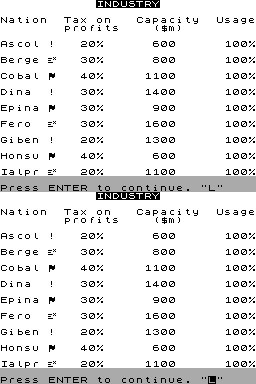
CRASH COURSE By Rosetta McLeod BUSINESS IN THE CLASSROOM Cases Computer Simulations have produced a range of educational software programs covering a variety of subject disciplines, including 'minority' subjects such as agriculture and political studies. The programs follow a set format, involving assimilating a wealth of information, and using it to make correct decisions at critical moments. Relevant information is presented in a variety of ways: bar charts, histograms and maps are used to very good effect, and maintain the players' interest throughout. Different levels of difficulty are also offered, and the games can be used by one player at a time or by small groups working on competition. Aimed at older pupils and college/university students, these programs are realistic simulations of real-life situations, providing the user with valuable practice in the application of the their acquired knowledge. Schools and Colleges are placing more and more emphasis on the importance of information skills, and CCS's range of educational software certainly fills a gap in the market - there are very few educational programs available for college students, and fewer still for the minority subjects. The programs are all for the 48K Spectrum and cost £5.95 each. They can be obtained from CASES COMPUTER SIMULATIONS, [redacted]. AIRLINE If it's your ambition to be the chairman of a large company, now is your chance to assess your potential. In this simulation, you adopt the role of chairman of L-Air, an airline which starts up business with £3 million. You have 7 years to increase your net assets to the £30 million necessary to take over British Airways! You have to decide on the number of aircraft to operate, whether to buy or charter the level of staffing and maintenance necessary, the duration of fuel contracts and when to repay loans. Problems encountered include tax demands, increases in fuel costs. and loss of revenue resulting from cancelled flights, strikes, hijacks, air crashes and sabotage. The information is presented through histograms., bar charts and graphics. The first chart displayed is a bar chart showing a forecast of the passenger payload for each level of activity. Using this information, the player must decide on the best aircraft to use, and then finalise his choices after looking at the level of revenue expected. When this is above normal, it may be cheaper to borrow money and buy aircraft instead of chartering. The market rate for each DC10 is £10 million, and when aircraft are purchased for more than this amount, the additional cost is debited against the capital reserves. thus reducing net assets. Crew costs are fixed at £50.000 per DC10 while the cost of maintenance is £90.000 for each aircraft. Results of trading are shown in the form of profit and loss accounts and balance sheets. The graphics are excellent, and the player's interest is maintained throughout by the constantly changing information - you can even read Financial Times reports and receive Telex messages. If you succeed in reaching the target of £30 million. then perhaps Richard Branson may have a rival! CORN CROPPER Aimed at students of Geography or Agriculture, Corn Cropper is a simulation of a commercial wheat farm. The player begins with cash resources of £50,000, 30 acres of rich arable land, a tractor and two farm workers. He must then build up his assets to £250.000. The menu allows the user to call up information of different types: the weather forecast shows the likely rainfall and average temperature for each month, but - as with all weather reports - this cannot be relied upon totally: the crop status histogram shows the stage of growth that the crops have reached, together with information on whether or not a fertiliser has been used; a farm map, showing the cultivated areas, must be referred to before decisions to plant are made; and the cash account shows the monthly expenditure and receipts. All in all, a wealth of information must be accessed before the player decides to take any action. A report is shown at the end of each month. detailing the results of the decisions taken. Unforeseen problems arise from time to time, including such disasters as frost damage, rats eating the seed corn, and even the dreaded fire. The accompanying notes include some useful hints: players are told for instance, that crops need an optimum level of water each month, and that fertilising two month old crops doubles the yield. The program contains five levels of difficulty, providing students with a very realistic and comprehensive simulation. It certainly drives home the point that farming is a highly technical and specialised industry! Corn Cropper is currently used for the secondary school Geography syllabus and in Agricultural Colleges. Amazingly enough, a French version is also available! OLIGOPOLY According to my dictionary, 'oligopoly' means "a market situation in which control over the supply of a commodity is held by a small number of producers, each of whom is able to influence prices and thus directly affect the position of competitors." This game is a management simulation for one to six players, and the objective is for each participant to create wealth at a faster rate than his competitors. The computer gives each player a balance sheet for the year, generates a forecast for demand and costs, and tells each manager about the capital goods industry. Using the computer's information on price, production, marketing, research and development, new equipment and dividends, the managers have to make decisions. When each has done so, the computer compares these and displays two reports for all firms. Results may be kept secret by agreement, as the program includes the option of using a punter for annual reports, forecasts and newsflashes. A bar chart compares the share values for each firm, and a pie chart shows each firm's share of the market. Occasionally, news of imports, overtime and changes in taxes may be flashed up on screen, and this new information may make it necessary to alter decisions. A duration of between 2 and 50 years is selected before play begins, and a useful feature is that even if a game were to be played twice with exactly the same decisions, the results would be likely to differ as the computer generates random factors. I also like the way in which shareholders demands have to be taken into consideration as the managers decide how much of their profits to share with them! If you think you have entrepreneurial skills, try them out with Oligopoly! PRINT SHOP A simulation aimed at Business Studies students, Print Shop covers a period of 12 weeks in which the student becomes sole proprietor of a small printing works. The prospective businessman is asked to make judgements on the following: the number and category of staff to employ: the amount and type of paper to purchase: the quotation for each job and the scheduling of work in an optimum week. The objective is to produce a net profit of over £4,000 in the first three months of trading, making decisions based on the weekly trading accounts, profit and loss, and balance sheets. A great many factors must be taken into account when, for example, hiring staff. A supervisor must be employed for every five production staff, and new premises are required (at double the rent) when this number rises to ten. It has to be remembered that additional staff will be needed when orders start to increase, but as it takes three weeks to train new employees, production will not increase immediately. It may therefore be necessary to contract out certain jobs. This is a particularly good simulation, in which students have to make a large number of decisions after having assessed a wealth of information. The information is presented clearly both on the screen and in the brief accompanying notes. There are three levels of difficulty, but I'm afraid I wasn't even successful at the easiest of these - to be honest, I managed to incur losses, which resulted in the net assets becoming negative. The banker foreclosed and the business ceased! Print Shop certainly tests your business acumen to the full, and creates a feeling of true involvement in the world of commerce. An enjoyable and challenging program. SUPERPOWER Superpower is a strategy game showing the superpowers' influence over Third World countries, and is intended to supplement a Political Studies course. Each player runs the intelligence agency of a major world power, with the ultimate aim of protecting his power's assets in a continent of developing countries. At the beginning, each player has assets in the nine Third World countries, and each is struggling to achieve the highest rate of profit growth. This might be brought about by peaceful strategies, such as building a defensive alliance among the strong countries, or by more aggressive means such as encouraging nations to nationalise a rival's assets. A variety of information is available: a report on any country shows its stability, wealth, foreign relations and government spending: a comparison can be obtained between nations in terms of industry, debt and government spending; or a study can be made of a superpowers' assets table. This information should help the player to make decisions, including what to do about investment, foreign policy, taxes and the armed forces. Annual budgets must be adhered to, and the players must therefore indulge in a variety of strategies, either to maximise the growth rate of their own country or to minimise that of the others. A player might, for example, find himself weighing up the arguments and counter-arguments for persuading a friendly nation to spend more on welfare. While this might reduce expenditure on the hated police force, it could mean that the country is left unprotected from coup or assassination attempts. A detailed understanding of political theory is a pre-requisite for the successful tackling of this program, but it is useful in extending a student's depth of understanding. MANAGE This is an interactive management game for two players which can be used to supplement a Business Studies curriculum. Alternatively, it could have a part to play in management training and economic studies. The aim is to teach the users, by placing them in a role-playing situation, about the significance of pricing policy and the correct allocations of cash resources. Participants begin with £7,601 in cash, and 71 units of stock valued at £35.35 each. They must then make decisions covering the price of goods, marketing expenditure, production/research costs and plant additions. The results of trading are shown by statements and by a line graph of orders and sales. An excellent feature is that the players' decisions interact with each other, leading to a strong element of competition. It's Interesting that players are forced to make immediate decisions, while always bearing in mind the long-term objectives for improving the performance of the company. Although no detailed financial knowledge is required, it is assumed that players will be able to assimilate the fairly detailed information supplied. The game may be played with or without a printer, but if one is used, the results are not displayed on the screen, thus ensuring the confidentiality of information, and making things more difficult for an opponent! The instructions are clearly explained on the inlay, and as this game does not depend on luck, the winner can be sure that it is his knowledge and acumen which has made him successful'. COMMENTS Control keys: clearly explained and kept as simple as possible Keyboard play: very good Graphics: sensible use of graphs and tables in most programs. The graphics in Airline are particularly good Use of Colour: limited
Crash #14Mar 1985 · p.126
Angus Ryall
FRONTLINES From our correspondent at the front Angus Ryall. When I was younger, working on various college Rag Mags and stuff, I had this peculiar idea that being a megastar journalist would change my life. In fact, all that happened was that I end up sitting up all night for about three days in a row, roughly two weeks after the final copy date has passed, madly trying to get everything together in time. I have a sneaking feeling that all part-time writers work this way; certainly I used to know some people who wrote for the music press, and they claimed that they simply could not write at all until after the copy date. Funnily enough, the soon-to-be-deceased/late lamented Big K magazine was staffed by a lot of ex-NME people, which tells you quite a lot about why it was like it was, and also why it no longer is. What the intuitive among you will have realised is that I am working my way round to apologising for the apalling errors I have made in recent issues, like abusing the wrong people, getting my opinions wrong, etc. I must say, actually, I had the good fortune to meet John Gilbert last week at the Toy Fair, and I'm sure if it hadn't been for the fact that we were giving away free wine on our stand, he would certainly have explained to me the exact nature of his identity crisis. A splendid chap. The point is, though, that we journalists are under an immense amount of pressure, and can't avoid making the odd slip, and there's really no cause for any offence to be taken. Anyway.... I'm back again, and just about suitably psyched up to deliver another vituperative harangue. In case you didn't realise I missed last month's copy date yet again (this is getting boring) but it wasn't my fault Your Honour, there were mitigating circumstances! You see, my fiancé and I live in a (how shall we put this?) derelict house, which we actually own (fools!) and intend to renovate, flog and make a hefty profit on. Unfortunately, there are some slight drawbacks to living in this salubrious joint, like the fact that when it snows it actually comes right down the chimney into the living room - and of course going to the loo becomes a major Arctic expedition. Once you've got the huskies hitched up, you have to negotiate a ten-foot high mountain of bricks in the backyard. The loo itself is frozen up, and sitting on it is something else - it leaves your posterior feeling like it's been ravaged by a rampant squid. In an effort to ease the tribulation of living in this hardship station, I have taken to using a potty indoors at night... I don't think I can go on with this - it gets really disgusting! As I had ten days off from my day job over Christmas, I thought I would really get stuck in to a number of desperate jobs, like putting some heating and hot water in, and so on. And now, in fact, our standard of living has increased by about 300%. We no longer have to trek over to the other side of town to wash at my mum's, and we've got a nice stereo. The thing is, though, that I just didn't get time to look at any games, let alone write about any. (This is not quite true, I did spend a little time playing Knight Lore, and I have to say 'Well done, all you lot at Ashby'). I think I'll just resign now, OK? Also, I will admit to playing Dark Star a bit, and I have a great tip for anyone with a joystick: easily the best way to play Darkstar is to define all the right-hand keys at accelerate, all the left-hand keys as brake, stick the Speccy on the floor, take your shoes off and use it like the pedals in a car. This enables you to keep both hands on your joystick all the time (after a while I found that I could even hit the '1' button pretty accurately with my toe). The only drawback is that it can get a bit smelly, and your friends tend to regard you as some kind of pervert. Just before Christmas I had the time of my day at the EMAP Christmas party at the Camden Palace. To those of you who don't know, EMAP is a big publishing company, which owns loads of magazines, such as C-5 User and C&VG. In view of my oft-expressed pleas for more friendly relations between magazine people, I was not at all surprised to get the call to Camden Town (funny Roger couldn't make it - had a bad attack of the belly ache, I hear) and headed off down the central line confidently expecting the usual gutful of gin. But - horror of horrors! - the free bar closed at nine o'clock, well before I'd hit my stride. In that time, though, I had managed to have a very meaningful 18-second conversation with Lee Guinty of Micro Dealer (Lee is a person of immense power, because he has a large say in how many games a Software Company is going to sell. He stands me up at lunch dates, but OK, I can take the humiliation)(sob). I'd also had a long chat with Clive Bailey of Beyond about how brilliantly they've been doing lately and, I can now reveal to you, in a sneak leak, that Beyond will shortly be launching a new label! Like, wow! You may have noticed from previous reports that I like going to exhibitions and things. Well, I think I've changed my mind. I've just spent the last five days at the Earls Court Toy Fair, an event which must surely rival even the dreadful ideal Home Exhibition for sheer tedium. Funnily enough, there were virtually no software companies there at all, although there were plenty of people looking for them - perhaps this explains why I was hardly bought any drinks at all during the entire show. Or maybe it was just the fascist car-park attendants, scaring them away. Who can tell? I'd also just like to say hello to the person who congratulated me on my column (wash your brain out with soap, you degenerate) - it almost makes it all worthwhile, although the odd beer would help as well. Incidentally, I had the most apalling experience with microdrives at the show - one day we had a press reception in the morning for all the hacks to see our new games. Guess what happened - all three cartridges with the new games on had mysteriously de-formatted themselves, and so I had absolutely nothing to show the assembled throng. I felt a right dingbat, and the moral is clear - if you have to rely on microdrives, then don't use them at all. SUPERPOWER Producer: CCS Memory Required: 48K Retail Price: £5.95 Author: Nicholas Hodges After the disappointment of the last two offerings, I was well pleased to come across this one. Once again it's from CCS, virtually the only company working in the strategy games field as their main area. Despite the fact that CCS continue to put out the most diabolical rubbish, along with the occasional goodie, I'd still like to commend them for a CRASH Plasticine medal for artistic bravery, in the face of ongoing public apathy. Superpower is a good game. It may not be anything spectacular to look at (definitely unspectacular), but it is intelligent and thought-provoking. The game is basically a variant of the old mainframe decision-making game, Hammurabi. You play the part of a superpower attempting to increase its influence in a certain region, made up of nine countries; these countries are democracies, dictatorships and one-party states. Each country has a certain output, which is taxed at various levels. The states spend their money on defence, welfare, infrastructure, and police; the multinational companies lobby to have their taxes reduced, but they might get them raised, or they might be nationalised (I remember Suez). The game really presents a remarkably accurate model of an unstable, developing area such as Central America or the Middle East, with all the Machiavellian comings and goings of the real, expansionist world. I got the feeling when I was playing this that I was in charge of a massive CIA operations to convert the entire region. There are six main ways of gaining power over a nation: by Investment (and bribery) in the economy; by Diplomacy (or counter-diplomacy) by which means you forge military and commercial blocs, or persuade countries to go to war with each other; by Economic lobbying, ie attempting to persuade countries to adopt a more favourable attitude to your investments in terms of taxes; defence spending etc; by Arms Aid; by funding opposition parties; and finally, by overthrowing governments, which can be achieved, among other ways, by hiring a hit man for five million dollars The range of options is huge; the author may be very well experienced in running political and economic models to have thought it all out. If all this sounds a bit heavy for your tastes, don't worry - it's actually great fun puzzling out how to maximise your advantages (and profits) in each country, and I got a little vicarious thrill each time my opponents' assets got nationalised. I've got a couple of ideological reservations about the game: it's very materialistic (What about your house, then, eh? -Ed), and I personally think it would have been better to have found some other basis apart from profit on which to gauge the success of the player(s). Despite that, though, this is still one of the best decision-making games I have seen, and even if you're not interested in politics, it beats stuff like The Great Space Race hands down (the graphics are better too!). If you're getting tired of sprites and shoot-em-ups, and the 48,000 views of an orc's ear lobe leave you yawning, I'd strongly recommend Superpower - you keep turning round expecting to see yourself on News at Ten! If I had my way this game would be compulsory for all new recruits to the Foreign Office - I got more out of this than a year's lectures on international relations at university.
Micro Adventurer #16Feb 1985 · p.28
Cath Bilgora
SUPER POWER MICRO: Spectrum 48K PRICE: £5.95 FORMAT: Cassette SUPPLIER: Cases Computer Simulations, [redacted] In Superpower each player takes on the role of an intelligence agency. Your goal is to protect and expand your country's influence and assets in a group of Third World countries, at the expense of the other players, or in the solo version, against the computer. You may play with up to six players. Having stated your password, your total budget allocation is shown. The actions open to you are broadly split into two areas. Information includes access to other players' interests, details of the countries' assets, defence spending, police strength, and which other players have a stake in them. The other major group is Decisions, which include investment (increasing your stake in a country), which involves bribing the countries politicians; foreign policy, a polite way of describing meddling; taxes and spending, influencing the countries allocation of their resources; arms and advisors, helping to equip their armed forces; funding opposition parties, to undermine the present form of government. The ultimate aim is overthrowing governments, by ballot, coup or assassination. The potential scope of the game is massive, and the more players the better. Backstabbing and undermining a player's most profitable assets are par for the course. There are so many different things to do that you never have enough resources to cover all your options, as well as defending and attacking. Data is constantly updated - a news bulletin comes up at the end of each whole turn, showing where investment has been made, and if any of the player originated events have taken place, or whether random computer generated disasters or good fortunes occur. Nothing is more frustrating than an oil strike in a country you have neglected. As with any multi-player game, you have to sit out away from screen view whilst the others take their turn. It does speed up quite quickly if you know what you are doing. Tactics generally should be to try to totally control two or three of the countries, and to dabble in the others to disrupt and frustrate. Caution must be exercised, particularly in a democracy, because if another player helps the opposition party to gain power, he can tell them to nationalise your assets, regardless of how much you have invested. One party states are hard to crack; they are often strong in detection, having large police forces and being adequately served by reasonable armed forces. Dictatorships are prone to assassination attempts but are costly and invariably attacks are doomed to failure. This game is most decidedly the sort of thing to involve yourself in if you love Diplomacy, Machiavelli, or the like. Give full rein to your most paranoid feelings, it hardly ever pays to be benevolent. Don't trust anything or anyone. The key is to invest, defend your investment, and when you think it safe, attack, undermine and be as unpredictable as you possibly can be. I liked this game very much. It's got simple mechanics, and is a nicely presented challenge for a group of schemers or just the one of you!
Big K #11Feb 1985 · p.333/33/32/33/33/3
Graphics 3/3
Playability 3/3
Addictiveness 2/3
Overall 3/3
John Conquest 3/3
MAKER: CCS FORMAT: cassette PRICE: £5.95 A real mega-game from CCS, combining aspects of both Insurgency - their two-player government vs. guerrillas strategy game - and The Prince, their multi-player interactive adventure. Up to six players meddle in the affairs of nine small Central America-ish countries, grasping for profits. Each country has a mass of differentiating parameters and players have dozens of possible options from the information and decision menus. The number of things you can do in a turn is limited only by your cash in hand, and with various possibilities carrying different price tags, you have to juggle things pretty carefully. The main problem, helped by a printer options, is top keep track of the sheer volume of changing information which, though very well laid out, can't be held simply in the head and isn't available just on demand. My admiration for this very complex, well thought out and demanding game is tempered only by an annoying glitch in the loading - you're not told to stop the tape during the game options selection, though you are told to start it again afterwards. Still, if you want a game that gives you plenty to do and think about, Superpower plus reams of notepaper will keep you busy.
News/Note1
- Crash #12Jan 1985 · p.173
Review1
- Home Computing Weekly #92Dec 1984 · p.40
Related
- Tags
- Turn based
- Elsewhere
- UVL
- Same entry at
- Spectrum ComputingZXInfo
Reviews from people here
Sign in to write about this, or make an account. It takes a minute and lets you correct the catalogue too.
No description recorded.
Sign in to correct or add to this.
Hold the rights to this and want it taken down?