
Handicap Golf
Sport Game: Action · ZX-Spectrum 48K · 2 players · English
CRL Group PLC · 1983 · Pound sterling 5.95
Also known as ZX Spectrum Golf (English)
.jpg)
Discussion
Nobody has started a thread about this yet.
Releases
- 1983CRL Group PLC Sold as ZX Spectrum GolfPound sterling 5.95
- 1984Rebit Computer
- 1984Sound-on-Sound
Play
- HandicapGolf.tzx.zipTape image English17 KB
- HandicapGolf(different).tzx.zipTape image English17 KB
- HandicapGolf.tap.zipTape image English16 KB
- HandicapGolf(RebitComputer).tzx.zipTape image English16 KB
Documents
- HandicapGolf.txtInstructions English1 KB
Files and rights
Distribution permission is on record, granted to another archive rather than to this one. Screens and pictures are copied here; everything else links to the archive that holds it.
- AllowedCRL Group PLC → WorldOfSpectrum
Credits
- Peter G. Curtiscredited
- Phil GascoineInlay/Poster Art
Sign in to credit somebody, or say what these people did.
Scores
In the magazines
- Crash #41984 · Overall81%
- Personal Computer Games #61984 · Overall Rating6/10
Elsewhere on the web
- WorldOfSpectrum 9 votes6.56
In the magazines 24
ZX Computing #15Oct 1984 · p.119
Owen Brooker
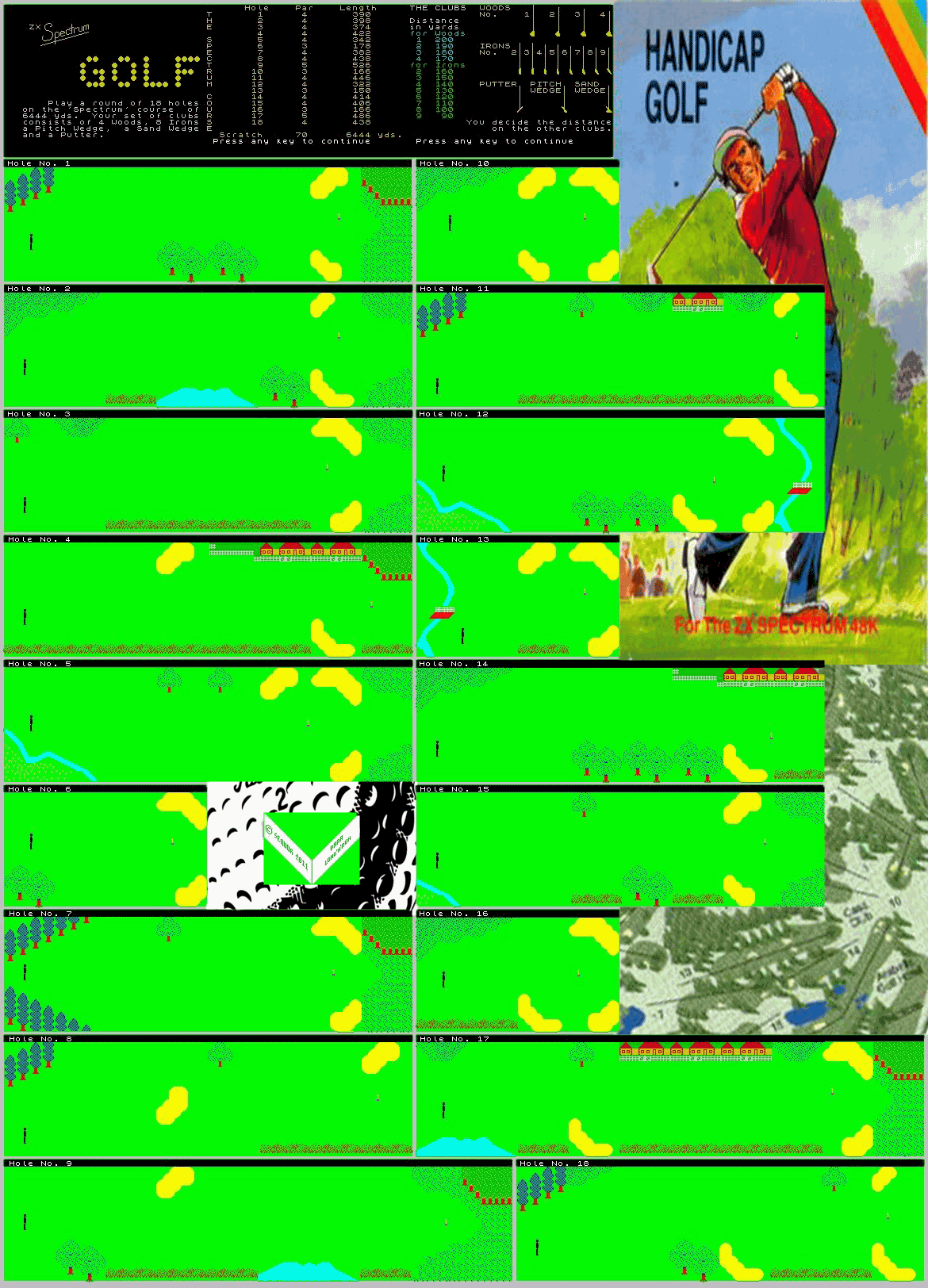
The title is misleading as no handicap is used in this game. The inlay card gives a brief description of the game but the instructions on the program are sufficient in order to play it. The program takes about 5.5 minutes to load and you are greeted with the information that the course is 6444 yards and your set of clubs consists of 4 woods, 8 irons, a pitchwedge, a sandwedge and a putter. Next is seen the course of 18 holes, their par and the distance of each hole. The overall par for the course is 70. The clubs are then shown and the expected distance for each one. There is a wind factor (or slope of green when you get there). This affects the distance and accuracy of your shot. It is displayed by a number between 0 and 9 for the strength of wind and an arrow showing the direction of the wind. The capacity of the game is for one or two players. You are asked if you want a preview of the course or to start the game. If you ask for a preview the computer will take you through all the holes and their different views. This is not worth seeing as you can see a preview of each hole as you come to it. When starting a hole, the view is displayed, the amount of yards in the hole, the score taken so far to this hole and the par for the hole. The graphics are good and well laid out showing trees, bunkers and water hazards. Also, if you go off the edge of the screen at either side you are told that you are out of bounds and must take the shot again. Before each shot you are asked which club you wish to use. This is a simple matter of moving an arrow to the desired club and pressing 'ENTER'. After this, the view is displayed again and you are asked to move the direction indicator up or down taking into account the wind factor. The animated golfer hits the ball, hands the club to the caddie and walks to the ball during which the process of club choosing is repeated until you reach the green. On the green, a close up is observed and your ball is seen along with the hole. A direction indicator runs round the screen and you have to stop it in line with the hole and your ball. The power is then asked and you move the indicator as high or low as you wish depending on the distance to the hole, This repeats until the ball has been holed. You are then told your score for that hole. You then go to the next hole and repeat the process. At the end of the round the player runs into the clubhouse for a drink but the poor caddie has to go back home! You can then see your card for the course and you are asked if you wish to play again. This is very good game and the graphics are exceedingly good. The main rules of golf are followed and at £5.95 it is well worth the money. I highly recommend it.
Personal Computer Games #6May 1984 · p.406/10
Overall Rating 6/10
Peter Connor
Steve Cooke
THE VIDEO SPORTSMAN Want to be a demon driver? Or a golfing wizard? Or a master of the big break? We load up the motor race, golf and pool simulations. MOTOR RACING The family will gasp in awe as you hurtle round the track, defying death at every bend and only occasionally have to be scraped off a billboard. Peter Connor enjoys the best of micro motor racing. The trouble with motor racing is that it's far too dangerous, it's all very well driving round Silverstone at 200 mph looking forward to a bottle of champagne and a kiss from a beautiful blonde, but what happens if you crash? Most likely third-degree burns and three months in traction. And that's if you're lucky. Such risks can be avoided, without losing too much of the excitement, by the simple trick of putting a racing simulation on your home computer. And there's no need to buy expensive cars or get oil all over your hands. But which team do you want to drive for? On the Spectrum, racing correspondents think that Psion's Chequered Flag is the one to watch. POWERFUL This is a powerful program for the 48K model with many excellent features. You're given a choice of ten tracks, some real and some imaginary. Three cars are available, two with manual gears and one, the McFaster Special, automatic. It is advisable for the novice to use the McFaster, since one of the difficulties with this program is the number of keys you have to manipulate. Chequered Flag's graphics are quite superb. The screen displays the dashboard and bonnet of the car. Ahead of you stretches the road, jet black against the rich green of the fields. Steering around the dog-legs of Brands Hatch or the tight bends of Monaco takes time to master, especially if the road is covered with oil, water, glass or even rocks. Once you get up some speed you must keep a close eye on the instruments or you could be forced to pull into the pits because of over-heating. Even the sound is almost convincing in this enthralling Spectrum game. ENTERTAINING In Chequered Flag it's just you and the car against the track and the clock. Road Racer, from Thom-EMI, is the other kind of motor racing program, in which you have to overtake other cars. This is only a 16K program, so it's not surprising that it isn't quite as impressive as Psion's. But it's still good value and an entertaining game. The graphics are good with a blue mountain range forming a backdrop to the black track. The cars themselves come in a variety of primary colours. The object is simply to pass as many cars as possible. Here too you must watch the instruments [or imminent over-heating. Although the game is fun, there is not really enough variety in the track to hold the players attention for very long. Salamander's Grand Prix for the Dragon is unlikely to have you trembling with excitement. In fact. there's a good chance you'll fall asleep at the wheel. In this game for one or two players the 'cars' are merely minute black dots. It's more like racing fleas than motor-cars. There's a choice of tracks, but it doesn't do any good. The two-player game is only marginally less tedious. Microdeal's Morocco Grand Prix is a better bet for the car crazy Dragon owner. Here you view the track from above. You bring you own car on to it from the side and try to overtake as many rival cars as possible. The screen scrolls down, unfortunately giving you the impression that all the other cars are going backwards. But the graphics are otherwise quite good and the sound gives a tolerable imitation of a crashing noise. It's by no means a great program, but when you compare it with the opposition... EXCITING Le Mans, on the Commodore 64, takes its name from the famous 24-hour race in France. On the computer game you also have to drive by night as well as by day. The track is seen from above and, as usual, you must pass as many cars as possible. Although there are no bends on this track there are plenty of chicanes and obstacles. Night driving is exciting; the screen goes dark and you see only the tail lights of cars in front. Le Mans' graphics are strong and the sound features excellent acceleration and overtaking noises. UNRIVALLED Pole Position, for Atari computers, is unrivaled in micro motor racing, both in quality and price. It has essentially the same graphics as the arcade game, which means that they are superb: blue skies, snow-capped mountains and excellent cars with spinning wheels. The sound is a deafening roar of engines as you hurtle around your choice of the four tracks. In almost every respect Pole Position is superior to other micro racing games. But when you pause to consider the price - £29.95 you realise that it ought to be the best. If it weren't, you might justifiably ask for your money back. Of the other programs considered both Chequered Flag and Le Mans stand out for the quality of their graphics and their lasting interest. Game: Road Racer (Thorn-EMI) Machine: Spectrum 16/48K Joystick: Optional Price: £6.95 Overall Rating: 5/10 Game: Grand Prix (Salamander) Machine: Dragon Joystick: Necessary Price: £7.95 Overall Rating: 2/10 Game: Morocco Grand Prix Machine: Dragon 32 (Microdeal) Joystick: Necessary Price: £8.00 Overall Rating: 5/10 Game: Le Mans (Commodore) Machine: Commodore 64 Joystick: Paddle Only Price: £9.99 Overall Rating: 7/10 Game: Chequered Flag (Psion) Machine: Spectrum 48K Joystick: No Price: £6.95 Overall Rating: 8/10 Game: Pole Position (Atari) Machine: Atari 400, 600, XL Joystick: Necessary Price: £29.95 Overall Rating: 9/10 GOLF Drive, chip and putt - without so much as a practice swing. Steve Cooke says which golf games are up to par. Golf isn't exactly the most strenuous of sports, but if you're too lazy to venture out into the great outdoors, you can now play a brisk 18 holes from the comfort of your armchair as you gaze into your micro's monitor. In a recent series of tournaments, held in the PCG offices, the results were as follows. First, the Spectrum Open, played in fine weather with challenging performances from six contenders. First prize in this competition went to Abrasco for their well-presented game Golf played in gusting winds over nine holes. They even managed to cram their performance into 16K, giving them an edge over CRL, who were narrowly beaten into second place. Abrasco's Golf has bold, clear graphics and a good choice of clubs. Information concerning your score and par is clearly displayed on the screen at all times. This program is also available on the Commodore 64. LEISURELY CRL's Handicap Golf boasted animated 3D graphics, which do add some interest to the presentation of the game, but not to the actual playing. A nice choice of clubs were available to sec you through 18 holes, but the action was perhaps slightly too leisurely, and the ball occasionally difficult to see. DK'tronics struggled into third place with acceptable graphics, a reasonable choice of clubs, and up to 18 holes. Honourable mention must also be given to R&R for a very simple 16K game that changes hands for only £3.75. However this program doesn't offer you a choice of clubs. Other contenders in the Spectrum Open included Virgin and Lyversoft. Virgin do versions for both 16K and 48K machines, but the graphics are poor and the presentation unimpressive. Lyversoft's was much more credible, though it was impossible to see the ball in flight - it just appeared somewhere as if by magic. This would be the equivalent of a real golfer teeing off with eyes shut, and trying to spot the ball after it had come to rest! Oric owners can also potter round either a nine- or 18-hole course with a version of R&R's game converted for their machine. Unfortunately they'll have to pay rather more for it. No choice of clubs severely limits the interest of this game. Teams competing in the BBC Masters included Birdie Barrage from Computasolve and Supergolf from Squirrel Software. Supergolf departs from the usual format by displaying the course from a different angle (see screen shot). Instead of choosing the direction of your shot, you have to choose your clubs carefully to put the ball on the right trajectory. The graphics on Supergolf were simple but very well done. Getting out of the bunker involves chucking a lot of sand about, and there are some nice splashes in the water hazards. The game is also available on the Electron. CHUNKY Birdie Barrage took second place with the usual display format, rather chunky graphics, and garish colours. It doesn't tell you how many shots you've had on a particular hole until you've finished but putting is given an added twist by varying conditions of the green. If you're a Dragon owner, then Tee-Off from Dragon Data tries to capture the realism of the game with a small animated figure. He walks slowly and jerkily about the screen, poking his (unidentifiable) club at the ball. You need a joystick to play, and pressing the button makes the player swing his club and, you hope, hit the ball in the right direction. Tee-Off is a brave attempt but you can't choose clubs, and after the novelty has worn off the limitations of the game cause one to lose interest. For a more conventional (and more interesting) game on the Dragon try Salamander's Golf, which uses the Stableford scoring system and accepts 2-4 players. HOW GOLF GAMES WORK Most golf games give the player an aerial view of each hole, with a close-up shot of the green to help accurate putting. First you select your club and then you input the direction of your shot using either a clock-face (or in some programs the points of the compass) as a reference. You then choose how hard you want to hit the ball. Choice of clubs usually includes one or two woods, up to nine irons, and in some games a wedge or sand-iron. The distance the ball travels depends on the strength (usually input on a scale 0-100) and of course your choice of club. Supergolf from Squirrel Software, has a different angle of view (see screen shot). You don't input a direction (which is chosen automatically) but you have to be very careful in your choice of clubs if you are going to clear the obstacles. Game: Oric Golf (R&R) Machine: Oric 48K Price: £5.95 Overall Rating: 4/10 Game: Golf (Salamander) Machine: Dragon Price: £7.95 Overall Rating: 5/10 Game: Golf (Lyversoft) Machine: Spectrum 48K Price: £5.95 Overall Rating: 5/10 Game: Birdie Barrage Machine: BBC (Computasolve) Price: £7.95 Overall Rating: 4/10 Game: SuperGolf (Squirrel) Machine: BBC or Electron Price: £7.50 Overall Rating: 6/10 Game: Golf (R&R) Machine: Spectrum 16/48K Price: £3.75 Overall Rating: 4/10 Game: Golf (DK'Tronics) Machine: Spectrum 48K Price: £4.95 Overall Rating: 5/10 Game: Tee-Off (Dragon Data) Machine: Dragon Price: £7.95 Overall Rating: 4/10 Game: Golf (Virgin) Machine: Spectrum 48K Price: £7.95 Overall Rating: 4/10 Game: Handicap Golf (CRL) Machine: Spectrum 48K Price: £5.95 Overall Rating: 6/10 Game: Golf (Abrasco) Machine: Spectrum 16/48K Price: £6.95 Overall Rating: 7/10 POOL Move over Steve Davis. Peter 'Hurricane' Connor gives a break-down of the green baize micro games. If you sincerely want to misspend your youth, snooker is still the best way to do it. But you no longer need to spend endless days in smoke-filled halls where the only sounds are of cues being chalked and criminal acts being planned. The miracle of modern technology means that now you can break the pack, sink a red, screw back for a colour, come off the cushion for another red and go on to make a 147 break - all in the comfort of that well-used armchair in front of your computer. Visions produce Snooker for five different micros: BBC, Electron, Spectrum, Commodore 64 and Vic 20. On the BBC the game is one of the best versions available. The graphics are superb, with a brilliant green table and blue cushions. All the colours are clearly distinguishable, from yellow through to pink - the only version I've seen where this is so. REALISTIC Your shot is controlled by moving a cross to the point on the object ball you want to hit, thus giving a high degree of accuracy. Strength of shot is easy to change and it's also possible to put spin on the ball. The behaviour of the balls is most realistic and the sound nicely mimics the familiar click of ivory on ivory. You can't expect the same quality on the Vic 20, which is a good thing, because you don't get it. Visions' Snooker, for 3K expansion, bears little resemblance to the BBC version. It has nearly all the same features, but is not as sophisticated. Rather than a cross you have a tiny black dot to position the cue. This is sometimes lost either against the table or one of the balls. The graphics are slightly unclear and the green of the baize is too vibrant. Not everyone, though, wants to play snooker. Some people find the large table intimidating. Those with poor eyesight can't see the balls, let alone hit them. Pool, played on a smaller table with fewer balls, is a more suitable game. Since pool, like snooker, is played on a table covered with green baize it seems to be exactly the right kind of game for the Dragon, whose screen display is greener than the grass on the proverbial other side. CLEAR Microdeal's Eight Ball, for the Dragon, is one of the better pool games around. The Dragon's green is just the job here, The display is very clear, with red striped balls and blue solids. Sighting before you make your shot is particularly good in this version: a solid line from the ball indicates your cue position while a flashing line shows the path the cue-ball will take. This makes it easier to hit the object than in the real thing. Another excellent feature is that the player can put spin on the cue-ball. This is done by positioning a spot on a ball displayed above the table, The computer then simulates the cue-ball striking the target ball with whatever spin - top, back or side - you've selected. This means that you have a high degree of control over your game. The balls move very realistically when struck and the sound is almost the same as the real thing. Abrasco's Pool, for the 48K Spectrum, is not really in the same class. Although the graphics are reasonable the balls have a jerky, creeping motion reminiscent of ants on the move. Aiming, too, is strange. You move a circle round the cushion using the cursor keys but must place it 'in the direction from which you want to hit the ball'. Admittedly, this is the way you do it in the real game, but on the screen it can make things very awkward. The program doesn't allow you to apply spin, but it does register fouls. Also included is a facility for up to eight people to play in a league. The ragtime theme music from the film 'The Sting' introduces CDS's Pool for the 16 or 48K Spectrum. In this version there are only seven balls on the table, the cue-ball, three red and three blue. The graphics are clear and colourful and again your shot is aimed by moving the cursor round the cushion. Unfortunately there is no spin facility and the program does not register fouls. But for those with only 16K machines it's not a bad buy. ZANY Billiards is traditionally thought of as a more gentlemanly game than snooker or pool. You play it after a superb dinner to the accompaniment of brandy and cigars. Dinner jackets are worn. Romik's Pottit, for the Commodore 64, is a zany and aggressive version, for two players, of this formerly peaceful game. If you can imagine two people trying to play billiards at the same time you will get something of the flavour of the game. On the table there are three balls: black, white and red. Using joysticks the players control a ball each and try to pot the white. It's great fun as the players jockey for position and frantically try to manoeuvre their balls. Romik wisely advise players that 'bending the joysticks will not make the balls go any faster,' INNOVATIONS So whither snooker simulations? How will this game develop in future micro incarnations? A way forward is pointed out by a feature of Microdeal's Eight Ball. The ball is sometimes struck before you've released the fire-button on your stick. 'This', says the blurb, 'is a random selection designed to simulate the player mis-hitting the cue-ball.' There's clearly great potential here: beer spilled on the table, fights over whose turn it is or even 'game over due to cue ripping the cloth.' Fortunately we'll have to wait some time for these innovations to be programmed into commercially available software! Game: Eight Ball (Microdeal) Price: £8.00 Machine: Dragon 32 Joystick: Necessary Overall Rating: 8/10 Game: Pool (Abrasco) Price: £6.95 Machine: Spectrum 48K Joystick: No Overall Rating: 4/10 Game: Pool (CDS) Price: £5.95 Machine: Spectrum 16/48K Joystick: No Overall Rating: 6/10 Game: Pottit (Romik) Price: £6.99 Machine: Commodore 64 Joystick: Necessary Overall Rating: 6/10 Game: Snooker (Visions) Price: £8.95 Machine: BBC Joystick: Optional Overall Rating: 7/10 Game: Snooker (Visions) Price: £8.95 Machine: Vic 20 + 3K Joystick: Optional Overall Rating: 5/10
Clockwise: Psion's Chequered Flag, Commodore's Le Mans and Atari's Pole Position
Top to bottom: Microdeal's Eight Ball, CDS's Pool, Romik's Pottit and Vision's BBC Snooker.
Top to bottom: Squirrel's Supergolf, CRL's Handicap Golf and Abrasco's Golf
Crash #4May 1984 · p.3778%80%84%73%84%87%81%
Use of Computer 78%
Graphics 80%
Playability 84%
Getting Started 73%
Addictive Qualities 84%
Value For Money 87%
Overall 81%
Unknown
Unknown
Unknown
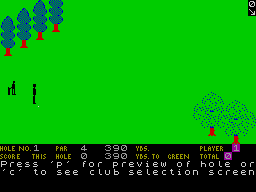
Producer: C.R.L. Memory Required: 48K Retail Price: £5.95 Language: Machine code 'Play a round of 18 holes on the "Spectrum" course of 5,444 yards. Your set of clubs consists of four Woods, eight Irons, a Pitch Wedge, a Sand Wedge and a putter. PRESS ANY KEY TO CONTINUE...' So goes the unpretentious start to C.R.L.'s charming golf simulation. Pressing any key then lists the 18 holes, the par and length for each, with a par for the course of 70. This is followed by a listing of the clubs with a graphic depiction of each and the distance in yards for each. Wind factor must be taken into account in the choice of club and direction, and the factor is also shown on the greens for putting. A final page asks whether one or two players are taking part. It is then possible to preview all 18 holes before starting if you so wish. This is not essential because you may view any hole before it is played as well. This element is quite important because unlike almost every other golf program, this one splits the holes into several views, thus simulating the real game, where you would not be able to see the end of the hole in any detail. The display is in a 3D-style perspective with 'you' and your caddy seen standing ready on the first tee. The figures and animation of them is very reminiscent of the Valhalla graphics. Pressing P will allow a preview of the hole to be played; pressing C allows selection of club, bearing in mind the statistics printed below the display area. Club selection is made by pressing any key which moves a cursor arrow along under the clubs until it reaches the one desired. It may then be ENTERed. The angle of the shot is selected by using keys 6 and 7 to move a cursor marker on the side of the screen up or down, ENTERing when it is correct. In full animation, 'you' then swing and the ball curves away. As soon as it comes to a rest, the golfer staring after it, the caddy lifts the bag on to his shoulder, and both set off after the ball. Two seconds of animation and the scene cuts to the next view, ready for the follow-up shots. COMMENTS Control keys: 6 and 7 F and S, very simple and logical, and all prompted on screen Joystick: no point Keyboard play: very easy Use of colour: excellent Graphics: very good Sound: very little, just the peace and quiet of a well-kept course Skill levels: 1
Valhalla on the gold course as caddy watches player take a shot. I can also see... a divot.
Advert19
- Sinclair User #26May 1984 · p.129
- Your Computer #4Apr 1984 · p.176
- Sinclair User #24Mar 1984 · p.15
- Your Computer #3Mar 1984 · p.225
- Your Computer #3Mar 1984 · p.197
- Your Computer #2Feb 1984 · p.203
- Personal Computer Games #3Feb 1984 · p.167
- Sinclair User #23Feb 1984 · p.23
- Your Computer #1Jan 1984 · p.239
- Sinclair User #22Jan 1984 · p.151
- Sinclair User #22Jan 1984 · p.13
- Your Computer #12Dec 1983 · p.253
- Sinclair User #21Dec 1983 · p.155
- Your Computer #11Nov 1983 · p.149
- Sinclair User #20Nov 1983 · p.65
- Sinclair User #19Oct 1983 · p.43
- ZX Computing #9Oct 1983 · p.106
- Your Computer #10Oct 1983 · p.132
- ZX Computing #8Aug 1983 · p.124
Feature2
- Crash #16May 1985 · p.44
- Personal Computer Games #6May 1984 · p.41
Related
- Compilations
- Outlet issue 133, Load 'n' Run issue 12, ZX-Spectrum Vega
- Ports
- (Amstrad CPC), (Commodore 64)
- Tags
- Golf, Turn based
- Same entry at
- Spectrum ComputingZXInfo
Reviews from people here
Sign in to write about this, or make an account. It takes a minute and lets you correct the catalogue too.
No description recorded.
Sign in to correct or add to this.
Hold the rights to this and want it taken down?