
The Girl Who Was Death
Adventure Game: Text/Illustrated · ZX-Spectrum 48K · 1 players · English
Stephen Preston · 1986 · Pound sterling 6.50
Discussion
Nobody has started a thread about this yet.
Remarks
Initially released through the Prisoner Appreciation Society, Six of One. "This adventure is probably my best achievement and was actually written over 18 months without much break. The game got so large that it had to be divided into two parts, with a data loader allowing the user to bring his time used and inventory over from part 1. Originally each part was on either side of a cassette. Overall the game added up to something like 92K of data, huge at the time! The game was positively reviewed by a couple of magazines at the time, but the greatest thing for me was beating the Scott Adams score for his latest adventure - for it was Adventureland on the Vic 20 (owned by Gareth Davies!) back in 1981 that first introduced me to the concept of the adventure game, one which I found thoroughly exciting. Looking back, the game could have been a lot better. It is linear in its strategy, and follows the adventure of the Prisoner episode it is based on very strictly. As such it is atmospheric and faithful, but loses flexibility and mystery. The input syntax is also a little limiting. Despite all this, it retain a lot of charm and proved popular with fans of the series."
Play
- girlwhowasdeath.zipRZX playback file
- GirlWhoWasDeathThePart1.z80.zipSnapshot image English18 KB
- GirlWhoWasDeathThePart2.z80.zipSnapshot image English19 KB
- GirlWhoWasDeathThePart2loaded.z80.zipSnapshot image English19 KB
- GirlWhoWasDeathThe.tzx.zipTape image English36 KB
- GirlWhoWasDeathThe(different).tzx.zipTape image English30 KB
Documents
- GirlWhoWasDeathThe_DeletedScene-FairgroundMusic.z80.zipGame additional material 3 KB
- GirlWhoWasDeathThe_In-gamePictures.z80.zipGame additional material 22 KB
- GirlWhoWasDeathThe.txtInstructions English3 KB
Files and rights
Distribution permission is on record, granted to another archive rather than to this one. Screens and pictures are copied here; everything else links to the archive that holds it.
- AllowedStephen Preston → WorldOfSpectrum
Credits
- Stephen Prestoncredited
Sign in to credit somebody, or say what these people did.
Scores
In the magazines
- Crash #301986 · Overall78%
Elsewhere on the web
- WorldOfSpectrum 12 votes8.00
In the magazines 2
Your Sinclair #12Dec 1986 · p.83
Mike Gerrard
Are the Welsh taking over from the Scottish in these adventure pages? Last of this month's bumper bundle is an adventure based on the TV series The Prisoner, from the episode entitled The Girl Who Was Death. Hope the author's got copyright permission to do it. This one's £5.50 from Stephen Preston at [redacted], and this time I reckon it's worth the asking price. The story involves Professor Schnipps, the crazy scientist, who has spent the last 26 years building a super-rocket to destroy London. He obviously doesn't believe in rushing things, and I believe he's now in charge of sending out the cheques from YS! (He was sacked for being too prompt. Ed.) Be that as it may, you've got to stop him and also watch out for his tall blond daughter. I certainly will, thank you very much. Oh, it seems this is the one know as the girl of death. Maybe she's not my type after all. You begin in a cricket field holding a bomb disguised as a cricket ball, and with one fairly obvious command to enter before you become not so much an adventure game, more a jigsaw puzzle. Down in town, Benny's Turkish baths are closed, and a hanky with a message written on it promises a rendezvous at the local hostelry, whose beer sadly cannot be recommended. Neither does Doris the barmaid fancy you, while in the fairground there isn't even a boat to take you into the tunnel-of-love. Oh woe is me, the hapless adventurer. And Number Two no doubt watching all the time, while Number Six plods on. Definitely not a plod of an adventure, though and I recommend you take a look.
Crash #30Jul 1986 · p.7885%52%65%80%78%78%
Atmosphere 85%
Vocabulary 52%
Logic 65%
Addictive Quality 80%
Overall 78%
Derek Brewster 78%
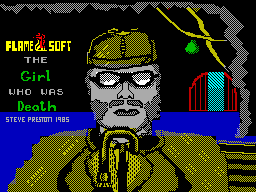
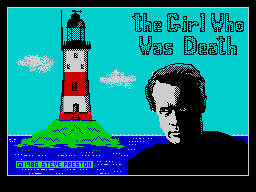
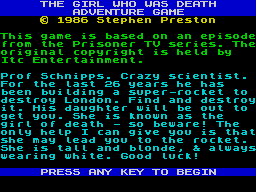
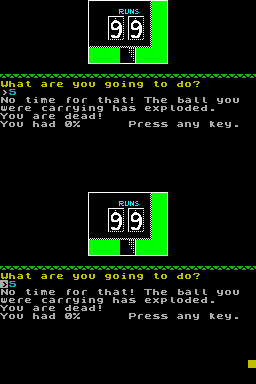
DEREK BREWSTER'S ADVENTURE TRAIL INDEPENDENTS' DAYS Clive Sinclair bows out of computing for the moment and Crash magazine announces startlingly high circulation figures, higher than any other computing title. Could there possibly be any connection between these two facts? I will endeavour to find out in my own inimitable way, concentrating on the notion of Crash being an independent, in a home games world dominated by Spectrum computers whose very existence can only be attributed to the dedicated band of independents who whole-heartedly backed the machine. As I've said before, I have owned at one time or another most of the home computers released in the UK, the ZX80 being the only one to escape my curiosity and to achieve mass circulation. Of all these computers, the Spectrum holds a special place in my affections. It was this computer, in the early days as much as now, which encouraged and fostered a wide band of dedicated programmers who were out to squeeze every byte of code until it paid dividends. All the credit cannot be given to Sinclair himself for the Spectrum phenomenon. It often seemed to programmers slaving over a hot heat sink that the boffin was determined to wreck the software market by a whole catalogue of hotchpotches and own-goals. These were: Interface 2, the Microdrives, and early (thankfully fruitless) attempts to corner the software market for himself, when profits from hardware were being cut to the bone under increasing competition from the UK and America. Interface 2 was a debacle of the highest ineptitude. For a price, it enabled the games player to connect a joystick (something which could be done without add-ons to competitor machines) and gave access to a glossy catalogue of ROM cartridge releases which only remained impressive so long as the reader was unaware of a major restriction: they were 16K programs only. This at a time when the 16K machines were sampling their last bytes as they were overtaken by the much more popular 48K computers. The irony is that 16K programs take little time to load in any case - it is the 48K programs which require the bonus of instant loading. As it was, the cartridges were a flop. Had they been aimed at 48K machines, the Interface 2 would have been an undoubted success; people were certainly prepared to pay an extra £2 for each faster, more reliably-loading program. But this was not the only faux pas to this interface, as its purchasers soon discovered to their undying chagrin. In the world of games joysticks Sinclair took on the Kempston system with his Interface 2 when the Kempston protocol had already become the standard. By breaking with this standard Sinclair created havoc with programmers and public alike. Many of the top games deemed the Kempston system as the only real must as an option for joystick control. Microdrives are now infamously known as unreliable and infuriatingly fickle. The Microdrive tapes wear quickly and are regularly munched up by the drive mechanism. More fundamentally, the drives do not offer what is implied is their reason for being: they are slow and require several revolutions of the tape loop before the drive warms up sufficiently to load the program. For those who haven't heard enough, the consequences of running out of memory are not good. When a program is too long the computer crashes and the Microdrive spins on - wiping everything from its tape. It's not hard to see that the Microdrive cannot be put to serious use and is a commercial non-starter, explaining the conspicuous lack of Microdrive software. If all the technical shortcomings of the micro passed largely unnoticed by the Spectrum latecomers, the lack of a proper keyboard was plain to all and sundry. In my opinion, the first rubber keyboard was better than the later intended improvement. Clive Sinclair single-handedly created the mass home computer market, and all the above criticism isn't much more than nit-picking in the light of his major achievement. The ZX81 first popularised the notion of affordable home computing in the UK. Owing to Clive Sinclair's brainchild, the UK has more computers per capita than any other country in the entire world. But of all the good and bad of Sinclair's reign, the one thing he did not attempt was publishing his own 'official' magazine, and for this he can only be congratulated. Unlike Acorn, Amstrad and Commodore who did try, he was alone in letting the independents do what they do best - reporting the facts enthusiastically, without fear or trepidation, and with a desire to do what's best for the entire Sinclair phenomenon, and not just the central nominal company. What I hope Alan Sugar realises about the company he has taken over is the role that independents played in making the Spectrum. The quality of their add-ons for the computer was very high and exceptionally good value for money. For example, Sinclair could only offer a 30 day waiting list and an inflated price for the 16 to 48K upgrade, while small workshops performed the service more rapidly and at less cost. I think that the Spectrum phenomenon, and the important role of independents in the computer's success is not only a lesson for microcomputing, but for the whole British economy. THE PRISONER Producer: Stephen Preston Retail Price: £5.50 Author: Stephen Preston A curious game this one, but I felt I must review it as it fares well when compared to the heaving mounds of poor quality cassettes I receive each month. Adventuring, more than any other area of games- playing, seems to attract the program yet to be signed up, or worse, sold only by mail order with no hope of being taken on by one of the big boys. Could I take the opportunity here to dissuade anyone thinking of writing an adventure who has not got any original ideas to contribute - even with humour, the old torch-plank-hole adventure with no interactive characters just isn't going to get anyone interested enough to buy it in sufficient numbers to justify the time and energy devoted to writing it. The Prisoner is curious because it is put out by a person with no company name (no big crime this as many adventure houses centre around a single programmer). Further, LOAD "" CODE is used to load it and, well, that really takes me back to the early days. What is unclear is whether the author has had express permission to use the copyright for the TV series. Up to a year ago, large entertainment companies were determined to stop unauthorised versions of their programs/books being used by small computer companies, but perhaps now they have become more lenient, I don't know. This game acknowledges the copyright without saying whether or not it has been granted by ITC Entertainments, the owners of The Prisoner TV series. The reason why I labour this point is because of one or two similar games appearing over the last year or so which have clearly not obtained copyright and yet survived whereas any transgression by very small games in the early days tended to be met by a letter winging its way from some huge Hollywood film company. If large companies have decided to turn a blind eye to small games which digress from standard behaviour then this is only sensible as such games represent little threat, and if they do, they can always be officially endorsed! The story of The Prisoner goes like this. You resign from your job in the secret service, but someone somewhere doesn't like it, and so they put you away (once a spy, always a spy?). You are abducted and wake up in a strange village filled with other people taken out of circulation. None have names, just numbers. You are Number Six. The village has a chairman and he is Number Two. His efforts to break you are not very successful, but then, neither are your attempts to escape. But one day the chairman hatches a plan to make you reveal your secrets whilst reading a fairy tale to some of the children in the village. You go to the nursery to see the children. There you find a storybook with pictures - a game of cricket, a boxing match, a village, a plane and a lighthouse. You start reading, forming a story from the pictures, but beware, Number Two is watching. The aim of this game (The Girl Who Was Death) is to track down a mad professor called Schnipps whose intent, in best mad scientist tradition, is to destroy London with a super rocket. The only way you can find and stop him is to follow his daughter (the girl of the title) to his hideout. She tries to kill you at every opportunity and can easily be recognised as she is tall and blonde, and always wears white. When you reach the hideout you have to find the rocket which is disguised as something rather peculiar and your task here is to deactivate it. There is a time limit of half an hour to complete parts One and Two of the game. When the time runs out, Schnipps launches his rocket and your mission fails. You begin with a game of cricket. An agent who had followed this trail before you was on the trail of Schnipp's daughter but, whilst playing a game of cricket for the local team, he was suddenly killed by an exploding cricket ball, presumably swapped when the last six was scored. This is your only lead. You start play with a game of cricket to try and find out exactly what happened. It's a pleasantly warm day on the cricket pitch. Birds twitter above and the opposition has clocked up 99 runs (shown on the picture). And... you're holding a ball which is a bomb. Hmmm, I'll leave you to work out what is the best course of action here! If you choose the unfortunate combination THROW BOMB, you are still blown up as it reports "No time for that! The ball you were carrying has exploded". This is the first of many examples of narrow, unfriendly vocabulary as the next step, GET BAT, is refused with preference going to TAKE BAT. Game play is very unhelpful a little further on when you attempt to pick up a photo and are unable to as you are already carrying too much - a bat, a watch and an umbrella! The idea of carrying a watch in this sense is illogical. The Girl Who Was Death is a very professional looking piece of software. The pictures at the top of the screen are very good (as is the loading screen) and the redesigned character set is most pleasant and readable. Both the theme and content are very interesting and absorbing for the player. COMMENTS Difficulty: not overly difficult Graphics: good Presentation: very good Input facility: verb/noun Response: fast
Licensed from
- The PrisonerTV showunofficialIncorporated Television Company
Related
- Elsewhere
- CASARZX ArchiveThe TipshopUVL
- Same entry at
- Spectrum ComputingZXInfo
Reviews from people here
Sign in to write about this, or make an account. It takes a minute and lets you correct the catalogue too.
No tag recorded.
Sign in to correct or add to this.
Hold the rights to this and want it taken down?