Special Agent
General: Education · ZX-Spectrum 48K · 1 players
Heinemann · 1983 · Pound sterling 9.95
Also known as Geheim Agent (English)

(WoltersSoftware)_Front.jpg)
(WoltersSoftware).png)
Discussion
Nobody has started a thread about this yet.
Releases
- 1983HeinemannPound sterling 9.95
- 1984Hill MacGibbon
- 1984Wolters Software Sold as Geheim Agent
Play
- SpecialAgent.tzx.zipTape image English15 KB
- SpecialAgent(GeheimAgent)(WoltersSoftware).tap.zipTape image Dutch26 KB
Documents
- SpecialAgent(EN).txtInstructions English9 KB
- SpecialAgent(EN).pdfInstructions English2,208 KB
Files and rights
No permission is on record either way. Screens and pictures are copied here on a take-down basis: if you hold the rights and want something removed, say so and it goes.
Credits
- Five Ways Software Ltdcredited
Sign in to credit somebody, or say what these people did.
Scores
Elsewhere on the web
- WorldOfSpectrum 1 votes7.00
In the magazines 13
Crash #31Aug 1986 · p.80
Rosetta McLeod
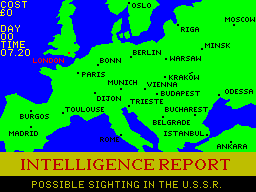
CRASH COURSE By Rosetta McLeod USING COMPUTERS IN THE HOME Quite often I'm asked to speak to groups of adults on the topic of computers in education. Most of the parents in the audiences seem to feel rather at a loss about how to encourage learning in the home situation. We've now reached the stage where a vast number of homes possess a computer of some kind, many of them bought in the hope that they will assist the children with their school work, or help them to cope with life in this high-technology age. Parents, however, are becoming increasingly concerned that the machines tend to be used in the main for game-playing - usually arcade games. Another worry is that girls seem to show less interest than boys in computers, and this is of particular concern to those parents whose daughters are aiming for a career in a modem office where techniques rely heavily on computers. It's hard to alleviate worries such as these, as there is really no simple answer. Young children often enjoy a large amount of parental support when it comes to using computers, and some of the early learning games reviewed this month are certainly of the type to encourage parent/child involvement. Older children, however, tend not to be given this kind of support, being left very much to their own devices. Programs like Special Agent and Car Journey are helpful in letting parents see the sort of related activities their children can be directed towards. Instead of taking a back seat, the adults may even be encouraged to work with their teenagers on the games. Certainly all children ought to have the chance to develop keyboard skills at least, and this means moving away from arcade games and joysticks. I do wish, though, there were more programs designed to appeal to girls - publishers please note! SPECIAL AGENT Producer: Hill MacGibbon Retail Price: £9.95 Age Range: Older children Special Agent is a program in the Games to Stretch the Mind series, and was designed by FIVEWAYS, well-known for quality educational software. The player assumes the role of a special agent for M16 based in London, and the mission is to catch a devious enemy spy on the loose in Europe. The player has to travel by air and rail to a variety of destinations, making the most of all the clues and intelligence reports that flash on the screen. The city from which a report is sent is highlighted - but if the enemy has eliminated your agent in a city, no report can be received! An informer's report can also be purchased for the sum of £100, and the record of your total costs is displayed at the top left hand corner of the map, together with a clock which records the passage of time. Sometimes, reports are received in code and the player has to choose the cipher option for clues on how to decode it or pay £100 for help from the back-room boffins in London. Money may also be spent in hiring new agents to replace those eliminated, and on making journeys. The educational possibilities of this game are immense. Learning about the map of Europe, reading timetables and solving codes are only a few of the skills involved. Intelligence reports such as, 'Spy reported in the capital of Turkey' may require a bit of research before the name of the actual city is discovered. The package also contains an attractive illustrated booklet with information about spies and agents such as Mata Han, Burgess and McLean. and the fictional Sir Percy Blakeney; beef descriptions on some of the major European cities; maps showing population and land use; and details regarding the contents of a spy kit - bugging devices, microdots and so on. This is an extremely well thought-out package which will hold a child's attention and make learning fun. A particularly useful feature is the facility for pausing the game to allow time for thought. Great care has been taken to ensure ease of operation. COMMENTS Control keys: an overlay is supplied for the top row of keys Keyboard play: good Graphics: very clear Use of colour: bright and attractive
ZX Computing #13Jun 1984 · p.24
Mike Edmunds
SPECTRUM LESSONS Mike Edmunds continues his quest against ignorance and assesses some of the latest educational software packages. Educational software has, to date, been of a very mixed quality, with often only a limited use in the classroom. Now, with the advent of material such as the Dudley Programs, we find software intended for use right across the curriculum. The programs, all with the theme of travel, have been designed specifically for use in schools by a team of 24 teachers and advisers from Dudley Metropolitan Borough, in conjunction with Five Ways Software. Each of the four titles; Punctuation Pete/Wordfinder, Car Journey, Special Agent and Ballooning is a complete package in itself or can be used in conjunction with the other titles to provide a really comprehensive series of resource materials. Each package comes in an A4 folder with a detailed guide/workbook which not only outlines the aims of the program but also suggests numerous associated activities to be carried out using either the program or the workbook material. There is also a set of keyboard overlays, a summary of instructions and a 'run card'. Loading is straightforward and the pupil is greeted by an illustrated title screen detailing loading time. As with the workbook, the programs are colourful and visually attractive, good use of graphics being maintained throughout the series. PUNCTUATION PETE WORDFINDER The first package, Punctuation Pete/Wordfinder, is really two for the price of one. Pete lives inside your computer and it is his job to keep everything tidy. Your job is to help him sort out sentences that have lost their punctuation. Although this type of program has been around for quite a while, this version is a step ahead of the others by virtue of its graphics. A delightfully animated Pete is guided around various texts to correct the mistakes (often physically kicking them into submission it seems!) This is aimed at reasonably able readers and provides various texts, chosen at random from a large bank, all on the theme of travel. The child can choose his own level, beginning with Junior Scribe (full stops and capital letters). If he can master this level he may wish to aim for higher status, where the exercises are correspondingly more difficult. Mistakes by the child are indicated by Pete and a second try is invited. Continuing errors are eventually corrected by the computer. Wordfinder, the second half of the pack, provides an extensive thesaurus on the travel theme, its aim being to develop vocabulary. Words can be selected from a comprehensive list and all linked possibilities then examined. This is a novel idea and it would be nice to think of this program 'sitting' at the back of a classroom available for constant referral as a source of vocabulary, stimulation and ideas, especially for subjects such as creative writing, topic work etc. CAR JOURNEY The second package, Car Journey, involves travelling around the main roads of England and Scotland and combines geography and mathematics with logical thinking and evaluation. Four levels of skill are provided and the child first has an opportunity to get acquainted with the vehicles and conditions in the Driving School. Here, selection of vehicle, route planning, cost analysis and fuel consumption all prove to be important decisions which the child needs to make. The correct choice makes the journey easy!!! Having passed through the Driving School, the child should be well equipped to tackle the hazards of everyday motoring. As an added bonus here you can also opt for driving with hazards, anything from radar traps to snowstorms! This program is realistic in approach and the child soon learns to tackle the tasks systematically in order to achieve good results. This is an excellent way of applying decision making and logical thinking to an everyday 'real-life' situation. SPECIAL AGENT In Special Agent you are recruited by M16, your job being to catch an enemy spy. This is a maddeningly frustrating program - sometimes the spy can be tracked down quite quickly, at other times you can spend weeks (or even months) chasing him around the cities of Europe. Continued lack of success might spoil this program for some children but it can also be very addictive! The strategies required are soon discovered and the various countries and cities involved quickly become familiar. (It is a decided advantage to have several atlases on hand!) The program also gives practice in the workings of train and airline timetables... all this whilst trying to understand intelligence reports and decipher codes! As a program for older primary children upwards, this is an ingenious way of encouraging quick, logical, decision making based on a wide variety of information. As an alternative to the normal procedure it is also suggested that the game be played with either limited time or limited money! BALLOONING Ballooning, the final title in the series, is a simulation program which encourages children to investigate and explore the science of lighter-than-air flight. There are several levels and initial tuition is gained in the Flying School. This is an essential duty before undertaking your Flying Test and eventually your Live Mission. If you pass your test you are assigned a score and your subsequent activities are influenced by the rank you have been given. You are then ready to embark upon a solo flight with specific tasks to perform. These are not at all straightforward - I'm afraid I left the vet stranded on a hillside miles away from the sick sheep! The program and activities suggested within the package introduce children to various scientific principles and seem an ideal way of combining learning with enjoyment. TO CONCLUDE Taken singly, each of the programs in this series is excellent. Put together, as a complete resource package, they are outstanding - each having the right blend of interest and skill to ensure continued usage. The programs are well written and overall presentation is of a high quality. As a theme package they test the child's abilities in all areas. Marvellous - fun whilst learning! Each of the packages reviewed above costs £9.95 and is published by Heinemann Computers in Education Ltd, [redacted].
Your Spectrum #2Mar 1984 · p.58
Peter Shaw
Ryan Davis
Stewart McPherson
SPECTRUM SOFT Starting this issue Your Spectrum will be touring computer clubs up and down the country in an effort to find dedicated games enthusiasts who will give us their impressions, thoughts and feelings on the current selection of new releases. Little do they know it, but these unsuspecting souls will be contributing a large slice of our regular review section in the future. This month we visited the Stanwell Computer Club (which meets weekly at the Stanwell School, Short Lane, every Friday evening from 7-10pm). Five of the resident 'freaks' were enlisted to tell us (and you) what was good or bad about the programs we gave them to play around with. In some cases comment was justifiably harsh, and in others they could hardly contain their glee at coming across a really well thought-out game. The guinea-pig five whose comments appear below, are all members of the club, and they are (in alphabetical order): Corrie Brown, Stephen Cathrall, Ryan Davis, Stewart McPherson and Peter Shaw. Peter, by the way, is also Secretary of the Stanwell Club. Them we do thank. SPECIAL AGENT Heineman/Five Ways £9.00 This is an educational adventure where players travel around Europe gathering clues and information. Its main aim is to teach geography to the 8-12 year old age group.
Crash #2Mar 1984 · p.98
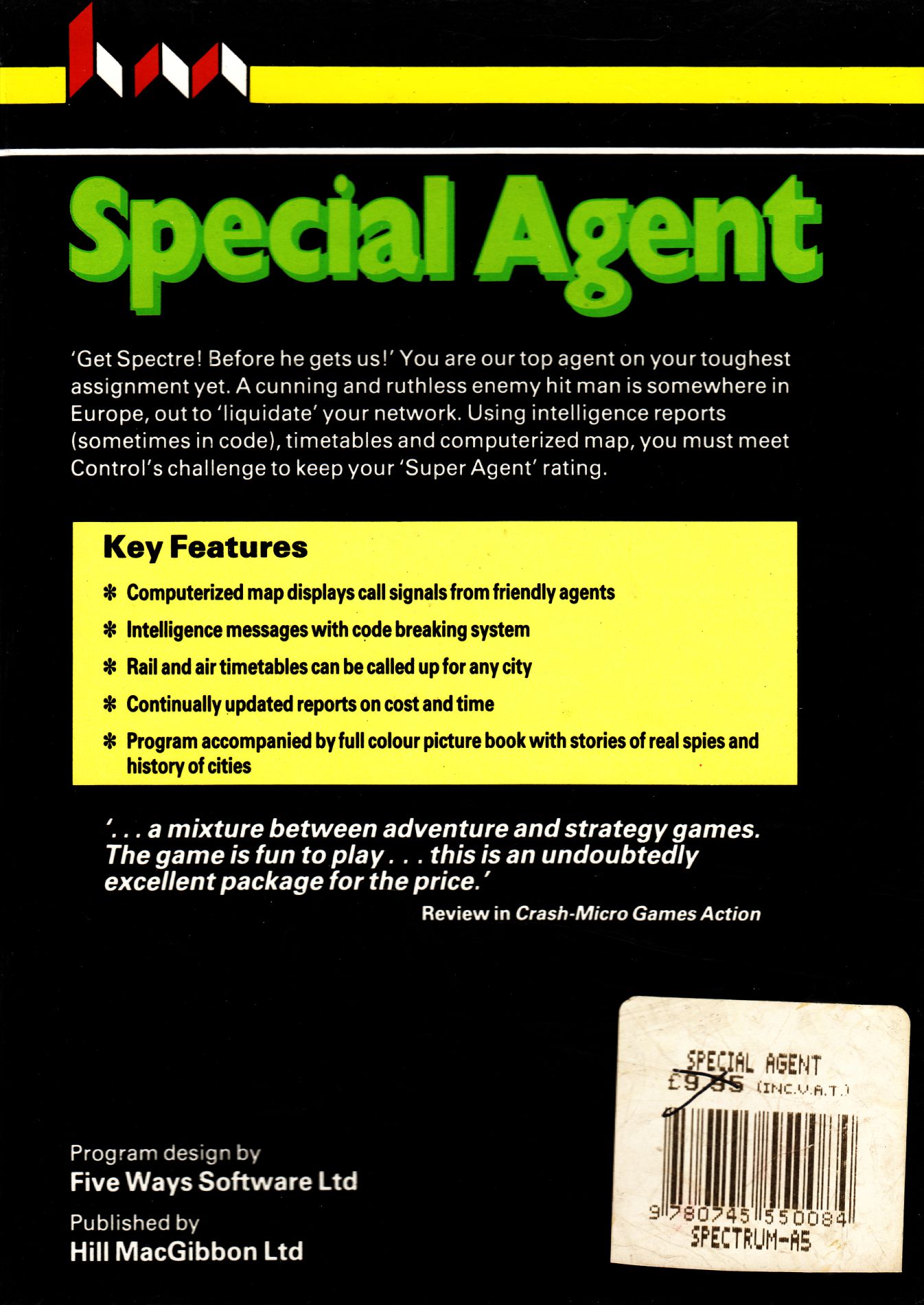
Producer: Heinemann Memory Required: 48K Retail Price: £9.95 Software: Five Ways This game is designed to develop the ability to read, understand timetables, interpret information quickly and make logical decisions based on information in a situation where there are many possibilities. It includes insights into the relative speeds and costs of air and rail travel, and lets children become familiar with the positions and names of Europe's cities and towns. The game comes in a large plastic folder with the cassette tucked in one side and the large format, colour book (16 pages) in the other. The game is played on a very large scale, and in fact comes very close to a mixture between adventure and strategy games that might well appeal to much older people. Basically you sit in your control centre of spying with a map of Europe. Below the map all sorts of reports come in from secret agents in the various locations. These may be in clear or code (which can be deciphered bit by bit). Information may well be from informers (which must be purchased) or it may tell you a spy has been eliminated. More spies can be hired. If you decide you must go to a city to make contact with your agent there, a sheet of various timetables can be displayed and journeys may be undertaken by various modes of transport relative to speed, cost and convenience. The graphics are very detailed and complex, but the game is fun to play, backed up by a heavily illustrated book with background to spies in fact and fiction as well as information on the many cities and towns involved in the adventure. Despite the slightly high price, this is an undoubtedly excellent package for the price.
Personal Computer News #40Dec 1983 · p.66
Theodora Wood
Punctuation Pete, Ballooning, Car Journey, Special Agent (£9.95 each), Heinemann (Five Ways Software), Heinemann Computers in Education: Book, [redacted]. PLAY TO LEARN Learning can be fun with open-ended games. Theodora Wood investigates some Spectrum software. Heinemann, one of the large educational software publishing houses, has produced four software packages 'designed by a team of 24 teachers and educational advisers from the Dudley Metropolitan County'. Each tape is accompanied by a glossy booklet that not only tells you how to operate the program but also contains interesting background information and suggestions for other activities associated with it. Overlays for the keyboard provide an easy method of controlling the programs which are aimed at the 8-12 age range. Punctuation Pete is the most traditional of the four packages in its use of graphics and educational methodology. Pete himself is a rather jolly character who moves along a line of text displayed on the screen and stops at all the spaces between the words to enable the child to enter the correct punctuation or capital letter. There are four levels of reading difficulty to select and three levels of punctuation difficulty. After correcting the punctuation the child has to press ENTER and Pete will either jump for joy if it is correct, or walk to the first mistake. Three attempts are allowed before the correct punctuation is given. Punctuation Pete introduces children of this age to elementary word-processing skills as well as being an interesting way to learn punctuation. Ballooning is a simulation program which involves flying a hot air balloon over a series of landscapes. The child can take off, fly and land a balloon by operating the burner and the vent controls. Three levels of difficulty can be chosen: Flying School, Flying Test or Live Mission. Flying School allows the child to practice at the controls of the balloon in all phases of flight. Flying Test tests these flying skills, and Live Mission gives a series of tasks to be performed, but only if the balloon is landed in the designated spot. Hazards are also introduced, such as instrumentation failure or high winds. The balloon flies over the landscape on the top half of the screen, while the instrument panel displays the rate of climb, temperature of the air inside the balloon, altitude and fuel level. The program operates in real time which makes it more vivid. A pause facility stops the balloon moving and allows the information on the dials to be assimilated and recorded. This leads to such activities as keeping graphs of the relationship between the temperature of the air inside and outside the balloon and its altitude. Car Journey is not as immediately accessible as the other two packages discussed. The objective is to make money by running a delivery service, and this is not as compulsive as flying a balloon, especially for the younger children in the age group. There are four difficulty levels: Driving School, Driving School with hazards, Delivery Service and Delivery Service with hazards. The type of car can be selected: they appear on the screen with each one of the four shown in profile with maximum speed, capacity for fuel and a petrol consumption graph. Driving School enables the child to move around the country and work out how much petrol has been used, and also the positions of the major cities in England, Scotland and Wales. On the lefthand side of the screen there is a space for hazard reports, a speedometer displaying speed controlled by keys 1 and 2, a bar chart of fuel consumption and a digital readout which indicates time elapsed since the beginning of the journey. Delivery Service enables the child to see contracts available by pressing 0, BREAK SPACE to cycle through them and ENTER to choose one. Contracts vary from computer parts to Persian carpets, with pickup and delivery places and times. One business colleague loved the way the money bags mounted up on the progress chart (seen by pressing 6) and wished his office programs were the same. Hazards include snow and road repairs, the everyday occurrences which can lay waste a delivery timetable. The booklet covers the history of roads, how a car works, and again plenty of suggestions and games to extend its use. I think perhaps the difficulty level is too high for the younger children of the age group who showed little interest after the excitements ofBallooning. The upper level could probably be extended to 14 and beyond. Special Agent, the fourth, is an adventure quiz game based on the idea of catching an enemy spy moving round Europe, rather similar to the BBC's Puzzle Trail. Pressing 6 will bring a map of Europe to the screen with all the main cities marked. Intelligence reports appear at the bottom of the screen while the top lefthand corner displays total cost so far, day number and time elapsed. The time between these reports can be speeded up by pressing 7. These reports can be very cryptic: some of them are based on the descriptions of the major cities given in the booklet while others would need an atlas or an adult to help. Other reports are in code. There is a facility to stop the clock to give the child time to decode the message. Sometimes an informer will be willing to sell information and this can be bought for £100. To travel to other cities in hot pursuit of the spy, air and rail departures can be checked through and chosen. The user can also see the timetables for other cities so that a journey can be planned in two stages if required. This said, Special Agent provides a vehicle by which a child in the 9-14 age range can become aware of the positions of the major cities of Europe, and the distances and relative travelling times between them, it also involves them in the logical process of route planning with timetables, and the brainteasers in the codes. Heinemann has produced an impressive range of programs as its first move into the educational software market.
Ballooning... attempting to land
Car journey... setting off
Pete punctuating
Advert6
- Big K #8Nov 1984 · p.36
- TV GamerNov 1984 · p.67
- Sinclair User #20Nov 1983 · p.13
- Your Computer #11Nov 1983 · p.273
- C&VG (Computer & Video Games) #25Nov 1983 · p.185
- Personal Computing Today #4Nov 1983 · p.85
Review2
- ZX Computing #13Jun 1984 · p.25
- ZX Collection1984 · p.111
Related
- Compilations
- Hill MacGibbon Special Christmas Pack
- Ports
- (Commodore 64)
- Tags
- g026
- Elsewhere
- Centre for Computing HistoryUVL
- Same entry at
- Spectrum ComputingZXInfo
Reviews from people here
Sign in to write about this, or make an account. It takes a minute and lets you correct the catalogue too.
No language, description recorded.
Sign in to correct or add to this.
Hold the rights to this and want it taken down?