
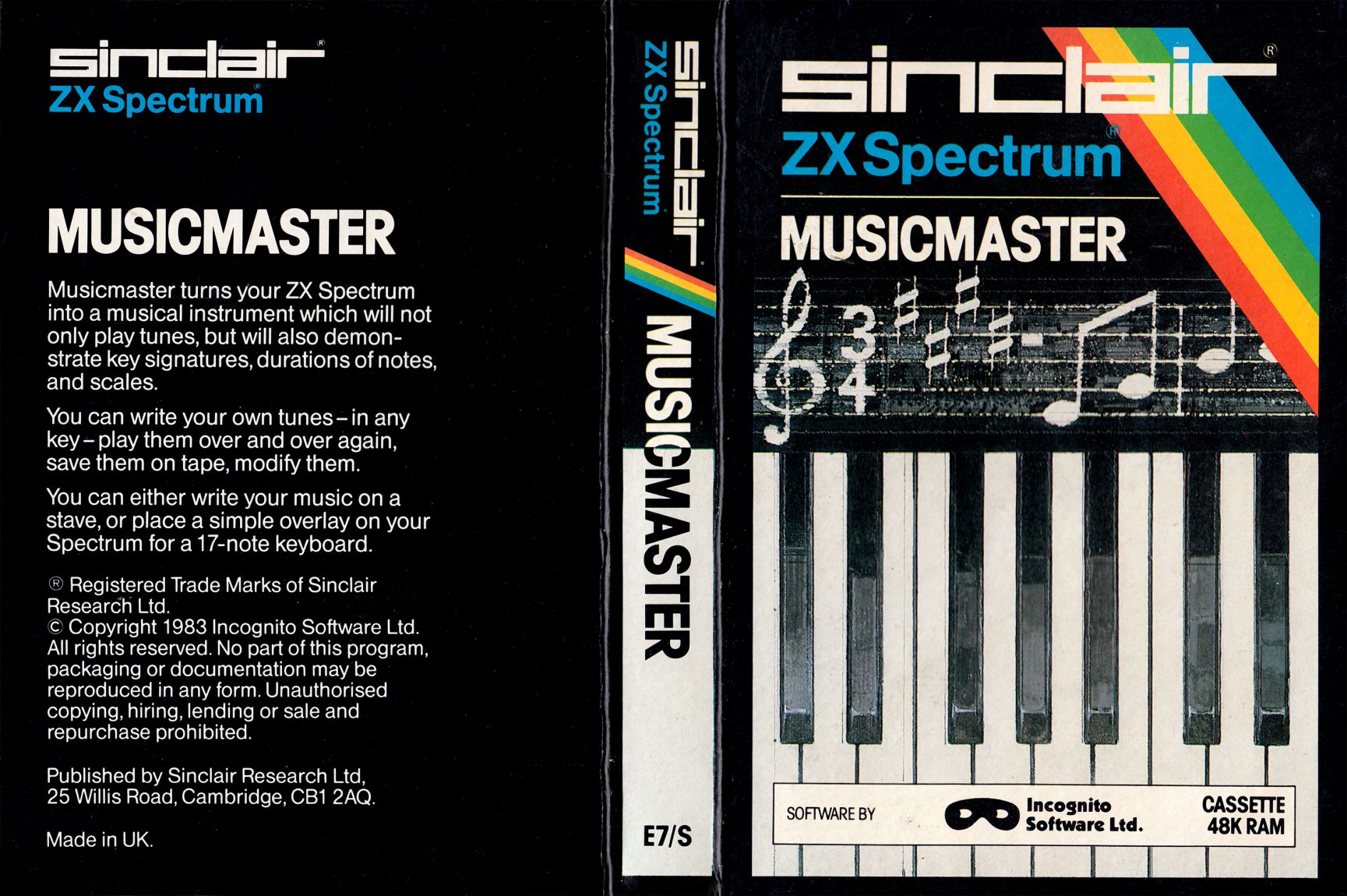
Music Master
Utility: Music · ZX-Spectrum 48K · 1 players · English
Sinclair Research Ltd · 1984 · Pound sterling 9.95
Discussion
Nobody has started a thread about this yet.
Preservation
Crash magazine number 16 mentions that a keyboard overlay was included with the game, but it is currently MIA.
Play
- MusicMaster.tzx.zipTape image English13 KB
Documents
- MusicMaster.zipInstructions English13 KB
- MusicMaster(EN).pdfInstructions English403 KB
Files and rights
Distribution permission is on record, granted to another archive rather than to this one. Screens and pictures are copied here; everything else links to the archive that holds it.
- AllowedSinclair Research Ltd → WorldOfSpectrum
Credits
- Incognito Softwarecredited
Sign in to credit somebody, or say what these people did.
Scores
In the magazines
- Crash #51984 · Overall67%
- Sinclair User #241984 · Gilbert Factor6/10
Elsewhere on the web
- WorldOfSpectrum 1 votes5.00
In the magazines 27
ZX Computing #27Jul 1986 · p.22
ZX WAXES MUSICAL WITH A SURVEY OF SOFTWARE PACKAGES FOR THE SPECTRUM. MUSIC MASTER Sinclair £9.95 Written by Incognito Software this is a good all round package. I have been using it on and off for the last year or so and it did not take long to master. At first I found the accompanying booklet, all four and a half pages, leaves a lot to be desired in the field of clarity. You are also assumed to know at least the rudiments of musical notation. There are two modes of operation, keyboard or stave and these dictate the method of note entry. The keyboard provides notes from middle C up ten tones to E and a keyboard overlay is provided, which is only of any real use on an early rubber key model Spectrum. Notes are played by pressing computer keys which represent a piano keyboard. In stave mode notes are entered by pressing a-g and A-G giving two octaves playing range. One aspect which takes a little getting used to is that any incidental sharps and flats, and indeed the note lengths themselves must be selected before the note pitch is entered. However a 'delete last note' option is supplied. The program is filled with prompts and I found it reasonably easy to get to grips with it, but the note lengths are displayed by their names and it is confusing unless you are familiar with such terminology. Save, load and, of course, play options are included. Most important is the Amend option and this makes life less stressful if creating your own masterpieces. The Spectrum cannot put any expression into its music and all songs tend to sound a little monotonous, however playback is fast enough and smooth enough to be satisfying to listen to. In itself this is a great program for those who have a little experience and want a program to experiment and play with. A pity that there is no option to save songs and include them in your own programs/games.
ZX Computing #19Jun 1985 · p.49
£7.95 Sinclair Research A good program though rather expensive. S/Time and R/Time entry and good playback and printout options. Instructions somewhat sparse.
Crash #16May 1985 · p.557/108/107/107/10
Graphics 7/10
Userfriendliness 8/10
Musicality 7/10
Educational Value 7/10
Graeme Kidd
Jon Bates
MUSIC MICRO, PLEASE Just to prove that Tech Niche isn't all soulless stuff about insensitive peripherals, JON BATES and GRAEME KIDD throw away their joysticks and take up the baton to conduct a round-up of sensitively musical software. No matter how wonderful you believe your Spectrum to be, in arguments with Commodore, BBC or even Amstrad owners, you will have to concede that they have the edge when it comes to sound. The Amstrad, for instance, has three channels, which allows you to create a stereo sound and a white noise generator. Your 'umble Speccy doesn't have a chip dedicated to sound generation and gets by when it comes to making sound by switching the 'speaker' on and off, more rapidly for higher notes, less rapidly for the lower ones. The BASIC Manual is a bit naughty when it tells you: '...because there is only one loudspeaker in the computer you can only play one note at a time, so you are restricted to unharmonised tunes.' 'Loudspeaker' it ain't, but the only reason why you can't play more than one note at a time is because there's only one channel which can be switched on and off to generate noise. Other computers, which have dedicated sound chips, let you use several channels and that allows more complicated, harmonised tunes to be put together. Like the manual says, if you want anything more than simple unharmonised tunes on the Spectrum 'you must sing it yourself.' As you might expect, there's quite a lot of specialised hardware and software available which extends the capabilities of the Spectrum, moving it towards (and maybe even past) the level of musical competence achieved by other machines. We'll be taking a look at these bolt-on musical goodies in future Niches; for the present we've confined ourselves to a close examination of the software which runs on the basic Spectrum. We found six programs which, to a greater or lesser extent, take the pain out of programming tunes in the 'BEEP 1,0: BEEP 5,3:' format, and three musical education packages which go part of the way to helping the musically illiterate get to grips with the subject. Rather than plunge in at the deep end on our own, we persuaded a real live musician - Jon Bates - to help evaluate the software. A professional keyboard player, author of a book on synthesisers and keyboard teacher, Jon invented a new rating for the purposes of these reviews - MUSICALITY. We've taken account of Graphics, Educational Value and User-friendliness, but Musicality is, in effect, a musician-friendliness rating and depends on the musical accuracy of the software. Before awarding the Musicality rating for each program, Jon asked himself the question, 'is it in accordance with the basic rules of how music is written and sounds?' 0/10 for Musicality would make a musician scream, he told us! The other half of the dynamic reviewing duo, Mr Kidd, claims to know a bit about computers but is a self-confessed music illiterate. Nuff said about him. MUSICMASTER Sinclair/Incognito £9.95 Musicmaster allows you to enter notes either direct onto the stave, pressing keys for the name of notes A-G and prefacing them with S for sharp, L for flat or N for natural, or you can use the keyboard overlay supplied with the cassette to make the two top rows of your Spectrum's keyboard simulate a real keyboard. The program offers all the basic elements needed to start making music with your computer, allowing the user to 'music process' a tune once it is entered into the machine using the editing facility. Only one tune can be held in memory at any one time, which can be mildly infuriating at times, given that there is room for up to 1000 notes for events, as a rest counts as a note), but there is a facility which allows you to save a completed tune to tape so it can be loaded back into the computer at a later stage. When you enter a tune and play it, the computer plays the notes sequentially from start to finish. If a section of music is to be repeated, it's necessary to edit that section into the sequential tune file. Another minor disadvantage of Musicmaster is the lack of a repeat command - to replay a tune you have to go back through the menu, but it does allow a tune to be played back at different speeds. Overall Musicmaster is a reasonable package which assumes no musical knowledge on the part of the user. Between them, the manual and the help function in the program were good, giving the user enough to get by on musically to make full use of the programs capabilities. While it isn't intended to be an 'educational program' as such, being more for amusement, it quite neatly teaches a little about keyboards. In striking the middle line, aimed at someone who is neither a dedicated programmer with no musical knowledge on the one hand, nor a keyboard wizard who's scared stiff of computers on the other. Musicmaster is a success. It's a realistic way of converting a Spectrum into a music processor and keyboard which presented our team with no problems whatsoever in use. FINAL VERDICT Graphics: 7/10 Good, if a little on the tiny side. Userfriendliness: 8/10 Musicality: 7/10 Slightly limited on pitch range and lacks the ability to put expression in music Educational Value: 7/10 Help facility and manual would give a total novice a reasonable start into keyboard music COMPOSER Contrast Software [redacted] £5.95 Composer appears to have been written more for someone who already knows about music. The program presents a bit of an intellectual challenge to the user, in that you can write and 'music process' tunes but not in the conventional notation used for music. The cassette inlay gives a brief summary of the modes used by the software, but the full instructions are presented on screen in one long chunk - which can be printed out, admittedly. The inlay states that full screen instructions can be recalled any time, but in use there didn't seem to be any help function which could be called up for advice on what to do next. Without a hard copy of the instructions in front of you, it was easy to get lost in the program, and it wasn't easy to write a tune into the computer to begin with. Composer uses a numerical notation, by which the duration of a note is entered as a fraction of a second rather than by note names - crochet, quaver etc. From the musician's point of view this is an added difficulty, and non-musicians could also be put off. Tunes written into the computer are not displayed onto a musical stave, and as a result it would be very hard for a non-musician to copy in a scored piece of music. A tune of up to 199 notes or events can be entered into memory. One useful feature worthy of comment was the facility which allows you to hear a note once it is selected, and before it is entered into your growing composition, which allows you the option of changing your mind! Overall Composer has the feel of a nice idea poorly executed. The displayed keyboard, for instance, has the keys labelled for the notes they represent - but the labels are out of alignment; the program is far from user-friendly, coming up with unhelpful error prompts like 'out of range, retype' rather than actually reminding the user of the range of acceptable values before requesting 'retype'. Composer presumes the user knows all about music before sitting down at the Spectrum, it doesn't help you get into the subject or the software, and then proceeds to present a new form of musical notation on the screen. FINAL VERDICT Graphics: 3/10 Some alignment problems; is blue text on a blue background ideal? Musicality: 3/10 Apart from the numeric notation, there seemed to be a slight timing inaccuracy in the demo tune which was repeated Userfriendliness: 4/10 Screen layouts were not self-explanatory and a help function could have made life much easier. With a printed set of instructions in front of you and the patience to get into the program, no doubt quite rewarding. Educational Value: 0/10 MUSIC MAKER Bellflower Software [redacted] £5.75 Music Maker comes with a fairly detailed inlay card which takes the reader on a whistle stop tour of musical notation and theory. It makes good sense to someone in the know but might be a little confusing to the novice. It must have been a difficult task to compress so much information into such a small space, and it's unfortunate that there's no additional help in the program itself, which is a bit complicated. The input method, using cursor keys (which move rather rapidly when selecting) takes a bit of getting used to. The screen displays the bar you're working on, and while it plays each note as you add it - giving you the option to delete it immediately - there's no real editing facility. Notes can only be deleted from the end of an assembled tune, and if you find the third note in your fifty note composition is wrong, there's no option but to delete the last forty seven notes you input before you get to the mistake, and then lay them all back in again. It can get a bit tedious keying in a long tune, and if you're re-keying an old tune which you've just deleted by editing, the aggravation factor increases dramatically. Musically the program is a bit limiting, in that there are only ten playback speeds to choose from, and it seemed impossible to tie notes together so that they can be sustained over a bar for instance. The program accepts up to 200 notes or events and allows tunes to be stored on cassette and printed out. In the main, a worthy piece of programming which scores plus points for printing a couple of tunes on the inlay for the user to try out. FINAL VERDICT Graphics: 6/10 A bit chunky, and the screen display is rather cluttered Musicality: 6/10 The pitch range is slightly limited, as is the range of beats per minute on offer, but quite accurate overall Userfriendliness: 5/10 Only half way there! Educational Value: 4/10 The inlay card reads like it was written as an afterthought, in a bit of a rush and could confuse as easily as enlighten. SPECTUNE XORsoft [redacted] £9.95 Both the demo section and the learning mode are well put together, and despite some misapprehensions about the graphics, the whole package is well ordered and comprehensive. The demo and keyboard/stave familiarisation games provide the user with a simple but good background to what he or she is about to do - and the range of options, including the facility to store a total of 2,500 events and up to 26 different tunes at any one time is truly impressive. The editor is a true music processor, which allows you to edit tunes by scrolling to the left and right. Short sections of music can be written and then merged together to compile one long tune, and while the editor can be a bit difficult to get to grips with, it's well worth the effort, being very accurate and comprehensive. The inlay instructions are straightforward and well set out, and given the sheer volume of facilities on offer, are bound to be complicated. Overall, the biggest plus has to be the facility that allows you to use the Spectrum keyboard to emulate a two and a half octave keyboard. In the practice mode, you can play music merrily, and once the piece is perfect you can play it into memory in real time. Given that a tune memorised from the keyboard can then be edited or printed out, the program could be very useful as a real-time music printer/sequencer, not least for the untrained musician who can't score out his tunes played by ear. This program was very accurate musically and while it would benefit from a keyboard overlay and a little graphical tidying up, it's well worth the effort required to get to know the complicated editing routines. Spectune would appeal to both the total musical novice and the competent musician equally - it's just a pity that the Spectrum isn't polyphonic! FINAL VERDICT Graphics: 8/10 Room for some improvement, a little clumsy at times Userfriendliness: 7/10 Complicated at times, but worth getting to know Musicality: 9/10 Educational Value: 8/10 MUSIC TYPEWRITER Romantic Robot [redacted] £9.95 Music Typewriter is a very impressive and well thought out package which assumes a level of musical knowledge before you start - and the booklet that comes with the program points out that no attempt is made to explain musical theory in the manual or in the program. The graphical representation of notes and staves is quite brilliant, putting to shame the displays generated not only by the other Spectrum programs we've taken a look at but bettering the offerings of most expensive professional music systems. A joy to look at indeed. Musically it is the most accurate of the Spectrum software allowing the use of bass and treble clefs and it's the only program to allow staccato and legato phrasing - music can be written exactly how a musician would write it out to be played expressively. Music Typewriter comes with a keyboard overlay which renders input both user and musician friendly. The program allows hard copy to be generated as well as providing a transposition facility, with all incidentals being adjusted automatically. Up to sixteen tunes can be stored in memory, which has a cataloguing facility and tunes may be repeated a discrete number of times or endlessly. Up to 254 bars of music may be stored at any one time. Working from a three screen menu the program is well documented and has a well ordered editing and cataloguing facility. Interestingly, Romantic Robot can supply a version of the software to drive a sound generation chip or even a MIDI interface (More about them next issue). Sadly there isn't a real time sequencing facility as offered by Spectune, and a little niggle is caused by the continental notation used for the note 'B' which appears as 'H', which might just confuse a few people. Overall a very respectable program, visually attractive which is simple to use and is bound to appeal to any musician. For a musical illiterate background reading would be vital - as the manual suggests - and the software would provide a useful visual illustration of the theoretical concepts. FINAL VERDICT Graphks: 10/10 Eat your heart out Fairlight Musicality: 9/10 Incorporates expression Userfriendliness: 9/10 (but see educational value) Educational Value: 2/10 not for the complete beginner; it is not intended as an educational program. PLAY, TYPE AND TRANSPOSE Hilton Computer Services [redacted] £9.00 This program is in a different league to all the others reviewed in this column. It is not a LOAD AND RUN FUN program, but a musical utility which has limited graphical presentation, lengthy and complicated documentation and is designed to be used by someone who has a fair knowledge of both music and programming. Notes are written to the 'play' program using BEEP statements, but putting in abbreviations for the standard names of musical notes rather than timings. A fair bit of pen and paper work is required before you start composing, and in many respects the program is a half way house for programmers who can't be bothered to work out the BEEP section of their Spectrum Manual. The type and transpose program allows you to type notes onto bass and treble staves and then transpose from one page to another. The music typewriter controls are more complicated than the average Chinese typewriter and the end result is less than graphically stunning although the transposition facility could be useful enough to a non-musician to justify the effort of getting there! All in all a very complicated package, with a large explanatory manual which is less than straightforward. It could be worth the mental anguish necessary to get to grips with the programs but there's very little offered in the way of musical explanation and there's no way someone could work out how to input a piece of music without prior musical knowledge. The program is in a fairly primitive state, and has obviously been written by a dedicated hobbyist, well wrapped up the subject material. An oddity which could be easy to dismiss out of hand; it's hard to work out quite who this package would appeal to. When it was first written several years ago it would have been 'state of the art', but the art has advanced by leaps since, and left it far behind. FINAL VERDICT Graphics: 1/10 Musicality: 1/10 Userfriendliness: 0/10 Educational Value: 1/10 All in it's fairly clear that you get what you pay for in the music software market - with a possible exception in the case of Play, Type and Transpose, where it's not clear as to what you are actually getting until long after you've got it, by which time it might be too late. If a CRASH Smash was being handed out here it would have to be shared by Music Typewriter and Spectune. Super graphics give Romantic Robot's product the edge while the real time sequencing facility pushes Xorsoft's program to the fore. The non-musician, hoping to learn something about music theory and have fun playing tunes on the Spectrum could be guided by price but would do well to go for either Musicmaster or Spectune. The more affluent muso, keen to produce good looking print-out of real time sequenced works would want to splash out on Spectune to do the work and Music Typewriter to do the display. Masochists will love Play, Type and Transpose. EDUCATIONAL INTERLUDE Why should Rosetta McLeod have all the fun? Three music education packages came our way during the course of the research for the feature, and so Jon Bates loaded them into a Spectrum and reviewed them with the assistance of his musically illiterate mate, Graeme, aged 28 and tone deaf! LEARNING TO READ MUSIC Rose Software [redacted] £5.95 Somehow, the four games contained in this package, which are all quite easy, basic and short, while being musically sound and logical don't quite carry through. The games are not appealing in their own right and probably wouldn't stimulate a real interest in music from a casual look. I got the impression that they have been designed somewhere between education-for-it's-own-sake and games, and have fallen towards simplistic education at the expense of entertainment - they don't offer much in the way of reward for the correct answer and are rather schoolmasterish in approach. Treble Clef is a straightforward note recognition game, confined to the treble clef only as its name implies, which offers a permanently available help facility and colour codes the notes (this could have been carried over to other games in the package, forming a link but wasn't). Yes, up to three people can play together, and yes they could learn to recognise notes on the treble clef - but what about the base clef? Scale position again uses the treble clef only, and was specifically designed to help Grade 5 theory and as such would no doubt assist - but surely a sharp or flat default would have helped. A bit technical this one - obviously not much relevance to the novice. My assistant hadn't got a clue. Note Values requires the user to enter notes or rests onto the stave displayed on the screen which build up into a sequence. A random time signature is chosen by the computer and the player will become familiar with the names of notes and their values. Unfortunately the whole stave moves to the left as the game progresses, and the novice could lose his or her position in the bar being assembled. Keyboard is the final program in the package, and is intended to teach the beginner the relationship between notes on the keyboard and notes on the stave. The player uses the cursor keys to find the notes displayed on a keyboard at the base of the screen, and gets three attempts before being given the correct answer. Without getting too technical, the logic is a bit out of order, in that flats and sharps on consecutive white notes on the keyboard could lead to severe confusion given the way the program presents them. A bit worthless for the beginner really. The four programs in this package, taken separately don't follow through under the title of 'Read Music'. If they had been linked together better, had been a lot more informative and most importantly more fun, the package could have been a good one. FINAL VERDICT Graphics: 2/10 Uninspiring, not much fun and it looked like some routines were transferred from one program to another rather inappropriately. Musicality: 5/10 Half way there Userfriendliness: 4/10 'the player can get help and a score is given at the end', and that's yer lot Educational Value: 5/10 tries to cope with too wide a range of abilities in one package perhaps. FIREWORK MUSIC & WATER MUSIC [redacted] £6.95 Musically the four games in the two packages from Software Cottage are accurate and have been designed with children in mind, but proved to be appealing to my not too young assistant. Firework Music is a charming little note naming game, in which you have to protect your box of fireworks against a descending spark by naming a note displayed on the screen's stave. A correct answer wins an extra firework, and the player is treated to a firework display after ten correct answers have been given. Water Music gives training in identifying sharps and flats, again displayed on either the Bass of Treble Clef. The player is encouraged to develop a familiarity with accidentals, playing against time as with Firework Music, only this time trying to raise a bucket in a well. The bucket slowly falls to the bottom of the screen as time passes, jumping up each time a correct response is given. Both games have an optional 'lesson' at the start (without which my assistant couldn't have attempted them) and are designed for children in the 7-12 age range. All in, the help facilities are quite good and the graphical presentation was quite cheerful. JUMPY SNAKE BLUES & HONY TONK Software Cottage £6.95 Jumpy Snake Blues is a musical game of snakes and ladders which helps to train the players ear to recognise musical intervals. Again, a demonstration program heads up the game, and the player can play against the computer (which gets the answer right every time, allowing for practice between turns) or against a friend which introduces an element of competition. The computer plays two notes and the player(s) have to recognise the interval - the correct answer moves the player's counter on the snakes and ladders board forward by the interval just identified. The winner is the player who gets to the top of the board first. Honky Tonk is a note matching game which helps develop the players sense of pitch. A grand piano, perfectly in tune acts as a reference while the player tries to tune a honky tonk piano by moving the pitch of its notes up or down in small or large steps. Each time the player refers to the grand piano for the correct note, ten points are knocked off the score so far, which starts at 1000. There are 4 levels to the game. At the lowest, where the honky tonk tunes up in quarter and semitones, even my assistant seemed to be able to cope passably well.At level four, where the steps are sixteenth and thirty-seconds of a tone, a very sharp sense of pitch is needed to achieve a high score. When the player believes the honky tonk piano is in tune, the games ends and it plays a rag-time tune - going out of tune painfully if the honky tonk wasn't tuned perfectly. (Even Graeme winced at this losers rendition of the tune)! Overall there is definitely a place for the games in the classroom. They're easy to use, friendly but perhaps a little repetitive on the graphics and visual strings offered up as rewards. Jumpy Snake Blues and Honky Tonk are aimed at anyone from 7 up who wants practice at training their ear and would be particularly useful to someone learning an instrument. Jumpy Snake would certainly help with Grade 5 or CSE Musical exams. Firework and Water Music could easily have been tied in with a Handel tune to add that extra bit of gloss - I wonder why Software Cottage didn't take this step. They're an interesting way to teach the basics of music, and I liked the way they coped with leger lines on both the Bass and Treble Clefs. The four games assume no musical knowledge at all and are quite fun to play as well as being instructional - though making a musician out of Graeme is probably beyond anyone's capabilities! FINAL VERDICT Graphics: 6/10 Cheerful, but a trifle repetitive methinks Musicality: 8/10 Userfriendliness: 9/10 Educational Value: 7/10
ZX Computing #17Feb 1985 · p.115
Ray Elder
MUSIC MICRO PLEASE! An outline of some of the more harmonious programs and devices recently produced. Ray Elder takes up the Baton and conducts the investigation. For the professional/dedicated/expert musician there is the Midi interface and synthesiser system, but for many others, including yours truly, the cost of such equipment is beyond the realms of an overdraft. For us interested but impoverished would be musicians there are a few more affordable, though much less versatile, alternatives. FORTE! An essential first step is to do something about the BEEP, there are several ways around this, you can simply amplify the thing or, if you want to get the most from the computer, then you will need to purchase a unit which incorporates a sound chip. Most of these units use a version of the AY-3-8910/8912 chip and this is a well tested and reliable chip which can produce some impressive sounds. Simple amplification of the BEEP can be achieved in several ways and is the least expensive of the two options. Beep amps either have a built in speaker or send the sound to the TV and some such units are: THE CHEETAH BEEP AMP, this puts the sound through the TV and is in the same size box as their other units, complete with a full through port for other peripherals. Cost £9.95. CURRAH MICRO SPEECH unit. This is primarily a speech unit but it also routes the Spectrum Beep through the TV and is worth considering if you want to investigate the world of speech as well. Cost £29.95. DK'TRONICS BEEP AUDIO AMP. This is a self contained unit in two parts, the amplifier interface and a separate 1" pod mounted loudspeaker. The interface has a full through port and, although lipped, fits both versions of the Spectrum securely. Cost £14.95. THE TRICHORD, a full sound box including AY chip, amp and speaker and software for both ZX81 and Spectrum, available from Newtech Developments Ltd. Cost ranges from £24.95 to £26.95 depending on model and internal amp fitted or not. WILLIAM STUART SYSTEMS sound generator unit, designed to go with their speech recognition and synthesiser units but can be used on its own (if plugged into a stereo system it sounds superb). Software is available separately and is excellent, the ARP program kept me fascinated for hours. FULLER (reinstated by Nordic) have a sound unit and a master unit which includes speech, we have not tried one out yet, but the new look packaging is nice. And finally DK'TRONICS again, identical to their beep amp in size and shape is a full Sound Synthesiser. This is based on the AY chip and is supplied with a demo tape. Cost £29.95. THE DK'TRONICS 3 CHANNEL SOUND UNIT I will give a detailed account of this unit as it is one of the few still left in my possession, most of the others had to be returned after each specific review, and anyway its one of the latest on the market, and most are similar in operation. This is supplied with an eight page booklet which gives setting up details, the volume is adjustable by a small screwdriver through a little hole in the top of the unit, full volume is loud enough for most purposes! Some demo programs are given which explain the basics of programming the beast, these are in BASIC but a machine code programmer can glean enough information to enable him/her to incorporate routines in their programs. Most of the manual is dedicated to operating instructions for the program supplied, these are brief and there are gaps which left me confused - the use of the Envelope generator for instance. The software itself is good and allows you to create tunes in 3 part harmony and is cursor controlled, this means that it can be operated by a joystick. However I found it a little tedious to use and the editing is almost non-existent, an error early on means re-entry of the rest of the line. During playback the three lines of music are shown as a letter/number representing note and octave. Without prior musical knowledge you may find it hard to get anything of worth from it. The sound quality itself is very good, the speaker handles the output with minimal distortion and many a long hour was happily spent with this program. A unit which is nicely made, looks and sounds good and is well worth considering. It also works well with other peripherals, the Technology Research Disk drive unit functioned without problems and it was easy to convert the software supplied to disk. The ZXLprint III Centronics unit also sat at the back quite happily, and of course DK's own units, joystick interface etc. proved compatible. MAKE MUSIC is a program produced by the Buffer micro shop which works in conjunction with any Spectrum sound unit using the AY-3-8912 chip and attempts to emulate a three track recorder, similar to the BBC Music Processor program. It is quite successful although rather awkward to operate, the screen display is not as informative as the BBC, and envelope control is non existent. Good, but not as versatile as it could have been, and as far as I know, the only one of its type for the Spectrum. XOR from a company called Xorsoft and described by reviewer Clive Smith as "one of the better ones" and Music Maker from Malan are two programs which help you compose simple tunes with the inbuilt Beep. Music Maker from Bellflower is an early attempt which didn't quite come up to scratch, editing and printer copies are virtually non-existent and there are irritating pauses when a new line is needed. Sinclair's own offering is Musicmaster. When it came out I said that it probably pushed this aspect of Spectrum computing to the limit and it remains a top program in this field. This has two modes of entry, note names and keyboard simulated, editing is good, replay is fast and a stave printout is provided. AND FINALLY... from a small company (you may like to play "spot the advert" for their products) comes my favourite program so far! MUSIC TYPEWRITER from Romantic Robot, [redacted] is a very professional piece of programming, easy to use, excellent screen presentation, error trapping and helpful prompts. Fast replay, versatile editing, stave and note printouts, transposing to other keys, six octaves, treble and bass clefs, 23-255MM (metronome scale), menu driven and up to 16 pieces of music held in memory at one time. Even without an amp it sounds good. Do you get the impression I'm impressed? A keyboard overlay is provided and versions of the program are available for use with a sound generator chip and even with the Midi interface if you so require. If you are interested in music and own a computer then get it. Cost £9.95. For those of you who enjoy DIY then watch out for our Beep amp hardware project and some musical programs soon to be published in ZX Computing.
Crash #5Jun 1984 · p.6355%68%72%78%60%67%
Use of Computer 55%
Graphics 68%
Playability 72%
Getting Started 78%
Value For Money 60%
Overall 67%
Roger Kean
Unknown
Unknown
Unknown
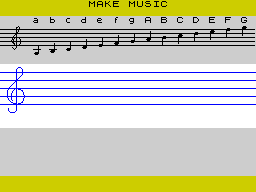
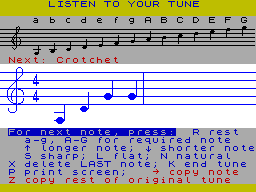
Producer: Sinclair Memory Required: 48K Retail Price: £9.95 Language: BASIC Author: Incognito Software It's unlikely that the sound output of the Spectrum will ever rival that of the London Symphony Orchestra or that a budding Beethoven will claim his Spectrum taught him what he knew. Mind you, unless you significantly amplify the sound output for this Sinclair program, you might think you are simulating Beethoven's inability to hear what he was playing because of his deafness! Musicmaster is a rather jolly tutorial program which allows you to create tunes and play them. The program can hardly be claimed as a utility, and it probably fails to be educational in a detailed manner. There are two modes available - stave or keyboard. Stave mode provides a range of two octaves upwards from A below middle C and uses the alphabet keys a to g and a to G. The notes may be prefaced by pressing keys S (sharp), L (flat) or N (natural). Keyboard mode allows the two top rows of the keyboard to be used as a keyboard instrument with 10 white notes and 7 black notes from middle C upwards. There is an overlay supplied for the keys to help you play. The main menu allows you to select Notes On Music, a sub-menu with five sections otters reasonably detailed notes on music and writing it as it applies to this program. Note pitch, duration are covered, rests - the space allowed between notes: key and time signatures. Tune creation may be done in either stave or keyboard mode. In either case the notes played are shown on screen and heard. Before a tune can be written you must enter the time signature and whether sharps and flats are to be used. At this stage a knowledge of music would be useful but it isn't essential. At any stage, pressing K will end the tune and it may be played back at varying speeds up to 200 crotchets per minute. Tunes may be saved. COMMENTS Control keys: all by on-screen prompts Use of colour: simple. But clear Graphics: stave and note representation works very well Sound: rather depends on you
Music Master's keyboard mode.
Or you can become a keyboard Beethoven with the Stave mode.
Big K #3Jun 1984 · p.67
Pete Shelley
Each month BIG K collars an expert in a particular field to review a selection of progs which claim to reproduce his line of work. This month: PETE SHELLEY Reporter: RICHARD COOK IF MUSIC BE THE FOOD OF LOVE... TAP ON As vocalist, guitarist and leader of Buzzcocks, Pete Shelley put a little romance into the attack of the New Wave which shook rock music in the mid-70s. His love songs channelled the power of punk into a form which laid groundwork for much of today's pop: beguiling music that was as fresh and energetic as any of the system-smashing ambitions of his contemporaries in The Jam and The Clash. After the demise of Buzzcocks back in 1981, Pete embarked on a solo career which has taken quite a different track. His starry-eyed songs are now set to music made primarily through synthesisers and sequences that show one of the most imaginative approaches to instruments otherwise commonplace in today's charts. And alongside this interest in new sounds Pete - along with a few others we know - developed a fascination with computers: the last track on his most recent LP was a program for Spectrum! Pete started with a ZX81. Now he has two Spectrums, a Commodore 64 and a BBC 'B' as well. Although he's hard at work in the studios recording his third LP for island Records, Big K asked him to take some time off to check out a handful of programs designed to help write, practice or maybe just fool around with music. Can a micro assist you in making fortune and infamy in the pop world? We set up the machines; Pete flexed his fingers; and here are the verdicts. KINDLY PAY ATTENTION CLASS! PROG: MusicMaster MAKER: Sinclair/Incognito Software Ltd MACHINE: Spectrum 48K FORMAT: cassette PRICE: £9.95 A much simpler program: the rudiments of music theory are explained onscreen in either a stave or keyboard mode using step-by-step instructions on pitch, time etc. Tunes are then constructed, played and amendid or stored as one wishes. There are no special FX to the program and the maximum length for a tune is 1000 notes. "It's all there on the screen - you don't need to keep looking at the manual, which is good. Shame it's for a machine where the sound is so poor. I like it a lot - it's very good refresher stuff on all the things you forgot at school! it tells you what you need to know about notes or whatever and the way it teaches you about each part of putting music together is very clear. You can go straight to any part of the process so it's very user-friendly. Presentation is excellent and the display is very clear."
THE SHELLEY CHART 1. System Software's Music Editor 2. Spectrum Software's Musicmaster 3. Bug-Byte's BBC Music Synthesizer 4. Quicksilva's BBC Music Processor 5. Quicksilva's Ultisynth Special Mention (Light Relief Department) K-Tel's It's Only Rock 'n Roll
C&VG (Computer & Video Games) #30Apr 1984 · p.1424/53/53/53/5
Performance 4/5
User Friendliness 3/5
Presentation 3/5
Complexity 3/5
NOW GET IN THE RIGHT MUSIC MODE Budding Mike Oldfields who'd rather stick with official Sinclair software can now try Musicmaster. Written by a company called Incognito software, it allows you to play and record tunes on the Spectrum. When it's loading, the five music lines appear on the screen and the treble clef is printed at the start. The notes are crotchets, of which there are four to a bar,.Once loaded there are two possible modes you can enter - keyboard or stave mode. Stave mode allows you to enter notes on the stave in two octaves (a total of 17 notes), by pressing the appropriate letter on the keyboard - lower case for the lower octave, and upper for upper. Keyboard mode lets you use the top two rows of the keyboard as a musical instrument to play in real time. An overlay is supplied for using the program in keyboard mode. There are 10 white notes and seven black ones. Whatever mode you are in, i.e, however you have chosen to enter the notes, you have the option of getting information on the characteristics of the music including pitch, duration, key signature and the like. As with the other Spectrum programs of this sort, length of notes is controlled by having a variable duration. To create a tune you must give the program the required key signature. All notes will then be readjusted. Various keys are used to insert either a rest or a note, to delete a note, to print the stave to ZX printer etc. You also have the option to play the tune at a chosen speed. If it's not quite perfect, then you can edit it, tabbing through the tune changing certain notes as you listen. Once perfected, you can record the data onto cassette to impress you musical friends with at a later date. The maximum length for a tune is one thousand notes. Overall, this program is quite easy to use, and certainly gives more guidance and information than any of the others. It's impossible to create any wonderful effects, though, owing entirely to the Spectrum's hardware. Musicmaster cost £9.95 and should be available in your local computer shop.
Sinclair User #24Mar 1984 · p.106/10
Gilbert Factor 6/10
Memory: 48K Price: £9.95 Musicmaster, for the 48K Spectrum is supplied in the now standard Sinclair presentation box and includes an instruction manual and a keyboard overlay. During loading you are given a screen display of two music staves which are re-drawn once the program has loaded. That is obviously a waste of time on a long program. In use, the program, which is menu-driven, gives you the option of a stave display which spans two octaves or a keyboard display which has only one. You then have a choice of notes on music, create a tune, play, amend, save or load a tune, stop or switch mode - keyboard or stave; there is also the option to COPY your tune. The notes on music begin by playing and drawing a very slow chromatic scale in both modes. It then explains the use of key signatures very well, using sound and a visual display. That is probably one of the most valuable parts of the program but is slightly spoiled because the Spectrum does not BEEP precisely in tune. When writing a tune the program is again interesting and fairly effective. You set your own time and key signatures - you can use only accidentals in stave mode - and each note is sounded and appears on the stave as you key it it is possible to play back the tune at any point and at any speed by entering the number of crochets per minute. The only problem is that the stave is rather short, allowing you to see only about three bars of music at one time. After a slow start it warms up to become an interesting program with educational possibilities, especially for children who are more excited by the idea of computing than ordinary music teaching. Available from Sinclair Research Ltd.
Advert12
- Computer ChoiceDec 1983 · p.42
- Sinclair User #21Dec 1983 · p.182
- Your Computer #12Dec 1983 · p.24
- ZX Computing #10Dec 1983 · p.36
- C&VG (Computer & Video Games) #26Dec 1983 · p.146
- Sinclair Programs #14Dec 1983 · p.16
- Your Computer #11Nov 1983 · p.156
- Practical Computing #11Nov 1983 · p.10
- C&VG (Computer & Video Games) #25Nov 1983 · p.174
- Sinclair User #20Nov 1983 · p.136
- Personal Computer News #32Oct 1983 · p.60
- Home Computing Weekly #33Oct 1983 · p.48
Feature4
- ZX Computing #17Feb 1985 · p.115
- Popular Computing Weekly #2Jan 1985 · p.21
- Your Computer #9Sep 1984 · p.77
- Popular Computing Weekly #19May 1984 · p.15
Review2
- Computer ChoiceMar 1984 · p.16
- Home Computing Weekly #46Jan 1984 · p.27
News/Note1
- ZX Computing #12Apr 1984 · p.117
Related
- Tags
- Keyboard Overlay, g066
- Same entry at
- Spectrum ComputingZXInfo
Reviews from people here
Sign in to write about this, or make an account. It takes a minute and lets you correct the catalogue too.
Everything ZXDB can hold about this is here.
Sign in to correct or add to this.
Hold the rights to this and want it taken down?