
Don't Buy This
Compilation · ZX-Spectrum 48K · 1 players · English
Firebird Software Ltd · Apr 1985 · Pound sterling 2.50 · Pound sterling 1.99 budget
Also known as Five of the Worst Games Ever (English)
Discussion
Nobody has started a thread about this yet.
Play
- DontBuyThis.tzx.zipTape image English46 KB
Documents
- DontBuyThis.txtInstructions English4 KB
Files and rights
Distribution permission is on record, granted to another archive rather than to this one. Screens and pictures are copied here; everything else links to the archive that holds it.
- AllowedFirebird Software Ltd → WorldOfSpectrum
Scores
In the magazines
- Sinclair User #401985 · Overall2/5
- Sinclair Programs #341985 · Rating9%
- Crash #171985 · Overall39.333333%
Elsewhere on the web
- WorldOfSpectrum 10 votes6.10
In the magazines 36
Sinclair Programs #34Aug 1985 · p.179%9%
Rating 9%
Colette McDermott 9%
PRICE: Too much How do you review a game which explicitly tells you: Don't Buy This? Not only that, it tells you that these are meant to be five of the worst games ever. Fruit machine can safely claim to be one of the slowest versions of a fruit machine ever produced. Race Ace, offered 250 speeds to the budding racing driver, each of which managed to be either too fast or too slow. Still, what do you expect from eight screens of Basic? Weasel Willy may be good, but we cannot comment, because it would not load. The loading screen was fairly rough, though, if that is any help. The gems of the piece are Fido One and Two in which, against a variety of backgrounds, a dog has to sit and smash moles to death with its tail. Surely games for the Spectrum have not been of a high standard for long enough for the industry to start being smart-alec on the subject? These games were fairly amusing for five minutes on a review copy. Whatever you do, do not buy them. Don't Buy This is produced for the 48K Spectrum by Firebird Software, [redacted].
ZX Computing #20Aug 1985 · p.74
Firebird, the BT company who made such an impact with their first collection of SW have added to their range with the introduction of seven new programs in their Silver, £2.50, series. From the sublime to the ridiculous, DON'T BUY THIS is a collection of some of the worst games sent to Firebird. Definitely not recommended unless you want to see how NOT to write program! All in all, apart from this last one, the Firebird range provides good value and a wide selection - I wish I'd bought shares in BT.
Your Spectrum #17Aug 1985 · p.421/5 MISS2/5 MISS1/5 MISS
Dave Nicholls 1/5 MISS
Roger Willis 2/5 MISS
Ross Holman 1/5 MISS
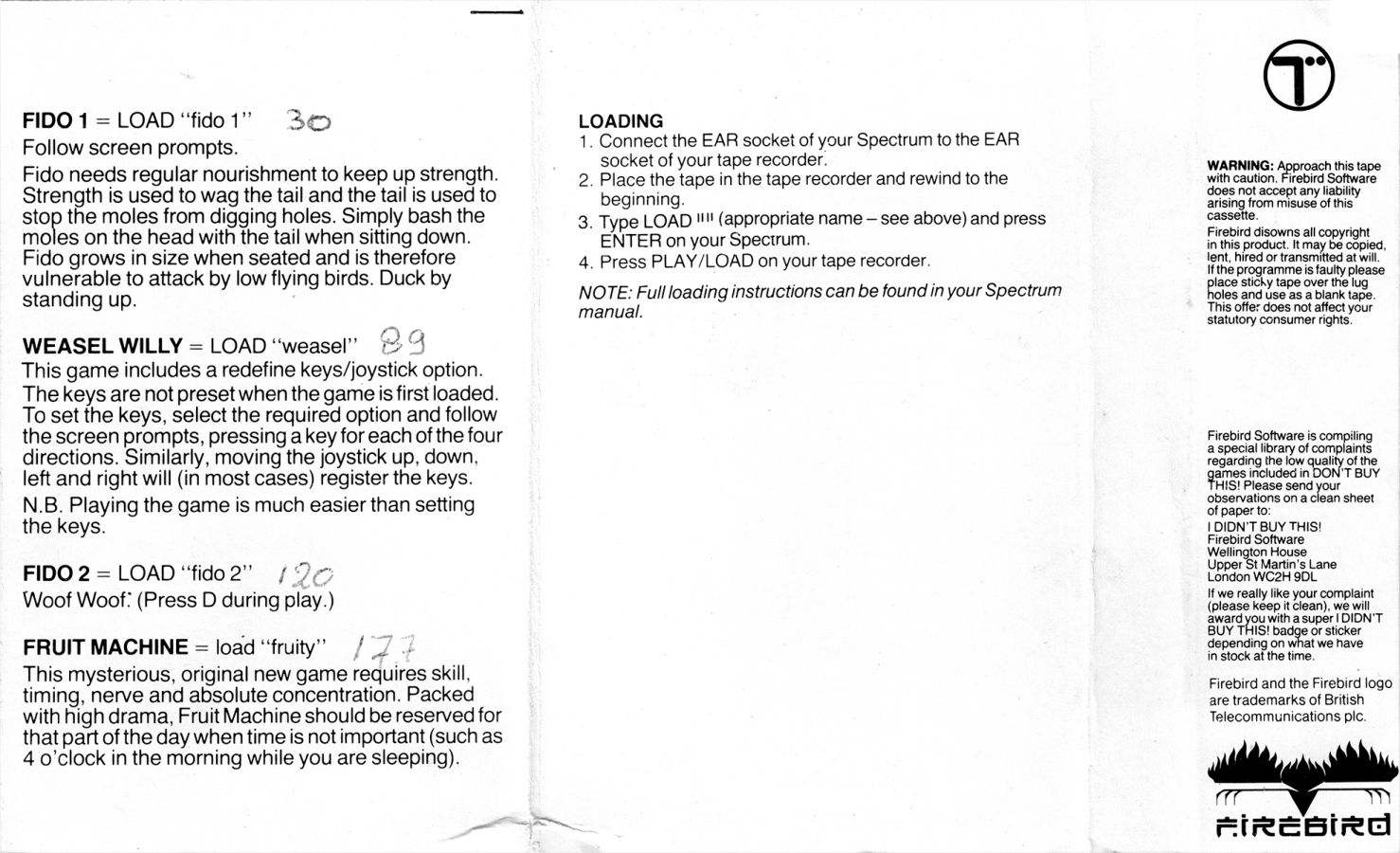
JOYSTICK JURY Our three-ring circus of Roger Willis, Ross Holman and Dave Nicholls is back in town. Watch 'em put all the latest arcade games through the hoops - and have a laugh at the clowning around. What's the score? Well, the marks out of five at the end of each review is a shorthand way of summing up what each reviewer thought of the game. But will it be a commercial success? For that you'll have to check out the HIT and MISS system. Simple, eh? DON'T BUY THIS Firebird Software £2.50 Dave: The games included on this tape are apparently the worst games submitted to Firebird for publication. Two of them star a puppy called Fido who has to flatten moles with his tail while avoiding birds flying overhead - both games are original and well worth a couple of minutes' attention. Race Ace is another 'also-ran', featuring a character-sized car moving around a single-screen plan view race track - there are two speeds: tediously slow or ridiculously fast! Moving on, there's Weasel Willy and a Fruit Machine. And that's really what you want to do when you're checking out this one ... 'move on'. The games aren't that bad as do-it-yourself games but, they won't provide that much fun. Take a good look at the words printed on the outside of the package before you buy... the title of the package really does say it all.
C&VG (Computer & Video Games) #45Jul 1985 · p.94
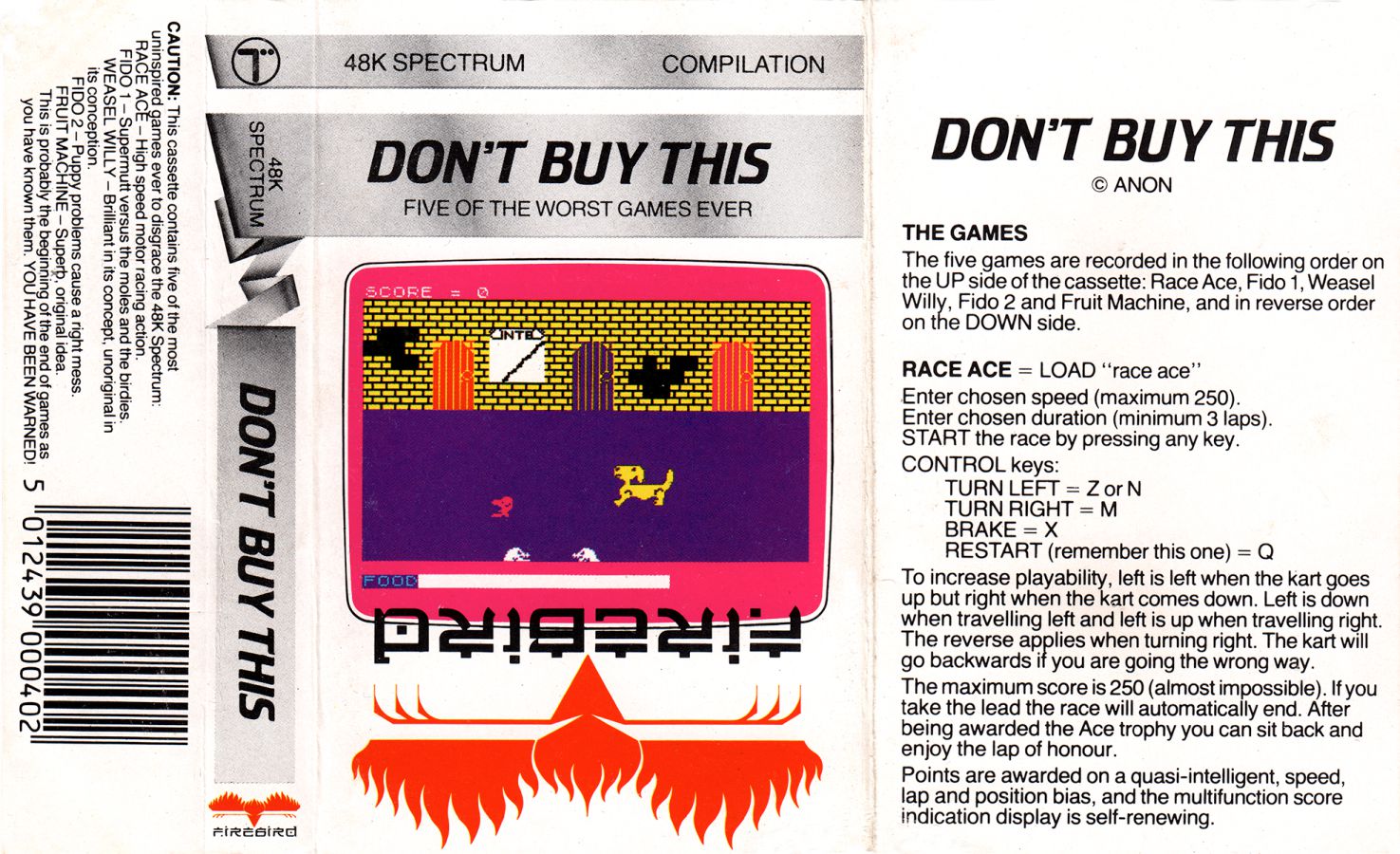
MACHINE: Spectrum SUPPLIER: Firebird PRICE: £2.50 Don't Buy This claims to be a collection of the five worst games ever. We believe it. Firebird proudly boasts: "This is the beginning of the end of games as we know them." Game titles are Race Ace, Fido 1, Weasel Willy, Fido 2 and Fruit Machine. It's hard to rate games that are publicised as being bad. But they are good for a laugh. Perhaps it's the start of a new cult. As Firebird warns "Approach this tape with caution."
THE PRICE IS RIGHT Buying computer games can be an expensive business. Some can cost anything up to £14. To buy all the latest titles as they come onto the market would cost a small fortune. And that's beyond the pocket of most people. So it's no wonder that software companies have started producing a range of games costing no more than a couple of pounds. Unfortunately, besides being cheap, some were very nasty and a waste of money. It seemed far better to save up and buy a top price game. But such is the potential of the market that the quality of the games has improved while the prices have been kept low. So Computer & Video Games thought it would be worthwhile to take a look at some of the current budget games on the market from software houses. Firebird, British Telecom's software company, is now in the process of updating its Silver catalogue which was launched in October 1984 with great success, with all the games selling for £2.50. Star of the original 20 titles was undoubtedly Booty on the Spectrum 48k and Commodore 64 which, claims Firebird, has sales now in excess of 100,000. It's now being converted to the Amstrad and should be available by late summer. In Booty, Jim the cabin boy faces death by drowning or at the hands of the Ghost Pirate as he searches through the hold of the Black Galleon in search of treasure. Another favourite is Gogo the Ghost on the Commodore 64 which has, believe it or not, 150 frames of haunted happenings. New games shortly to be introduced into the Silver range are Microcosm for the BBC B, Subsunk for the Commodore 64 and Don't Panic for the 16k and 48k Spectrum. Mastertronic, formed in April 1984, now claims to be the brand leader in budget games - its extensive range sells for just £1.99 each. In its first 12 months of trading, Mastertronic says it has audited figures of sales for two million games. New developments for 1985 in the £1.99 range include two semi-educational games in its Mistertronic titles - Make Music with Mistertronic and Type Rope - aimed at the six to 11 age range. Earlier this year, Atlantis Software launched three games under its new Atlantis Gold label, selling at £2.99 each. They were the Dungeons and Dragons-style Adventure Velnor's Lair for the Commodore 64 and Nicotine Nightmare and Self Destruct, both on the Spectrum 48k. The last two have proved so popular that Atlantis is in the process of converting them for the Amstrad - a move which again points to the growing popularity of the machine. Mike Cole, of Atlantis, says: "We believe in the Amstrad as the next thing to come. It's a lovely machine. We will be supporting it." Being launched this spring is The Sparkler range of games from Creative Sparks at £2.50. Sandy Mackenzie, of Creative Sparks, says: "There is a a need to supply good quality software at prices affordable to kids". The company's decision to produce cheap software was prompted to a great extent by the large number of excellent games sent in by amateur writers. "By promoting games in the budget range," says Sandy, "we are opening the industry to new talent, and also serving the interest of games buyers by publishing good games at reasonable prices. After all, low prices doesn't have to mean low quality." Soit seems that pocket-money power is being recognised at last and computer star wars could soon become computer price wars. About time, too!
Sinclair User #40Jul 1985 · p.262/52/5
Overall 2/5
Clare Edgeley 2/5
Publisher: Firebird Price: £2.50 Memory: 48K Joystick: Kempston Warning. This cassette contains five of the most uninspired games ever to disgrace the Spectrum. In Fido I and Fido if you play Fido the mole bashing pup. When a mole incautiously lifts its head above ground, Fido rushes over, sits down and thumps it with its tail. Weasel Willy refused to load. The cassette inlay states that 'playing the game is easier than setting the keys'. Race Ace is the antithesis of any race game ever. It is alternatively too slow and too fast, and to increase playability the control keys are backwards - 'left is left when the kart goes up but right when the kart comes down...' You are advised to play Fruit Machine at around four in the morning when you are asleep. Firebird disclaims all responsibility for the game and states that the product 'may be copied, lent, hired or transmitted at will.' it also advises action if the programming is faulty - put sticky tape over the lug holes and use it as a blank cassette.
Crash #17Jun 1985 · p.466%17%10%27%76%700%39.333333%
Use of Computer 6%
Graphics 17%
Playability 10%
Getting Started 27%
Addictive Qualities 76%
Value For Money 700%
Overall 39.333333%
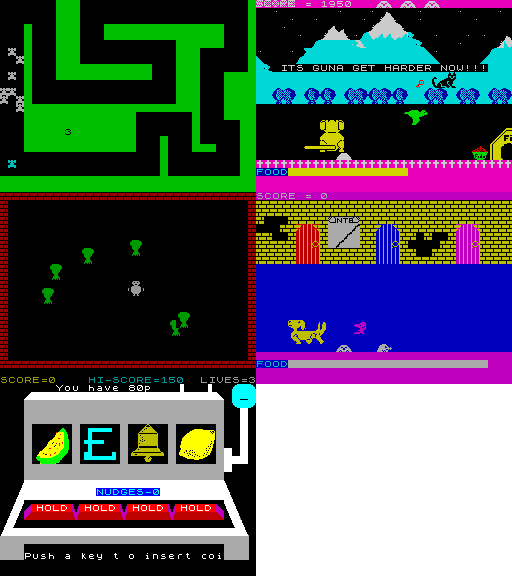
Producer: Firebird Memory Required: 16/48K Retail Price: £2.50 - it's a steal! Language: Megabasic (it's a very good basic though) Author: Anon RACE ACE Race Ace is a very straightforward racing game, in fact its simplicity is one of its strongest features because you can get stuck in straight away. The player steers one of nine little cars round a fixed track, the others being controlled by the computer. Any one of 250 speeds can be selected for a race of four or more laps. At first I thought the game a little limiting because it only has one track until I realised that by using the simple trick of going backwards a completely new race could be run - unfortunately the other cars persisted in going the wrong way. The graphics are very simple but this is necessary in order to follow the fast action that the game provides. A particularly admirable feature is that no matter what happens to the player's car, like colliding with another car, or with the kerb, or indeed with anything, it suffers no damage. This means that since your car can't be damaged you won't have to keep going back to the start as other race games tend to insist you do. Once your car pulls out into the lead then the race is over: this neatly avoids the tedium you encounter in games like Full Throttle of having to stay ahead once you are. FIDO This same requires the player to position the dog, Fido, so that when he sits down and wags his tail he batters little moles to death. The moles keep popping up at the bottom of the screen. This may sound easy to do but you must be careful not to exhaust the little pooch, his energy decreases as he moves across the screen so you must guide him to his feed bowl to boost his energy. The game gets harder still when you consider the action of the birds, they just fly across the screen but because Fido is larger when seated than when standing the birds can crash into his head and kill him. To avoid this awful end Fido can duck (another sort of bird), you do this by making him stand up. To make the game harder still the program seems to have been written so that every now and then Fido dies for absolutely no apparent reason - very realistic. WEASEL WILLY This has simply got to be the best version of Weasel Willy available. The object of the game is to guide what looks like a bear round the screen without touching the trees, which are cunningly placed at random. Should you collide with any object then a superb message comes up saying 'YOU'VE BLOWN IT' and you lose a life. If you manage to steer the bear round the park then just when you least expect i tthe screen will re-draw with more trees all in different places. You continue in this way until you have exhausted all of your lives, which is inevitable because nobody is that good. The program has some neat touches, two in fact. The first is a league table and the second lets the player re-define the keys, this feature is cleverly offered every time you re-start the game just in case you feel like a change. I particularly liked the way the bear flashes. What happened to the Weasel? FIDO 2 Fido 2 is probably better known under its other title of Puppy Power. The gameplay in this powerful follow up to the immensely successful Fido remains the same, ie to batter the moles with your tail, this version is a great deal harder though, as befits a sequel. Firstly, although the programmers have left the diminishing energy bar in, they have cunningly left the food bowl out so Fido starves to death. This game has more screens than before: rather than just a simple street scene we now have a cave and beach scene as well. What makes Fido 2 such a winner is the way Fido is chased by little thingies. If they catch him while he trying to batter a mole then he will die. The pursuing objects vary from screen to screen; in the first screen we have a purple bust of a chap with a very long nose, the other screens have flowering scotch thistles, ashtrays with smoking cigarettes, smashed up sandcastles and finally toy pistols. All of the backdrops have doors of some kind, but the amazing thing is that no matter what you do you won't be able to get through any of them. Should you find the game too hard the programmers have built in a feature which allows you to flick through the five screens and admire the graphics. FRUIT MACHINE Everybody knows how to play this so perhaps I should point out the features that can be used to advance your enjoyment of the game. Firstly there is a an accountant telling you how much money you have left out of your original pound. Every so often, about once in a thousand pulls, you can take advantage of the Nudge feature, the hold facility is offered a little more frequently. On winning you will be asked if you want to gamble, another screen puts this offer to reality and two numbers will flash, the first slightly higher than your initial win, the second will be nothing, that's what I call gambling. One problem with many fruit machine programs is the sheer speed at which everything happens, not with this game, this is nice and ever so slow, the player can sit back and be sure of missing nothing. COMMENTS Control keys: Z/M left/right X to brake but it rather depends on the game Joystick: none on one; others allowed the Kempston but didn't say why Keyboard: ours had funny little rubber keys that squished up when you pressed them this tended to make rapid game play difficult but that didn't matter since rapid game play isn't required Use of colour: some of them had colour and those colours looked very... coloured Graphics: fairly uncomplicated some were actually very uncomplicated Sound: I don't think there was any, apart from the odd bleep Skill levels: not so much skill as persistence Lives: by and large, taken as a whole, there were too many N.B. Using the old CRASH system of having the overall figure as a strict average of the other marks, it looks much better that way. One other point I feel that 'should raise is that The Headitor tells me that because this package has five games all on one tape tradition demands that the percentages must be given in brackets. This seems a shame because readers might get the idea that this means they are minus points, but that would be silly as only accountants put negative numbers in brackets and boring accountants don't read CRASH anyway, do they? (Answers, on an postcard please, to J Spencer CRASH)
Best Graphics of the Year award goes to WEASEL WILLY. The mushroom shaped things are actually trees and the square in the middle is Willy. Unfortunately the camera caught him just as he was flashing, otherwise you would see an elegant character...
FIDO is a dog with an Impossible Mission, side swiping the naughty moles with that rigid tail of his.
If you're happy with the 'nudges', just break into BASIC and edit line number 880 and change the random number in the brackets to whatever you would rather have! If you reckon the machine hasn't given you a nudge for some time, just break in an GOTO 880 - CRASH, the mag that gives playing tips with your captions!
A QUICK WORD FIRST... We've had some fun this month extracting the Michael from the Software Editor. Playing on his kind, easy going temperament we handed him a copy of Firebird's Don't Buy This and persuaded him that it was a collection of megabrill games. At first he seemed less than convinced so we produced a few review sheets extolling its virtues. Graeme finally clinched it by telling him that he hadn't learned to appreciate the more subtle aspects of some Spectrum games. Almost convinced, Spencer the Corpulent then phoned Firebird - so we all dashed upstairs to listen in on the extension... 'We have a copy of your latest release here but it seems to have five games all on one tape, surely there must have been a mistake?' 'No there's no mistake, at least not as far as those games are concerned.' 'Why is it called Don't Buy This when it seems such great value?' 'Who did you say you were?' 'Jeremy Spencer from CRASH' 'Are you serious?' 'What? about being from CRASH?' 'No, about the games.' 'Well of course I am.' 'Are you the new Software Editor? The guy that used to sell yellow wellingtons for horses, the ones you filled with water?' 'Well... er... yes' '... and now you own an Amstrad and a lamb that answers to the name of Ernie?' 'Yes' '... and a dog that chews empty wine bottles?' 'well yes but what...' '... you are serious!' 'Yes of course but why call the cassette "Don't Buy This"?' 'It wasn't meant to be called Don't Buy This but the type-setters made a mistake.' 'What was it meant to be called?' 'Oh it's been called all sorts of things, lots and lots of different names but since we've had so many inlay cards printed it seemed to stick you see.' 'Fair enough I suppose, perhaps you could give me the names of the authors? I can't find any credits.' 'Too right, John... they said they wanted to be kept out of it, out of the limelight I mean, and for that matter perhaps you could keep Firebird's name out as well... please.' 'Well that's very modest of you.' 'All part of the image you know.' BBRRRRRRRRRRRR
Advert19
- C&VG (Computer & Video Games) #49Nov 1985 · p.12
- Computer Gamer #8Nov 1985 · p.46
- Popular Computing Weekly #41Oct 1985 · p.6
- Popular Computing Weekly #40Oct 1985 · p.6
- Your Spectrum #19Oct 1985 · p.40
- Your Spectrum #18Sep 1985 · p.36
- Crash #20Sep 1985 · p.123
- Sinclair User #41Aug 1985 · p.21
- C&VG (Computer & Video Games) #46Aug 1985 · p.46
- C&VG (Computer & Video Games) #46Aug 1985 · p.9
- Computer Gamer #5Aug 1985 · p.26
- Your Spectrum #17Aug 1985 · p.40
- Crash #19Aug 1985 · p.79
- Sinclair User #40Jul 1985 · p.115
- Your Spectrum #16Jul 1985 · p.40
- Home Computing Weekly #120Jul 1985 · p.4
- Crash #18Jul 1985 · p.89
- C&VG (Computer & Video Games) #44Jun 1985 · p.14
- Home Computing Weekly #117Jun 1985 · p.4
News/Note4
- Sinclair Programs #32Jun 1985 · p.11
- Your Computer #6Jun 1985 · p.23
- Sinclair User #39Jun 1985 · p.7
- Home Computing Weekly #112May 1985 · p.6
CompoEntry2
- Computer Gamer #5Aug 1985 · p.4
- C&VG (Computer & Video Games) #46Aug 1985 · p.62
Review2
- Computer Gamer #4Jul 1985 · p.64
- Home Computing Weekly #111May 1985 · p.15
Information1
- SSD-IISep 1999
CompoResult1
- Computer Gamer #8Nov 1985 · p.57
Letters1
- Popular Computing Weekly #25Jun 1985 · p.6
Contains
Related
- Versions
- MCoder II (Authored with)
- Same entry at
- Spectrum ComputingZXInfo
Reviews from people here
Sign in to write about this, or make an account. It takes a minute and lets you correct the catalogue too.
No credit, description, tag recorded.
Sign in to correct or add to this.
Hold the rights to this and want it taken down?