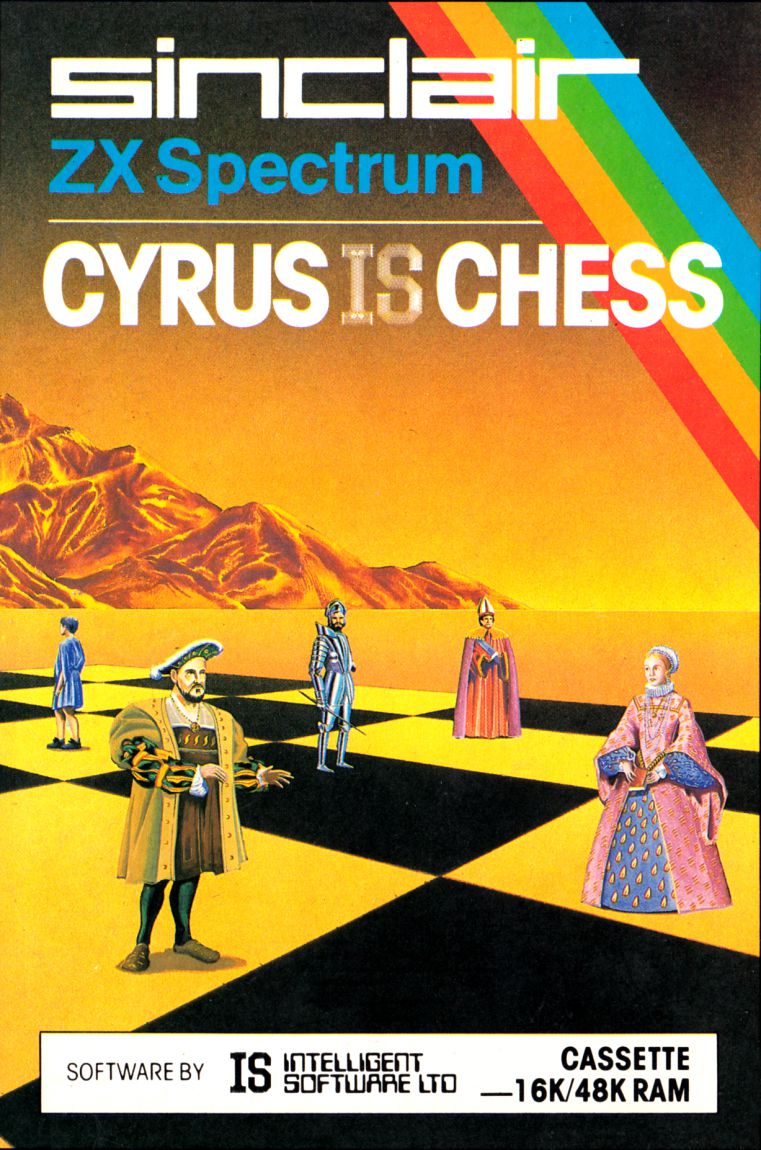
Cyrus IS Chess
Game: Board · ZX-Spectrum 16K/48K · 1 players · English
Sinclair Research Ltd · 1983 · Pound sterling 9.95
Also known as Cyrus 1981 European Champion (English)
CyrusISChess, 1 of 2
Cyrus II →
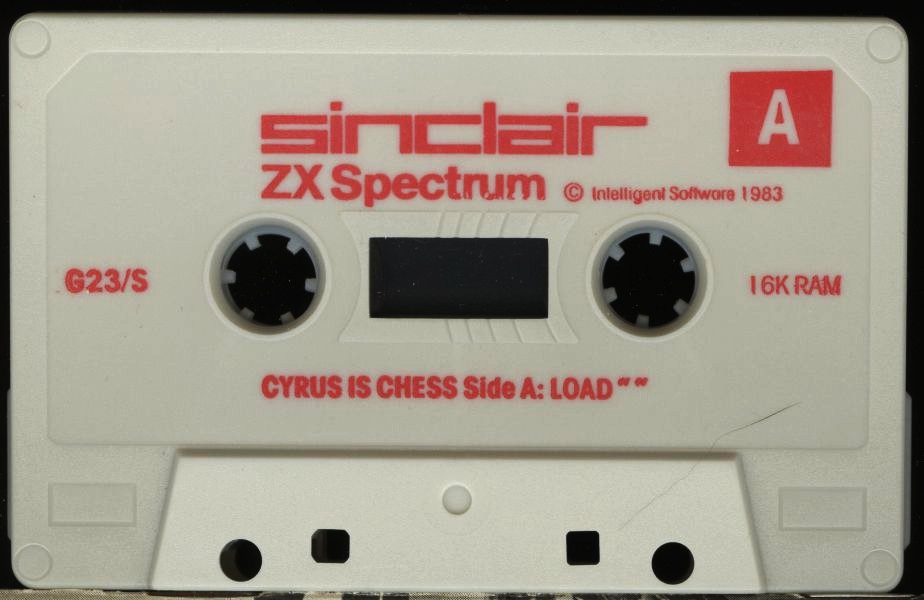
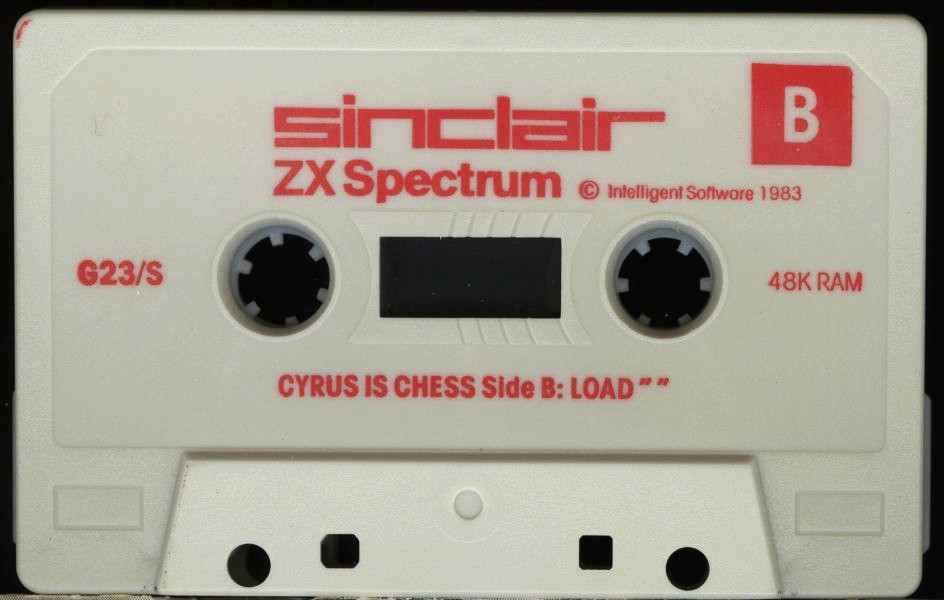
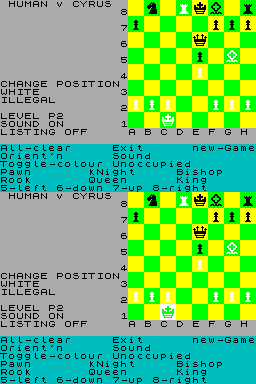
Discussion
Nobody has started a thread about this yet.
Releases
- 1983Sinclair Research Ltd Sold as Cyrus 1981 European ChampionPound sterling 9.95
- 1983VentamaticSpanish peseta 3000.00
Play
- cyrusischess.rzxRZX playback file
- CyrusISChess.tzx.zipTape image English19 KB
- CyrusISChess.tap.zipTape image English12 KB
Documents
- CyrusISChess.txtInstructions English24 KB
- CyrusISChess(EN).pdfInstructions English1,312 KB
Files and rights
Distribution permission is on record, granted to another archive rather than to this one. Screens and pictures are copied here; everything else links to the archive that holds it.
- AllowedSinclair Research Ltd → WorldOfSpectrum
- AllowedVentamatic → WorldOfSpectrum
Credits
- Richard Langcredited
Sign in to credit somebody, or say what these people did.
Scores
In the magazines
- Your Computer #81983 · Overall4/5
Elsewhere on the web
- WorldOfSpectrum 28 votes8.12
In the magazines 31
ZX Computing #17Feb 1985 · p.20
Christopher Doran
Philip Crocker
BATTLE OF THE GIANTS Philip Crocker and Christopher Doran match Superchess 3.0 and Cyrus IS Chess in a fight to the finish Since the Spectrum first came out there have been many chess programs written for it. As the Spectrum has become more popular there has been a greater incentive to write the best Spectrum chess program. The two most obvious contenders for title best Spectrum chess program are Cyrus IS Chess and Superchess 3.0 by CP Software. Cyrus IS Chess is based on a program which won the 1981 European Microcomputer Chess Championship. While Superchess 3.0 comes with a guarantee from CP Software, that it will beat any other Spectrum chess program. CYRUS IS CHESS VERSUS SUPERCHESS 3.0 Both chess programs come in a well presented package which contains a cassette and an instruction booklet. Cyrus contains two programs: one for the 16K and one for the 48K Spectrum. Both Cyrus programs have the following features: 1 Eight playing levels. 2 Cursor key movement of pieces. 3 Auto-demonstration mode. 4 It can be used as a chessboard by two humans. 5 Take-back facility. 6 Replay a game. 7 Set up a position. 8 It solves chess problems (up to mate in three). 9 Turn round board. 10 Change sides during a game. The additional features for the 48K Spectrum are: 1 Full library of chess openings. 2 Change colour of board and 2 Change colour of board and pieces. 3 Print out a record of the game. 4 Save game on tape (for future 4 Save game on tape (for future continuation). 5 Force the computer to make its best move. Superchess 3.0 is for the 48K Spectrum only. Its features are: 1 Ten playing levels. 2 Recommended move option. 3 Change sides and level of play during game. 4 Set up a position. 5 Self-play option. 6 Technical information (how the program works). During the game Superchess gives itself a score dependent on positional factors and material advantage or loss. 7 Library of opening moves. 8 Change colour scheme. 9 Solve chess problems (up to mate in four). 10 List Moves. Cyrus definitely has more features than Superchess 3.0. For example Cyrus's take-back facility is a very useful feature which Superchess lacks. There is also a replay feature which enables the beginner and expert alike to examine the previous game, and even to begin the game at a chosen point. CHESS ABILITY In order to discover the chess ability of both programs we decided to play the two programs off against each other. We attempted to play the two chess programs off at approximately equal time limits. The results are shown in table 1. EXAMPLE GAME This game was between Cyrus (white) and Superchess (black). Cyrus played on level 6 and Superchess played on level 3. The game was typical of the games which were played. Cyrus played a fine opening due to its superior opening knowledge and the game soon reached a middlegame with a positional advantage to Cyrus. Cyrus exploited this advantage with some fine, logical play and won a pawn. However this led to a multitude of exchanges and an endgame was reached with Cyrus having some winning chances and almost certain drawing chances. However in the endgame Superchess came into its own. Its driving, delicate play forced zugzwang (the compulsion to make a move resulting in material or positional loss) upon Cyrus. Superchess then proceeded to overwhelm the depleted Cyrus and quickly concluded the game. The moves are listed in table 2. For those of you who are not familiar with the notation used in table 2, I will briefly explain how it works. The piece to be moved is shown by the first letter of its name except for the knight which is represented by N. There is then a dash, or an x if the move captures a piece. The square to which the piece should be moved is shown by the piece which would be on the same file at the beginning of a game and then by the number of squares forward (one to eight). The symbols are KR (kings rook), QR (queen's rook), QN, KN, Q, K, QB and KB. Kingside castling is shown by 0-0 and queenside castling by 0-0-0. Check is shown by + and ! indicates a good move. If for example two rooks could move to the same square then the correct rook is shown in brackets. The moves should be worked out by looking at the board from the point of view of the person who is moving. CONCLUSION Superchess was the clear winner in this contest and this supports the claim that it can beat any other Spectrum chess program. Superchess seems to improve as the game goes on. Its standard opening play and weak (compared to Cyrus) opening library convey a dubious impression. Its middlegame is sound without being spectacular but its endgame is excellent and this is where it won or drew games in which it had a material or positional disadvantage. For example in the final game Cyrus reached the endgame three pawns up and with a better position after a brilliant combination. However by playing outright blunders which lost Cyrus material and decentralised its pieces it enabled Superchess to draw the game with some subtle play. Cyrus was rather a disappointment in the game just described. Often it would play an excellent opening and middlegame and then lose a "won" endgame. Sometimes on lower levels it would play nonsensical moves in the middlegame or in the endgame. For example it would move a rook backwards and forwards for several moves which enabled Superchess to improve its position unhindered. Both packages have room for improvement. Superchess has fewer features than Cyrus and it also has a weak opening library compared to Cyrus. Cyrus has weak endgame play and it has a habit of making nonsensical moves. Cyrus iS Chess is written by Intelligent Software and is priced £9.95. It can be obtained from most computer software retailers. Superchess 3.0 costs £8.95 and can be obtained from the following address: CP SOFTWARE, [redacted] It may also be available from good software shops.
Table 1. Results from IS Chess v Superchess play off. White: Cyrus Level 1 Black: Superchess Level 0 Result: 0.5-0.5 Moves: 35 White: Superchess Level 0 Black: Cyrus Level 1 Result: 1-0 Moves: 64 White: Cyrus Level 4 Black: Superchess Level 1 Result: 1-0 Moves: 25 White: Superchess Level 1 Black: Cyrus Level 4 Result: 1-0 Moves: 57 White: Cyrus Level 5 Black: Superchess Level 2 Result: 0-1 Moves: 38 White: Superchess Level 2 Black: Cyrus Level 5 Result: 0.5-0.5 Moves: 30 White: Cyrus Level 6 Black: Superchess Level 3 Result: 0-1 Moves: 60 White: Superchess Level 3 Black: Cyrus Level 6 Result: 0.5-0.5 Moves: 65 White: Cyrus Level 5 Black: Superchess Level 1 Result: 0.5-0.5 Moves: 57 White: Superchess Level 1 Black: Cyrus Level 5 Result: 0-1 Moves: 65 White: Cyrus Level 7 Black: Superchess Level 6 Result: 0-1 Moves: 110 White: Superchess Level 6 Black: Cyrus Level 7 Result: 0.5-0.5 Moves: 81 Game: 1 Superchess: 0.5 Cyrus: 0.5 Game: 2 Superchess: 1 Cyrus: 0 Game: 3 Superchess: 0 Cyrus: 1 Game: 4 Superchess: 1 Cyrus: 0 Game: 5 Superchess: 1 Cyrus: 0 Game: 6 Superchess: 0.5 Cyrus: 0.5 Game: 7 Superchess: 1 Cyrus: 0 Game: 8 Superchess: 0.5 Cyrus: 0.5 Game: 9 Superchess: 0.5 Cyrus: 0.5 Game: 10 Superchess: 0 Cyrus: 1 Game: 11 Superchess: 1 Cyrus: 0 Game: 12 Superchess: 0.5 Cyrus: 0.5
Table 2. The Cyrus versus Superchess example game. 1.P-K4 P-QB4 2.P-KB4 N-QB3 3.N-QB3 P-Q3 4.B-Qn5 B-Q2 5.N-B3 N-B3 50.K-Q2 KxP 6.P-Q3 P-QR3 51.K-Q3 K-B4 7.BxN BxB 8.Q-K2 P-K3 9.B-K3 P-Q4 10.PxP NxP 11.NxN BxN 12.B-Q2 Q-KB3 13.Q-K5 BxN 14.QxQ PxQ 15.PxN B-N2 16.R-N1 0-0 17.B-QB3 K-R1 18.0-0-0 P-QR4 19.R-N4 P-R5 20.R(Q)N1 R-N8 21.RxB! RxR 22.BxBP R(R)N1 23.R-N5 P-QN3 24.K-N1 P-KR3 25.R-N4! K-R2 26.BxR RxR 27.P-QB4 P-KB4 28.RxR + KxR 29.K-B2 K-83 30.K-Q2 K-B2 31.K-K3 P-R4 32.P-R4 K-N3 33.P-Q4 K-82 34.P-Q5 PxP 35.PxP K-K2 36.P-N3 P-R6 37.K-Q3 P-N4! 38.P-N4 P-B5 39.K-K3 K-Q2 40.P-Q6 KxP 41.K-Q4 Kb3! 42.K-B3 K-Q4 43.K-B2 K-75 44.K-Q2 P-B6+ 45.K-K2 P-B7 46.K-Q2 P-B8(Q) 47.KxQ K-B6 48.K-Q1 KQ6! 49.K-B1 K-85 50.K-Q2 KxP 51.K-Q3 K-B4 52.K-B3 P-N5+ 53.K-Q3 K-B4 54.PxP P-R7 55.K-B2 R-R8(Q) 56.K-Q3 Q-Q5+ 57.K-B2 K-N5 58.K-N1 Kxp 59.K-B1 Q-Q5 60.Q-Q8 mate
Crash #4May 1984 · p.62
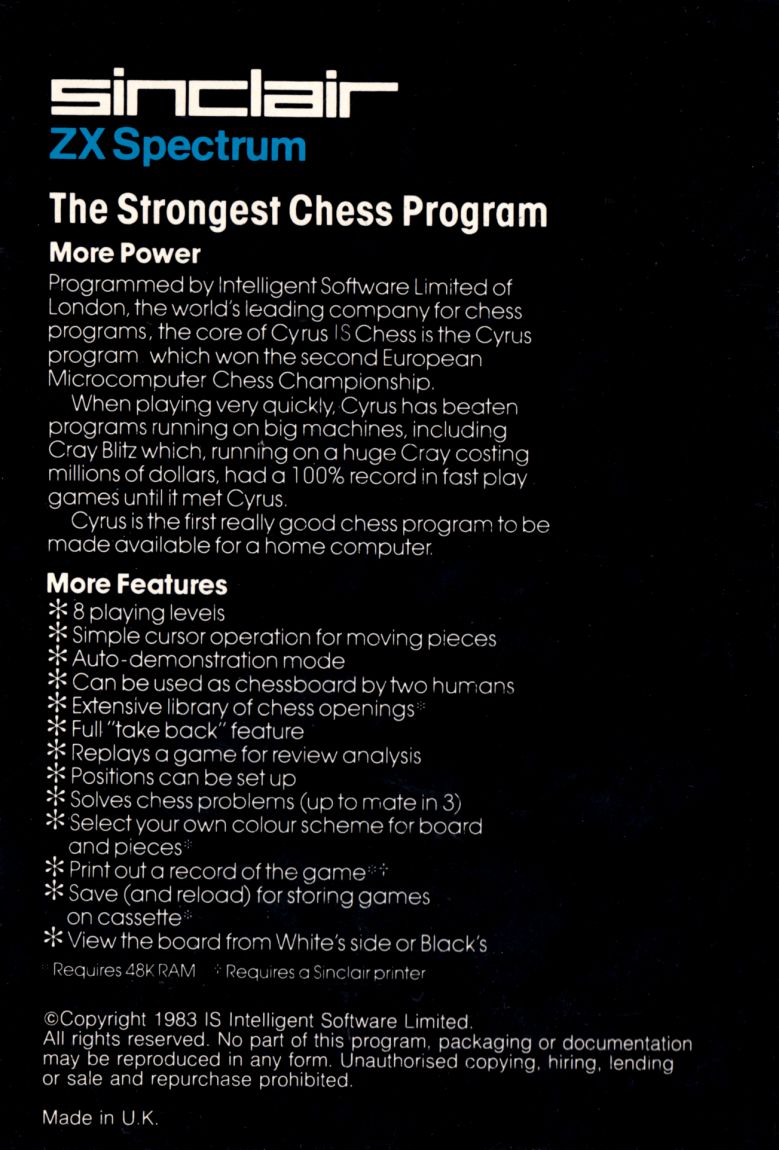
Producer: Intelligent Software. 16K/48K £9.95 This program is winner of the Second European Microcomputer Chess Championship. The 48K side has more sophisticated options such as altering the colours of board and pieces, printouts and game saving. Cursor keys movement allows you to analyse a move or take the piece back. Illegal moves are buzzed. Eight skill levels and a problem level system whereby the computer can be instructed to look for a mate in one, two or three moves. Comes complete with an instruction manual and a library of opening moves. Excellent value.
C&VG (Computer & Video Games) #28Feb 1984 · p.38
Martin Bryant
COMPUTER CHEQUE-MATES... Thinking of buying a chess program for your micro? Don't know what to expect or which one to buy? Then read on... Whether you're a chess fanatic or you just know the rules, you will probably at some time want to set a chess program for your home computer. With the great number of programs now available, it may be a difficult decision to choose the best one for your micro. In this article Chess programmer Martin Bryant looks at the standard of play and the features you can expect from the best modern home computer chess programs. STANDARD OF PLAY The very best programs can now play at a fairly good club level, from around 1600 to 1800 ELO (125 to 150 BCF). The standard of play can vary greatly from game to game depending on the type of position encountered and the stage of the game. Modern programs also usually have a much fuller understanding of the more obscure rules of chess such as underpromotions, draws by repetition, draws by the fifty move rule and chess clocks. FEATURES Here's what you should look for in a good chess program. The most recent programs are provided with many more features of a much higher quality than their older counterparts, such as: - Move entry by a cursor positioning method. Why should people have to turn their thoughts into an algebraic form, just because its easier for the program to understand? The cursor method allows you to 'move the piece on the board, more like a real chess game. The best programs can accept both methods. - The ability to step backwards or forwards through the entire game. Older programs would allow you to take back only a couple of moves, but with new techniques the whole game record can be stored and scanned with small memory overhead. - The orientation of the board should be reversible. That is the board should be displayable with white or black at the bottom of the screen. This allows you to play black "up" the board, like a real chess game, instead of having to reverse your way of looking at it. Several "modes" of play can add a great deal of flexibility to a program. The old fashioned eight "levels" can be vastly improved upon these days. Some of the sensible "modes" are: (i) "Tournament" mode: Full tournament parameters can be set up, to make the program play within any specified time limit. An easy to use version of the full mode is helpful as well, where you can just specify the average move time you wish the program to take. This can range from one second to 99 hours, effectively providing thousands of "levels". The program automatically adjusts its "look-ahead", to play within the required time. (ii) "All the moves" mode: Chess clocks are used, where you must play all the moves of the game within a specified game time. If you play too slowly, you lose on time! Club players often use this method in "five-minute" games where both players have five minutes each to play all their moves. (iii) "Problem" mode: The ability to solve chess problems of the type in many newspapers is good. Beware however of the programs which claim they can solve mates in five or more, but then take a week or so to do it! If the program averages more than a few seconds on any mate in two it is likely to be horribly slow on deeper mates. (iv) "Losing" and "Equal" modes: Many players can't beat the programs on their lowest settings. These modes allow the program to quite deliberately try not to win! Instead it either tries to gradually lose or stay roughly level. These modes can be of enormous help to the beginner or very weak player. As the player improves, the program magically improves with him, always challenging him, but not totally smashing him so he just gives up. The ability to quickly and easily set up different positions is essential. The program should also check that you don't try to play on with an illegal board position. For example, having P's on the first rank, more than one king for each side etc. WHICH PROGRAM? The best programs for playing strength are usually the most recently released. Any program which has been around for over a year without an update, is probably totally outdated as far as its playing strength goes. A year is a long time in computer chess, as can be seen from the results of programs which compete in recognised tournaments, such as the European Championships at the PCW show each year. A chess programmer may achieve glory one year, but has to work very hard on new ideas/techniques to improve the program, so as not to be leapfrogged by other programs by the following year. You should try to go for recognised quality programs, which have competed in many tournaments. There are several reasons for this. Some of the programs have obviously proved themselves by actually winning some of these tournaments. Others will have at least performed reasonably well. The ones that don't enter at all, would probably be smashed out of sight! Also the programmers behind these programs are dedicated and knowledgeable enough to really write a quality program, rather than just another software "rip-off" as are many chess programs. The same arguments really apply to the features as well. A "real" chess program will have most of the best features as a matter of course. REVIEWS I'll now take a brief look at two programs which are probably the best available. They are White-Knight Mark II for the BBC Micro and Cyrus I.S. Chess for the Spectrum. Cyrus was originally written in 1981 by Richard Lang and won the European Championships in the same year. It has competed in several tournaments since, with varying success and has been adapted for several micros. The Spectrum model is not the latest version of the program, but can still beat almost all other programs. It comes in 16K and 48K versions. The 48K version has more features and also uses an openings book. It contains a wide range of features, including set-up position, saving to tape, printer output and full game take-back. The bottom of the screen shows the various features available as single letter commands. The display is clear and the programs cursor move entry easy to use. It allows user underpromotions, understands draws by the fifty move rule and some draws by repetition. It has eight levels and can solve problems u p to three moves ahead. White-Knight was originally written in 1977. Mark II won the home computer section of the European Championships in 1983. It is certainly the strongest home computer program available at the moment. It runs on the BBC model B and like Cyrus, comes with several excellent features, including set up position, whole game takeback/replay, orientation, play-self, blindfold and even volume control. When it computes its move, it displays the best line it has found so far in its search. This can be used to provide a "hint" move as well as an indication as to what "White-Knight has "seen". Again the display is very clear and the program easy to use. You can use cursor positioning move entry or algebraic notation. The program can easily be set to play within any average move time you require of it, thus providing thousands of potential "levels". It can also solve mates up to five moves ahead. Its problem solving speed is phenomenal. It examines around 1,200 positions each second and when compared to the Program Power chess program was found to be around 200 (yes, two hundred) times as fast! It was recently used in a study of several hundred chess problems and found that a dozen of the original problems were in fact in error! In a series of sixteen test games between the two programs on various levels, White-Knight beat Cyrus I.S. Chess by twelve games to four. For other micros there is a wide range from fairly good to appalling programs. Cyrus is also available on the Dragon. Not as good as the Spectrum version but still a good buy. White Knight is soon to be released on the Electron. The Atari cartridge I tried was horrible and at £25 has got to be one to miss. For the Commodore 64 comes the Grand-Master. It didn't offer many real features and I beat it twice with no real trouble and wasn't very impressed. At £15 I would also give it a miss. A new program called Collosus, which won second amateur prize at the European Championships is soon to be released on the CBM 64 and Atari micros. This program promises to be one of the best around. For the Apple, Sargon 2 has had its day, but Sargon 3 is now available.
Crash #1Feb 1984 · p.59
Producer: Intelligent Software, 16K/48K £9.95 This program is winner of the Second European Microcomputer Chess Championship. The 48K side has more sophisticated options such as altering the colours of board and pieces, printouts and game saving. Cursor keys movement allows you to analyse a move or take the piece back. Illegal moves are buzzed. Eight skill levels and a problem level system whereby the computer can be instructed to look for a mate in one, two or three moves. Comes complete with an instruction manual and a library of opening moves. Excellent value.
ZX Computing #11Feb 1984 · p.97
P.D. Fiddler
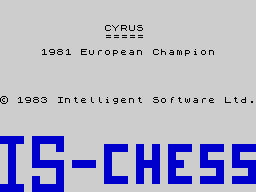
READERS REVIEWS Next time anyone claims that we are a nation of illiterates I'll just let them read your letters! I have never read so much well thought out, individualistic, critical literature. The old saying, 'spoilt for choice' was never so appropriate - perhaps we'll run a special supplement later in the year. For new readers, this feature provides space to air your views on any software, be it for the ZX80, ZX81 or ZX Spectrum. If you've had a good or bad experience of any of the commercial software packages available for your micro, why not write and tell us. Your reviews should contain your critical thoughts about the software and the relevant details concerning the availability of the package, its price, etc. If you can provide any screen dumps to illustrate the review, so much the better. Any reviews published in this section of the magazine will be rewarded with the price of the tape you review. So, if you buy a cassette and send in a review that gets published, you'll get your software for free! CYRUS IS CHESS Intelligent Software P.D. Fiddler Rightly or wrongly, many judge a a computer by its ability to play a good game of chess and every self respecting micro has at least one chess program to offer. Many commercial mainframe computers are not above a quick game of chess either and national pride is put on the line in organised International Computer Chess Tournaments - micros too have their own International Chess Competitions. Several chess programs have been available for the Spectrum for some time, so the appearance Intelligent Softwares Cyrus is Chess program in July accompanied by the slogan "based upon the program which won the European Micro Computer Championship 1981" must arouse some curiosity - especially as it comes with a 16 page User's Manual, and is marketed by Sinclair who already have a chess program in their Spectrum Catalogue. The Cyrus program is designed by David Levy, the Scottish International Chess Master and noted chess computer expert whose programs can be found in several dedicated chess computers. How does the Cyrus program differ from its contemporaries? It is one of the few chess programs that fit into either the 16K or 48K models. Side A of the cassette has two copies of the 16K version whilst side B has two copies of the 48K version with some additional features. Side A (16K) loads in 90 seconds and Side 8 (48K) in 2 minutes. The graphics are clear and they are moved using the cursor keys; a flashing square is moved to the piece to be moved then 'entered'; the flashing square is then moved to the destination square and 'entered' again. The cursor method requires five key movements - the same number as the more usual E2 E4 'ENTER' method - but for some reason the cursor actually moving the pieces seems closer to 'over the board confrontation'. Cyrus has eight playing levels and three problem solving levels (mate in 1 ,'2 or 3) and the approximate times for each level are: Level 1 - 2 secs. Level 2 - 5 sees. Level 3 - 10 secs. Level 4 - 20 secs. Level 5 - 30 secs. Level 6 - 1 min. 15 secs. Level 7 - 3 mins. Level 8 - 5-12 mins. P1, P2, P3 - Computes until 'Mate' found. Levels or sides can be changed during the course of the game and the board can be turned around but of more interest is the fact that the level times are faster than those stated for many 'dedicated' chess computers to be found in the shops - this should mean that you can have a worthwhile game of chess without waiting too long for the computer to reply to your move. The Cyrus program also enables the player to take back moves, up to 80 moves in the 16K program and up to the beginning of any longer game in the 48K version. The 48K program also enables a player to ask the computer to take its move back and play its next best move, then second best move, then third etc. This means that you can 'cheat' but of more importance to the chess enthusiast is the fact that you can use your computer to analyse various openings and positions. In addition by tapping the R key you can ask Cyrus to automatically replay the game for both sides up to the present position, be it a mid-game position or a final mate. This is rather like watching Mastergame on television. In demonstration mode Cyrus will play both sides through a complete game at any preset level and as a bonus there is a Human v Human mode which enables two players to use Cyrus as a chessboard and pieces. This also means that a school or chess club can use Cyrus instead of a demonstration board at a quarter of the normal cost. An impressive list of features - but how well does Cyrus play? On loading, Cyrus automatically sets itself to level 2 (response time 5 seconds). The manual states that the 48K version might be quicker in the opening than the 16K program as it has a larger opening 'book' ie it has been programmed with a larger repertoire of popular openings to respond quickly to anticipated moves. Impressive for a 5 second response! Cyrus, then, can prove a formidable opponent. As a further measure Cyrus was pitted against two dedicated chess computers - Morphy Encore {£140) and Mini Sensory-Advanced (£80) both of advanced design which 'think' in their opponent's time. At approximately the same response levels and playing Black in each case: Cyrus Level 3 defeated Mini-Sensory Advanced Level 2 (29 moves). Cyrus Level 6 had the better of the exchange and was heading for a win endgame against Morphy Encore Level 3 (44 moves). To be fair, Morphy Encore has a lot more reserves to call up having nine levels, including two at tournament level but the fact that Cyrus did so well says a lot for the Cyrus Program and a Mate-in-Three Chess Problem was solved in a very acceptable 3 minutes. One irritating feature of the 16K version is that it does not display the Menu of 15 options on the screen with the chess board but fills up the lower area Of the screen with a rather distracting 'I S Chess' Logo. Playing strengths of the 16K and 48K versions are the same. Apart from the larger opening 'book' and 'menu' display on screen the 48K version offers: (a) The option of using a printer to print every move as it is made, to produce a record after a complete game or to print out the current board position. (b) A game may be saved on tape and re-entered into the computer's memory later. (c) The colours of the screen display can be changed. (d) In problem mode the 48K will display 'NO MATE FOUND' if it cannot solve a problem in the number of moves stipulated. An unusual feature for both the 16K and 48K versions is that Cyrus will announce a DRAW if no pawn is moved or piece captured during a sequence of 50 moves or if both sides move the same pieces backwards and forwards over the same squares three times running. This is in accord with the rules of chess but is a feature not to be found in many other computer chess programs. In conclusion, Cyrus is a strong yet flexible chess program suitable for both beginner and chess enthusiast, even if you already have a chess program for your Spectrum you will be fascinated by this one!
1 - Human: e4, Cyrus: e5 2 - Human: Nf3, Cyrus: Nc6 3 - Human: Bb5, Cyrus: a7 4 - Human: B x c6, Cyrus: d7 x c6 5 - Human: O - O, Cyrus: f3 6 - Human: d4, Cyrus: Ba4 7 - Human: d x e5, Cyrus: Q x d1 8 - Human: R x d1, Cyrus: f x e5 9 - Human: Rd3, Cyrus: Bd6 10 - Human: N(b,)d2 Cyrus: Be6 11 - Human: b3, Cyrus: Nf6 12 - Human: Bb2, Cyrus: Nd7 13 - Human: Ng5, Cyrus: Nc5 14 - Human: Rg3, Cyrus: n6 15 - Human: B x e6, Cyrus: N x e6 16 - Human: Rd1, Cyrus: O - O - O 17 - Human: Nc4, Cyrus: Bc5 18 - Human: Rc1, Cyrus: Rf8
Your Computer #8Aug 1983 · p.514/5
Overall 4/5
16/48K Spectrum Boardgame £9.95 Sinclair Adapted from a competition-winning program by Intelligent Software, Cyrus plays an exceptionally fast and strong game. Fits into 16K with eight levels of play and full board display.
Advert14
- Sinclair User #18Sep 1983 · p.117
- C&VG (Computer & Video Games) #23Sep 1983 · p.89
- Your Computer #9Sep 1983 · p.117
- Personal Computer News #26Sep 1983 · p.61
- Sinclair User #17Aug 1983 · p.41
- Your Computer #8Aug 1983 · p.25
- Home Computing Weekly #25Aug 1983 · p.41
- ZX Computing #8Aug 1983 · p.47
- Personal Computer News #23Aug 1983 · p.61
- Computing TodayAug 1983 · p.43
- C&VG (Computer & Video Games) #22Aug 1983 · p.57
- Personal Computing Today #1Aug 1983 · p.63
- Personal Computer News #18Jul 1983 · p.61
- Home Computing Weekly #20Jul 1983 · p.41
Feature4
- ZX Computing #17Feb 1985 · p.20
- Personal Computer Games #7Jun 1984 · p.36
- Sinclair User #27Jun 1984 · p.51
- Computer ChoiceMay 1984 · p.34
News/Note4
- Your Computer #8Aug 1983 · p.43
- Sinclair User #17Aug 1983 · p.13
- ZX Computing #8Aug 1983 · p.65
- Personal Computer News #10May 1983 · p.13
Review3
- ZX MagazínMar 2001 · p.8
- Home Computing Weekly #24Aug 1983 · p.17
- Popular Computing Weekly #27Jul 1983 · p.49
Licensed from
- ChessBoard/Tabletopunofficial
Related
- Compilations
- Load 'n' Run issue 09, ZX-Spectrum Vega
- Ports
- (Thomson MO/TO)
- Elsewhere
- Centre for Computing HistoryMobyGamesRZX ArchiveThe TipshopUVLSpectrum Computing RZX - YouTube
- Same entry at
- Spectrum ComputingZXInfo
Reviews from people here
Sign in to write about this, or make an account. It takes a minute and lets you correct the catalogue too.
No description recorded.
Sign in to correct or add to this.
Hold the rights to this and want it taken down?