
Cammac 1
Programming: Assembler/Mcode · ZX-Spectrum 48K · 1 players · English
Micro Zeighty · 1985 · Pound sterling 40.00
MIA Missing in action. This is known to have existed, and no copy has ever been found. If you own one, the archives would like to hear from you.
Discussion
Nobody has started a thread about this yet.
Remarks
machine code dis/assembler & monitor - "I can't think of any package worse"
Files and rights
No permission is on record either way. Screens and pictures are copied here on a take-down basis: if you hold the rights and want something removed, say so and it goes.
In the magazines 4
Crash #28May 1986 · p.107
Franco Frey
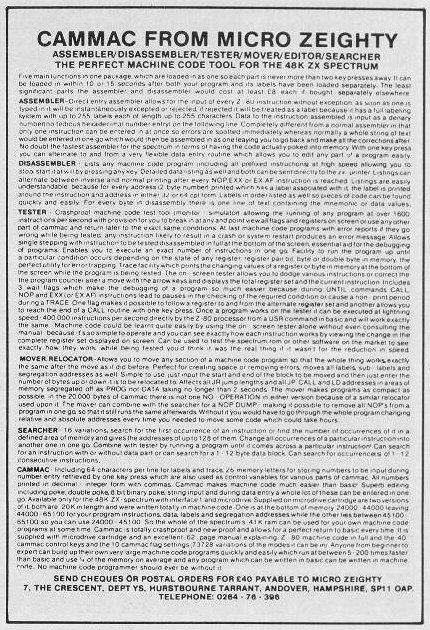
MONTIOR LIZARD I'll turn to another type of monitor now, and the Cammac One package which costs £5.95 from Micro Zeighty of [redacted]. Sadly, this is not a package that I can recommend. Cammac One is a large program, mostly written in ZX BASIC, which allows you to assemble, disassemble and monitor Spectrum machine code. The program takes up about 24K of memory, leaving 17K for code and data. The documentation - a piece of A4-sized paper - discusses the package under three headings: the assembler, the disassembler, and the tester/monitor. All three parts are called up with a BASIC GO TO command. If you accidentally type RUN you'll wipe out all the variables and you'll have to reload the whole package. You enter assembler instructions in response to a normal Spectrum INPUT statement - there is no prompt. In fact, there are no prompts or menus anywhere in the package. There's no error trapping, either. If you make a mistake, or type something you shouldn't, the program either ignores you, generates an instruction 'similar' to what you typed (!), or halts with a BASIC report. A beep greets instructions which are recognised; the line is then printed on the main part of the screen. If your chosen instruction has a parameter - a value or an address you must type it in separately. Labels are not allowed. Nor are equates. The assembler just ignores both. If you are so bold as to try to use one of the few hundred instructions that require a prefix byte you must warn Cammac first - each and every time or your input is ignored. The disassembler, accessed with GO TO 5, is the fastest part of the package; it takes about three seconds to fill the screen with data, before pausing with the usual Scroll? question. Instructions are only partially disassembled - the program prints N or NN in place of parameters, followed by the appropriate values spread over up to three lines. The tester/monitor turns out to be a routine that prints register values and a single sort-of disassembled instruction over the top of anything else on the screen. Every couple of seconds a black square appears, and the next instruction may be executed (with appropriate changes to the display) when you press a key. You can't alter register values or set breakpoints. If you want to load, save, display memory values, or jump to an address you have to Break into the monitor and use ZX BASIC as normal. You can step over instructions more quickly, without the display, with a RAND USR call from BASIC. Cammac One is non-standard, unreliable, slow and inadequately documented. Micro Zeighty describe Cammac One as 'one of the best machine code packages around'. Don't believe them - I can't think of any package worse.
Advert2
- Your Sinclair #2Feb 1986 · p.84
- Your Spectrum #20Nov 1985 · p.60
Review1
- Popular Computing Weekly #51Dec 1985 · p.18
Reviews from people here
Sign in to write about this, or make an account. It takes a minute and lets you correct the catalogue too.
No credit, tag recorded.
Sign in to correct or add to this.
Hold the rights to this and want it taken down?