
Clever Clogs - Blockbuster
General: Education · ZX-Spectrum 48K · 1 players · English
Computer Tutor · 1984 · Pound sterling 7.95
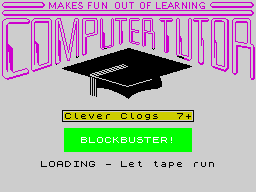
Discussion
Nobody has started a thread about this yet.
Play
- CleverClogs-Blockbuster.tzx.zipTape image English19 KB
Files and rights
No permission is on record either way. Screens and pictures are copied here on a take-down basis: if you hold the rights and want something removed, say so and it goes.
Scores
In the magazines
- Crash #241986 · Overall6/10
In the magazines 27
Crash #24Jan 1986 · p.1386/106/10
Overall 6/10
Rosetta McLeod 6/10
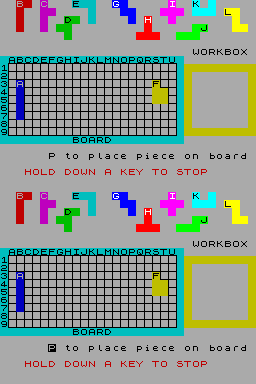
CRASH COURSE Rosetta McLeod A LITTLE LEARNING LESSON FOR THE FESTIVE SEASON? This month, with the help of a panel of children, Crash Course looks at some Chrismtas Crackers! First of all, though, there is some good news on the educational front. A new organisation, British Educational Software Associates, has recently been set up to improve the availability and distribution of educational software. Eight firms (ASK, Bourne, Calpac, Collins, Griffin, Hill MacGibbon, MacMillan and Widgit) have formed this new marketing consortium to help selected retailers service a market which, according to Roy Davey, marketing director of Collins Soft and Hill MacGibbon, is 'diffused and frustrated'. He feels, quite rightly, that schools have difficulty in finding a retailer who offers a good choice of software together with a fast ordering service, and who allows the customer to view programs before purchase. BESA has now appointed 200 retailers throughout Britain who will stock a 'core list' of 40 programs and will be able to meet orders for other titles from some 250 in the catalogue within 48 hours. Support for retailers will be handled by Proteus, the leading educational software distributor. This is a very welcome move, both from the point of view of schools and of home users. Up till now, most of the high street stores have paid only lip-service to the area of educational software, and it is hoped that the promotion of BESA in local newspapers and in information hand-outs to schools will begin to rectify matters. If the experiment proves successful, the consortium would hope to expand in 1986. More information about BESA can be obtained from BESA at [redacted]. But now on to this month's software selection, I asked a panel of children, ranging in age from 7 to 13 years, to look at the programs with me, and to decide whether or not they'd like to get the games for Christmas. Each game was awarded a score out of 10. BLOCKBUSTER Producer: Argus Press Retail Price: £7.95 Age Range: 7 and over Author: Computertutor (Clever Clogs Series) Blockbuster (not to be confused with the popular TV quiz game) is a puzzle 'with a million billion variations'. The child has to make a rectangle out of 12 different blocks which appear on the screen. The screen itself is divided into three pans. At the top is the STORE where the blocks are displayed before being used: on the right is the WORKBOX where the blocks can be rotated before being positioned on the board; and to the left is the BOARD marked with a grid where the rectangle is to be made. The game is very good for developing skills of spatial awareness, and there is also the option of playing it in its quiz version. If you get 12 questions correct, you are given a complete solution as to the creation of the rectangle. As with all the programs in the Clever Clogs series, pressing CAPS SHIFT/Q takes you to a secret Parents' Page, and enables you to reset the questions. Another useful and flexible game. COMMENTS Control keys: P to place a piece on the board, M to move a piece to the workbox, S to move a piece back to the store, Q to end the game. CAPS SHIFT/Q to reset the questions Keyboard play: very responsive Use of colour: bright and clear Graphics: simple but effective Panel's comments: we thought it was a reasonably good game, but it would be better for schools rather than home use.
Sinclair Programs #23Sep 1984 · p.28
June Mortimer
CAN YOUR SPECTRUM TEACH YOU ANYTHING? What can we learn from the Spectrum? We review the educational software on the market. The Spectrum has great potential as an educational machine. When programmed correctly it knows all the right answers, it is never impatient and it combines the fun of a games computer with serious lessons. It is, therefore, not surprising that more and more educational programs are being produced. The problem, for teachers and pupils, is that these programs are, in many cases, being produced for the wrong reasons. Some manufacturers believe that the current enthusiasm for computer games cannot last, and that when the last games company goes under the educational companies will be selling more than ever before. Other manufacturers believe that the Spectrum will sell better and that they, therefore, will have a wider market, if parents see it as an educational machine which will be good for their children. Software written for these reasons, rather than by teachers who need it, suffers from various flaws. Simple games such as Hangman, which would no longer sell in their own right, are marketed under the dubious claim that they are educational. Programs are presented as being suitable for young children simply because older children find them boring. There is a general inability to understand how children learn, and what they are capable of doing at different ages. HIGHER STANDARDS At the other end of the educational range the standard is much higher. Programs aimed at 0-level and A-level students achieve their aims well, and the programmers seem to have a much clearer idea of what they are doing. General interest educational programs, that is those aimed not at pupils but at those studying a subject by choice, are also of a high standard, perhaps because they are written by people who are, themselves, enthusiasts. The Clever Clogs range of programs is produced by Argus Press Software for children aged from three to ten years old. Shipshapes is aimed at children from three upwards and is intended to teach shape recognition to this age group. There are some points which even those who have not met a three year-old since they were three themselves would consider essential to a program catering for this age group. Do not include long words. In fact, do not include words at all, as the vast majority of three year olds cannot read. Error trap the program so that pressing the wrong key does not result in the program stopping, or in an unexpected result. Make all shapes bright and bold, and avoid confusing ambiguities. Shipshapes falls down on every one of these points. For a start, there are a large amount of written instructions, including words such as "rectangle". Glaringly obvious at the beginning of the program is "Let's" , written without the apostrophe. The program is in Basic, and is not error-trapped, so pressing the wrong keys could quickly break a child out of the program. When shapes do appear to be identified they are very small, and so arranged that it is not immediately clear whether you are supposed to be identifying these small shapes, or the pattern which they are forming. Next from Clever Clogs is Sam Safety, for children aged five and upward. This program is designed to teach road safety. The aim is to guide your character around town, crossing roads safely, and picking up prizes where possible. To keep your prize you must identify a road sign correctly. The animation makes this an enjoyable way of learning road safety, although it is extremely slow and the machine-code action promised on the cover fails to materialise. It would be important , though, to impress upon children that the aerial views shown on screen should be identified with real traffic lights, subways and bridges. PITCHED TOO HIGH The questions on road signs appear to be pitched at a rather older age group than 5+, for knowledge of road signs is likely to be of little use to children until they can ride bicycles on the road. The way in which the questions are presented is probably not the best way of teaching recognition of these signs. Multiple choice questions are fair enough, but when some of the answers are amusing, it is all too easy to remember the wrong, but amusing answer, and forget the correct answer. Music, also in the Clever Clogs range, is aimed at seven year olds and over. It falls down, as do all music programs for the Spectrum, firstly because the Spectrum's BEEPs have very little to do with good music and, secondly, because the Spectrum keyboard is not sufficiently like that of a piano to make simulation practicable. The program allows tunes to be played or composed, but all but the most enthusiastic computer users would learn more by spending time with a tin whistle and manuscript paper. Blockbluster, which is aimed at children of seven upwards, is the most enjoyable program in the Clever Clogs range. A variety of different shapes are displayed on the screen, and these must be put together to form a rectangle. Shapes can either be placed as they are, reversed or turned around. Children can also complete a simple general knowledge test in order to see a possible solution to the puzzle . Strangely, the questions used in this test seem to be aimed at children of a lower age than those who will be reading the instructions for the program. Children who can read words such as "initial" in the program introduction are likely to have little difficulty in answering questions such as "2+2+1". Fun to Learn is produced by Shards Software for children aged between 6 and twelve. It is menu-driven, and divided into five different sections. The first provides a series of letters to be counted, the second produces an anagram to be unscrambled, the third performs simple calculations, the fourth is a form of hangman, and the fifth a codebreaker game. VERY SLOW-MOVING The program as a whole is very slow-moving, and demands that the user press keys frequently. The graphics are very limited. More importantly, each section is a simple program, none of which is particularly well presented. The worst presented is the calculator section, in which very simple calculations are presented in a long winded and unconventional way which would probably confuse most children. Fractions 1 from Kemsoft forms an introduction to the learning of fractions. It explains fractions clearly, if rather briefly, and then moves on to worked examples and test questions illustrated by clear graphics. The program is clearly designed to be used at home or in a classroom where there is a teacher or parent present to help in cases of confusion. Again, the program is slow-moving, especially in the production of graphics. It is also written in Basic, and therefore easy for a pupil to break into or stop. Penguin Study Software produce a range of programs for studying the Shakespearean plays. These must be used in conjunction with a copy of the plays in book form, and form a large data base in which various sections can be cross-referenced. In each program there are a largo number of headings, covering both characters and themes within the play, which can be used. Under each heading are a group of references to the play, and comments upon it. Information provided can be combined by the user in a variety of different ways, to show interrelationships between characters and themes which would not normally be obvious. This range of cassettes make excellent use of the Spectrum as database, and would provide opportunity for study at home for those studying Shakespeare for O or A level. They provide clear, precise help in essay writing, without acting as a crib. While many educational programs are aimed at those in schools or colleges, a significant amount of them are aimed at enthusiasts who wish to study a subject in their spare time. An example of this is Th e Complete Machine Code Tutor , which is produced by New Generation Software. The two cassettes contained in this package have different programs on each side, and are subdivided into a series of lessons designed to teach machine code to complete beginners. Each lesson contains text covering one area of machine code, and then a worked example which can be viewed as many times as the student wishes and also changed by the student in order to check that the concept explained has been fully understood.. Machine code is a difficult subject which cannot be learned in the abstract, as trying out examples at every stage is essential. For this reason the Machine Code Tutor is good, for it takes the student steadily through a course. Despite the importance of worked examples, there is also a very large amount of text to be studied in any machine code course. None but the most enthusiastic computer buffs can claim to enjoy reading large amounts of text from the Spectrum screen, but reading from the screen is just what you are required to do in this program. It is to be hoped that later editions of the Machine Code Tutor will contain an accompanying booklet, which can be studied in conjunction with the information displayed on screen.
Advert20
- Sinclair Programs #31May 1985 · p.58
- ZX Computing #18Apr 1985 · p.30
- ZX Computing #17Feb 1985 · p.31
- Your Computer #12Dec 1984 · p.130
- Home Computing Weekly #92Dec 1984 · p.41
- ZX Computing #16Dec 1984 · p.39
- Sinclair Programs #26Dec 1984 · p.42
- Home Computing Weekly #87Nov 1984 · p.47
- ZX Computing #15Oct 1984 · p.26
- Home Computing Weekly #85Oct 1984 · p.17
- Home Computing Weekly #83Oct 1984 · p.31
- Home Computing Weekly #80Sep 1984 · p.24
- Home Computing Weekly #65Jun 1984 · p.10
- ZX Computing #13Jun 1984 · p.80
- Your Computer #6Jun 1984 · p.114
- Home Computing Weekly #61May 1984 · p.24
- Home Computing Weekly #62May 1984 · p.15
- Home Computing Weekly #59Apr 1984 · p.47
- Home Computing Weekly #57Apr 1984 · p.27
- Home Computing Weekly #56Apr 1984 · p.25
Review2
- Home Computing Weekly #75Aug 1984 · p.6
- Home Computing Weekly #70Jul 1984 · p.19
Offer1
- ZX Computing #19Jun 1985 · p.90
Feature1
- Sinclair Programs #23Sep 1984 · p.28
News/Note1
- ZX Computing #14Aug 1984 · p.39
Related
- Versions
- MCoder II (Authored with)
- Tags
- Clever Clogs
- Same entry at
- Spectrum ComputingZXInfo
Reviews from people here
Sign in to write about this, or make an account. It takes a minute and lets you correct the catalogue too.
No credit, description recorded.
Sign in to correct or add to this.
Hold the rights to this and want it taken down?