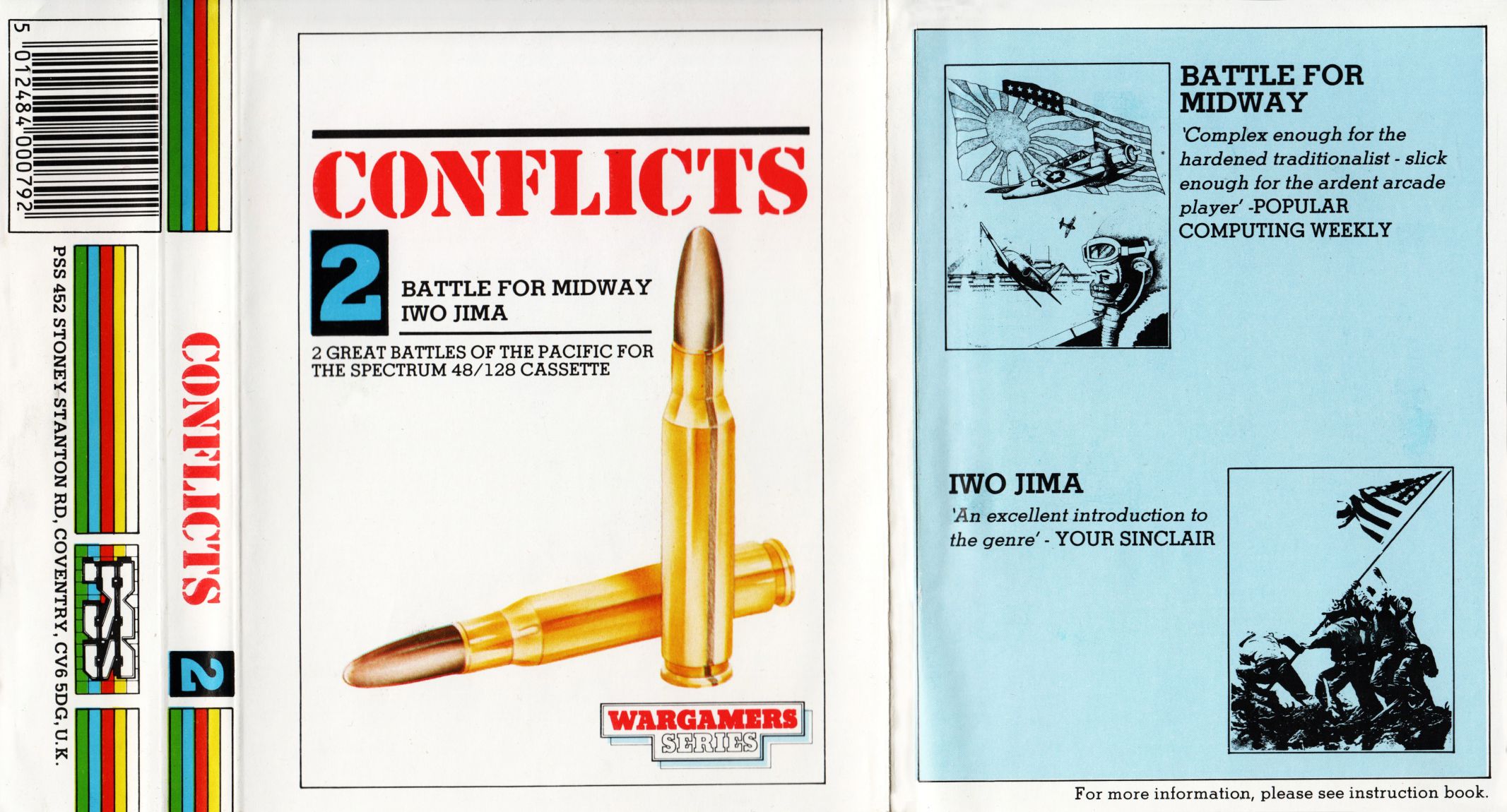
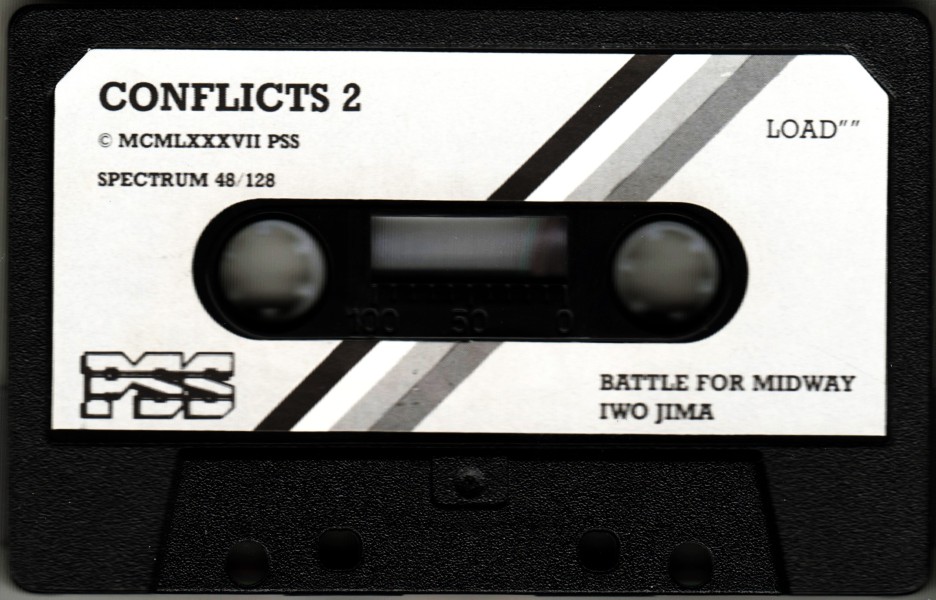
Conflicts 2
Compilation · ZX-Spectrum 48K · 1 players · English
PSS · 1987 · Pound sterling 7.95
Conflicts, 2 of 2
Discussion
Nobody has started a thread about this yet.
Play
- Conflicts2.tzx.zipTape image English34 KB
Documents
- Conflicts2.txtInstructions English19 KB
- Conflicts2(EN).pdfInstructions English977 KB
Files and rights
No permission is on record either way. Screens and pictures are copied here on a take-down basis: if you hold the rights and want something removed, say so and it goes.
Scores
In the magazines
- Sinclair User #671987 · Overall6/10
- Your Sinclair #201987 · Overall6/10
In the magazines 7
C&VG (Computer & Video Games) #79May 1988 · p.514/102/103/103/10
Graphics 4/10
Realism 2/10
Playability 3/10
Value 3/10
Paul Boughton
MACHINE: Spectrum SUPPLIER: Destiny Price: £8.95 REVIEWER: Paul Boughton Okinawa has already appeared as part of a games compilation from PSS, Conflicts 2, so putting it out by itself, even at so low a price, is a bit of a mystery. This is the same "amphibious forces invade an island" format as the nearly identical Falklands 82 and Iwo Jima. Only this time the island is the gateway to Japan, Okinawa, captured by United States Marines and Army forces in April 1945. The player takes the American side against the computer, using a joystick to select simple options for his troops to land, move and fire against a virtually static enemy. Like its cousin, Okinawa is for young children who like simple games with lots of sound effects and screens flashing, and aren't worried about the quality of the graphics. Anyone else will find it too simple-minded to give much enjoyment. And any serious wargamer who has met the earlier, related games would never buy it anyway. PSS now put out such a wide range of wargames, including games which are a lot better than this.
Sinclair User #67Oct 1987 · p.636/106/10
Overall 6/10
Gary Rook 6/10
Label: PSS Author: In-house Price: £9.95 Memory: 48K/128K Joystick: various Reviewer: Gary Rook This time around, you get Battle for Midway and Iwo Jima on on cassette. Both battles are set in the Pacific during WWII. Battle for Midway is great but Iwo Jima isn't. In the first you control the American fleet. You know there's a Japanese task force, full of aircraft carriers, steaming towards Midway island, where you have an air base. But you don't know where it is you have to find the enemy, and then bring your own ships - including your aircraft carriers - within range and give 'em hell. It's an excellent game. I wish I could say the same about Iwo Jima, but I can't.. You control the US marines storming ashore on the little island of Iwo Jima towards thousands of fanatical Japanese soldiers hidden in almost impregnable fortification. After the initial landings, you find yourself pinned down turn after turn... After a while, it's a pain in the rear achelons. Conflicts 2 is one really good game and one that's a bit of a snooze.
C&VG (Computer & Video Games) #72Oct 1987 · p.185/105/106/106/10
Graphics 5/10
Sound 5/10
Value 6/10
Playability 6/10
Steven Badsey
MACHINES: Spectrum/CBM 64 SUPPLIER: PSS PRICE: £7.95 (cass) Spectrum/£9.95 (cass), £14.95 (disk) CBM64 Like Conflicts 1, the second compilation is also available in different versions. Along with Battle for Midway the Spectrum version has only Iwo Jima, a game using the same mechanisms, and of the same quality, as Falklands 82. The CBM64 version also includes a completely new game, Okinawa. However, as the instruction book admits, this is only another version of Iwo Jima with a different terrain map. Perhaps the best way to describe these two games is as slow-moving shoot-em-ups. Battle of Midway, however, is one of the best wargames that PSS have so far produced, despite being over two years old. The player take the American carriers against the computer in the first decisive naval battle of World War Two fought without the two sides ever seeing each other. Everything depends on the ability of the American search planes to find the Japanese carriers and launch an air-strike first. The game includes a training option, a regular game in which the Japanese follow their historical course, and a "trap" scenario in which they suddenly appear with more than twice the number of carriers they are supposed to have. This is an almost perfect mid-level of difficulty game, it can be played in about 20 minutes without getting bogged down in details, but is close enough to the real event to be exciting. If you can't get Battle of Midway by itself the compilation is worth it for this game on its own.
Crash #44Sep 1987 · p.50
Philippa Irving
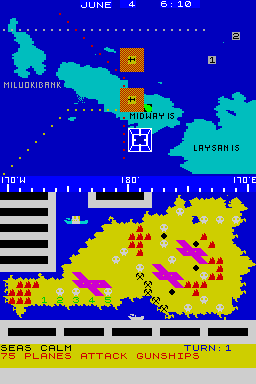
FRONTLINE With Philippa Irving HITTING THE HARD STUFF Some computer games are junk food for the mind: strong in flavour, instantly palatable, but empty of nutritional content. They can be dangerous because they provide such an instantaneous, direct and easy stimulus. They also give you interaction without the presence of another human being, and can act as a painkiller for loneliness. The right kind of mind can be absorbed by the simplest of addictive games for hours, but it's empty enjoyment. On the other hand, I feel refreshed after emerging from the depths of a good adventure. Adventures don't give your mind the same moment-by-moment input as the addictive arcade games; there are long moments of staring out of the window, reloading a saved position for the seventeenth time after yet another unexpected death and contemplating maps in bitter frustration. But when you're playing an adventure you're letting your mind stay awake and work independently, rather than turning yourself into a jellied mass of nerves whose purpose in life is to move as quickly as possible to the right or to the left. Strategy games strike a balance. Adventures aren't really addictive in the usual computer-gaming sense, because they're too much on a literary plane: the player types in words, which makes him continually aware of the separation between himself and the game. But it is possible to get lost in the 'game reality' of a fast-moving wargame while pursuing a cogent strategy. And despite my misgivings about excessive indulgence in computer games, there's no doubt that the basic quality of addictiveness is an essential ingredient of any good piece of software. CONFLICTS 2 Producer: PSS Retail Price: £7.95 In Issue 42 I looked at the first three-game volume of this compilation series; Conflicts2 has only two games, both set in the Pacific theatre during the Second World War. Battle For Midway deals with a surprise attack by the Japanese fleet on the American Midway Island air base, and the ensuing battle. The Americans won an overwhelming victory, largely because they'd broken the radio codes of the Japanese and were aware of their plans. The game's demanding victory conditions tailor it to this historical success; the player must take the American side, and to win he has to destroy more than two Japanese aircraft - earners for every one of his they take out. It's neither sophisticated nor satisfying. The player has command of two task forces and two squadrons of aircraft. Attack aircraft can be launched from the Midway air base, and from the fleets as long as the aircraft carriers survive. These units are moved around the sea surrounding Midway Island in a fairly aimless way, waiting for one of the Japanese fighting units to come into sight. When that happens, a task force or an air-attack squadron can move into intercept the Japanese; this involves positioning the player's unit next to the Japanese one, and watching a short tacky animation of planes swooping over a panorama of ships. The player is provided with movable sights and the ability to fire, but this seems to have no effect on the outcome of the battle. There are three levels of difficulty and six speeds to choose from (none breakneck), and occasional excitement is injected by surprise Japanese air attacks. Battle For Midway is competently enough presented, complete with lists of the ships, but it lacks all atmosphere. I found it difficult to make sense of the gameplay, and there's no scope for interesting tactical play. Sadly, the same has to be said for Iwo Jima. This game recreates the battle for that island south of Japan, which was of strategic importance for American air missions. It was the first time in the war the Americans had really come up against the fanaticism of the Japanese army. And though the American superiority in numbers guaranteed victory, the 22,000 Japanese soldiers defending the island held out to their last 216 men and the Americans losses were enormous. The screen display is reminiscent of Falklands 82, as are the orders system and gameplay. A garish picture of Iwo Jima shows a few landscape features and five landing positions. The player, taking the American side, deploys his forces by landing units on the island and moving them inland. The orders are dealt with in a rotation sequence, and in each turn units have the choice of moving or attacking. The Japanese forces don't come into view till the player's units are within five squares of them. Iwo Jima has most of the features of a conventional wargame - hidden movement, terrain effects, and basic statistics for each unit which affect combat - but it's very poorly presented. Still, the gameplay is much more entertaining than Falklands '82; after I'd spent a frustrating morning trying to get something out of Battle For Midway, Iwo Jima had me absorbed, in a simplistic sort of way, for an afternoon. But it looks like a budget game and should probably be one, let's hope Conflicts 3, which PSS says will be released in the late autumn, will be better than this compilation.
Both sides lost thousands at Iwo Jima, one of the two World War II Pacific battles featured in Conflicts 2.
You're defending the crucial Midway air base in Conflicts 2 - and history had better repeat itself.
Your Sinclair #20Aug 1987 · p.746/106/106/10
Overall 6/10
Audrey Bishop 6/10
Owen Bishop 6/10
FAX BOX Title: Conflicts 2 Publisher: PSS Reviewer: Owen Bishop, Audrey Bishop A game that takes you to the blue, blue Pacific to see how Uncle Sam helped win the war in the east. Though both games are set in the same area and in the same period, they couldn't be more different! BATTLE FOR MIDWAY Battle For Midway is all about a battle that marked a turning point in the war in the Pacific - it was the first time the Japanese suffered a major defeat. The game captures much of the atmosphere of steaming steadily ahead for hour upon hour, scanning the horizon for distant battleships. Or you may be patrolling the skies keeping a weather eye open for those tell-tale signs of Japanese shipping. Then, suddenly out of the blue, there's a Japanese naval force ahead, or a bunch of bombers, and the action begins. Before you've had time to do much about it, the action is over and you're left to clear up the damage. Much of the Pacific war was like this and this game a fair simulation (apart from no radar).But does this make it a good wargame? We reckon not. In practice, the tactical element is too slight, as you only have ten units to control. Once you've given these their orders, there's nothing much to do except wait for the Japs to attack. The action comes in the form of arcade screens, which aren't optional. Your success in this game depends too much on dexterity and not enough on brainpower. If the flat-top is your scene, or perhaps if you long for a change from foot-slogging, Midway could be worth a try. We were glad to return to dry land! IWO JIMA The other game on this tape, Iwo Jima, employs much the same system as Falklands 82. The aim is similar too - you have to land on and capture an island. Iwo Jima, a tiny volcanic island, was heavily fortified by the Japanese. Lying 700 miles from Japan, it was on the track of the US bombing raids, and used as a forward base for fighter attacks against the bombers. In the hands of the Americans, it would become an important air-base for hammering home the ever-intensifying bombing of Japan. This was a bitter, hard-fought battle, one of the costliest in human lives of the whole war. For months the Japanese had fortified the island, digging out tunnels and gun positions in the solid rock. In the game, as in real life, the Japanese units are invisible until they reveal themselves by attacking. They remain firmly in their secure bunkers and are very difficult to eliminate. We played the game following the historical sequence, landing near Mount Suribachi, advancing across the island to cut it off and attacking the mountain fortifications fiercely. Then we captured the airfield and advanced along the north shore. We won in the end, but only after a hard struggle. There's plenty to do in this game, and the simple three key control system helps keep the game (and the Marines) moving. Battle for Midway: 5/10 Iwo Jima: 7/10 Total: 6/10
Iwo Jima
News/Note2
- Popular Computing Weekly #22Jun 1987 · p.53
- Popular Computing Weekly #24Jun 1987 · p.53
Contains
Related
- Ports
- (Commodore 64)
- Tags
- Wargamers
- Same entry at
- Spectrum ComputingZXInfo
Reviews from people here
Sign in to write about this, or make an account. It takes a minute and lets you correct the catalogue too.
No credit, description recorded.
Sign in to correct or add to this.
Hold the rights to this and want it taken down?