
Dark Star
Arcade Game: Shoot-em-up · ZX-Spectrum 48K · 1 players · English
Design Design Software · 1984 · Pound sterling 7.50
DarkStar, 1 of 2
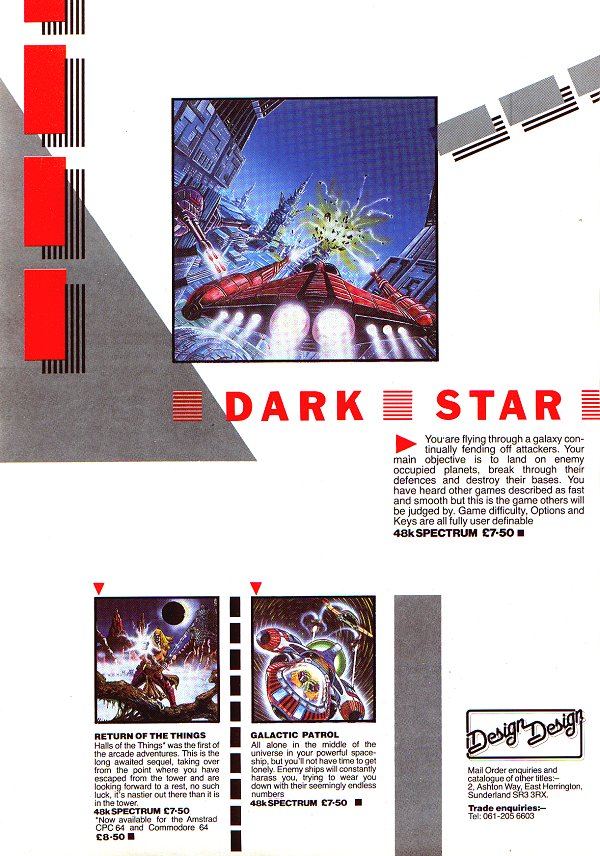
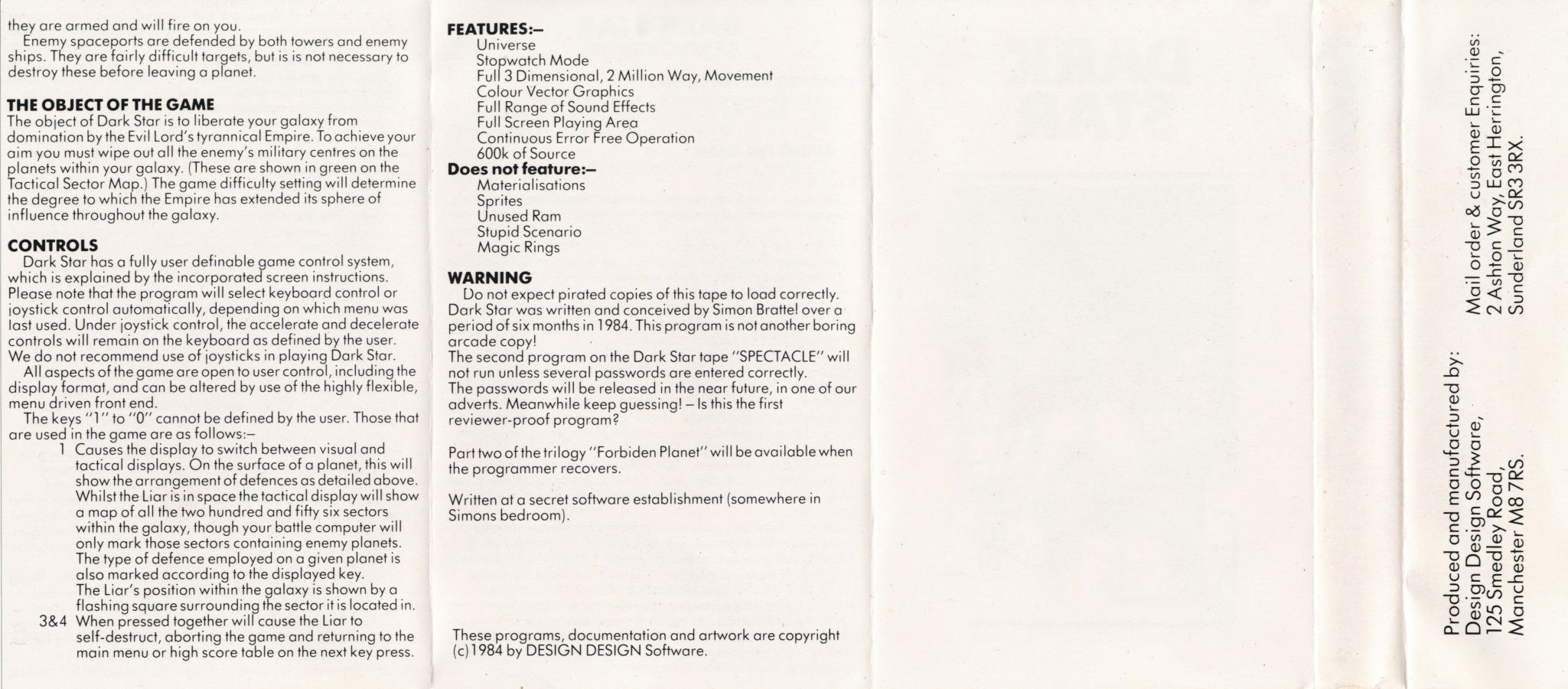
_Back.jpg)
.jpg)
.jpg)
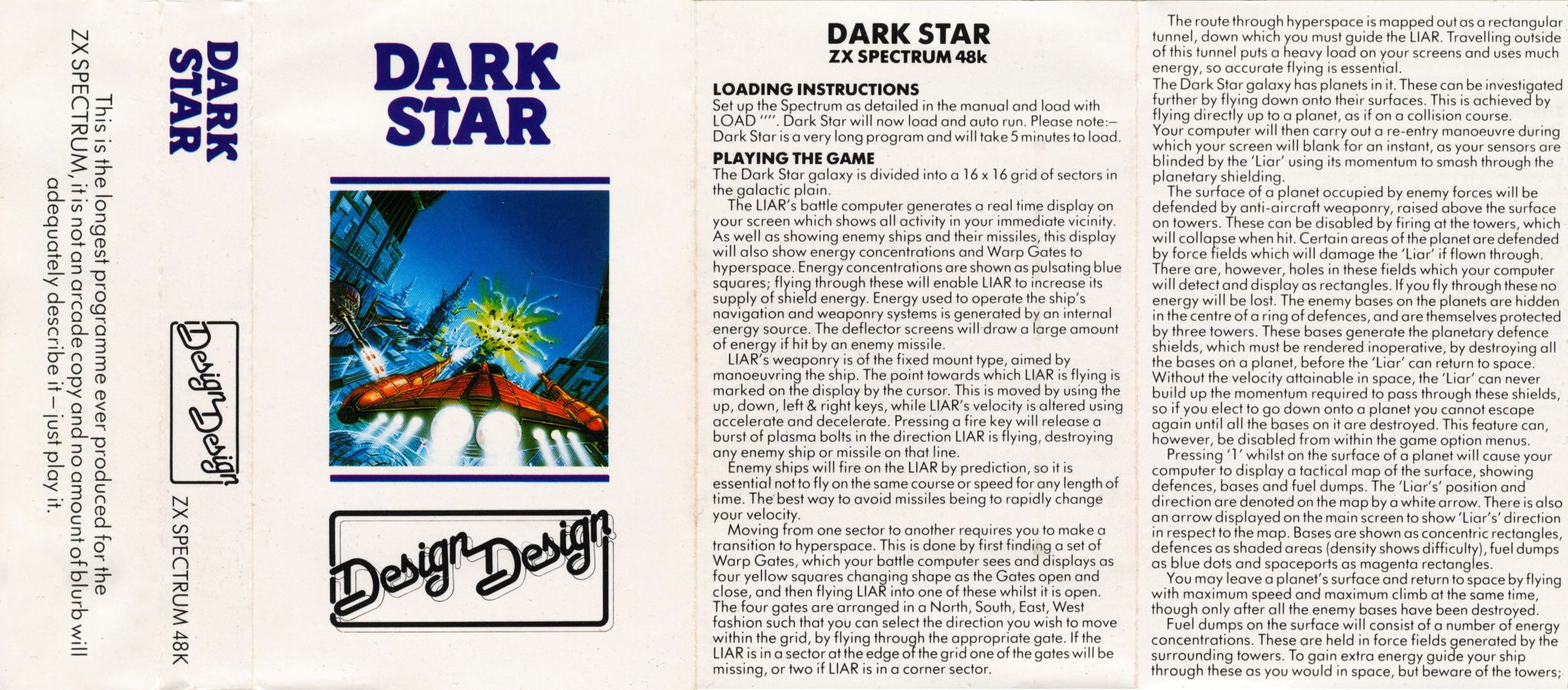
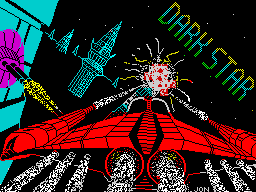
_Media.jpg)
Discussion
Nobody has started a thread about this yet.
Remarks
Came with a password protected {Spectacle|Design Design Software|0009269} as bonus.
- Control Option
- Redefineable keys
Releases
- 1984Design Design SoftwarePound sterling 7.50
- 1984ComseSpanish peseta 1600.00
- 1985Firebird Software LtdPound sterling 1.99
- 1988MCM Software S.A.
Play
- DarkStar.tzx.zipTape image English82 KB
- DarkStar.tap.zipTape image English24 KB
- DarkStar(FirebirdSoftwareLtd).tzx.zipTape image English24 KB
- DarkStar(MCMSoftwareS.A.).tzx.zipTape image English24 KB
- DarkStar.pzx.zipTape image English82 KB
Documents
- DarkStar.txtInstructions English10 KB
- DarkStar(MCMSoftwareS.A.).pdfInstructions Spanish15 KB
Other files
- Dark Star (1984)(Design Design Software).pokPOK pokes file 0 KB
Files and rights
Distribution permission is on record, granted to another archive rather than to this one. Screens and pictures are copied here; everything else links to the archive that holds it.
- AllowedDesign Design Software → WorldOfSpectrum
- AllowedFirebird Software Ltd → WorldOfSpectrum
Credits
- Simon Brattelcredited
- Neil Mottersheadcredited
- Graham Staffordcredited
- Jon Ritmancredited
- Dave De LeuwInlay/Poster Art
Sign in to credit somebody, or say what these people did.
Awards
Scores
In the magazines
- Sinclair Programs #261984 · Rating68%
- Crash #111984 · Overall89%
- Personal Computer Games #131984 · Overall8/10
- Personal Computer News #841984 · Overall10/10
- Sinclair User #691987 · Overall8/10
Elsewhere on the web
- WorldOfSpectrum 37 votes7.97
In the magazines 32
Sinclair User #69Dec 1987 · p.578/108/10
Overall 8/10
Chris Jenkins 8/10
Label: Firebird Author: Design Design Price: £1.99 Memory: 48K/128K Joystick: various Reviewer: Chris Jenkins Nowt to do with the ace science-fiction film of the same name, Dark Star is in fact a 1984 vintage Design Design zapper. A cross between the traditional Star Trek defend-the-universe-which-is-conveniently-divided-into-squares game and more modern efforts like Starglider, Dark Star features fast animated wire-frame graphics. The aim is to speed through the a starscape soaking planets to land on, then knock out all the defences, using your scanner to locate powerplants, gun emplacements and refuelling towers and blasting them to fragments. Dark Star is best played entirely with the keyboard. Fast, colourful and entertaining, well worth searching out.
Your Spectrum #11Feb 1985 · p.513/5 HIT2/5 HIT3/5 MISS
Dave Nicholls 3/5 HIT
Roger Willis 2/5 HIT
Ross Holman 3/5 MISS
JOYSTICK JURY All the latest software from around the houses! Passing judgement this month are Dave Nicholls, Ross Holman and Roger Willis. Our regular crew of software screw balls are in fine form this month. Draining the dregs of Christmas spirit are Dave Nicholls, the hairy hacker; JSW champion Ross Holman; and our own two-wheeled terror, Roger Willis. Just in case you find our scoring system too confusing, here's what it's all about. The score out of five at the end of each person's review is based on their own experience of the game. But that's pretty subjective... so, they also use the HIT and MISS system to indicate its potential as a commercial success. DARK STAR Design Design £7.50 Dave: Design Design has taken vector graphics to a stage where the speed of the game is limited by players' ability rather than hardware restrictions. The game itself is basically a derivative of the Star Wars arcade game, with the trench section missing. Your task is to rid the universe of nasties by flying your spacecraft, called the Liar, through the galaxy and down on to occupied planets where you have to destroy the enemy bases: these consist of defensive rings of towers that must be shot or dodged. Planets can have more than one base; in fact, some planets also have spaceports and energy dumps on them. Spaceports don't have to be destroyed, but the energy dumps replenish your energy supplies and become vital after a while as there are 256 sectors to clear! Dark Star has a very versatile menu system allowing the game to be customised; for example, the speed and accuracy of the alien weapons (as well as the keys used to control the Liar) can all be changed to suit your own requirements. Unfortunately, after the novelty of the blindingly fast graphics has worn off, the game becomes rather repetitive and loses most of its appeal. Hopefully Design Design's next offering will be a game instead of a programming exercise.
C&VG (Computer & Video Games) #40Feb 1985 · p.449/107/108/109/10
Graphics 9/10
Sound 7/10
Value 8/10
Playability 9/10
MACHINE: Spectrum/keyboard or joystick SUPPLIER: Design Design PRICE: £7.50 The blurb for Dark Star claims that it is the longest program ever written for the Spectrum. I can well believe it - the game takes around five minutes to load. No super flash loaders here! It's well worth the wait. Once you delve into the Dark Star galaxy, you'll be hooked. The scenario is simple. You are in control of the Liar, a heavily armed space ship, on a mission to liberate the Dark Star galaxy from the Evil Lord's tyranny. To succeed, you must wipe out all the Evil Lord's bases on planets within the galaxy. You fly around planet-hopping and zapping through hyper space gates to jump from sector to sector blasting the bases and fighting off attacks from enemy space ships. You fight in space and across the surface of occupied planets - so you begin the game flying through space. A Tactical Sector Map displays the whereabouts of the enemy bases. You can call up the map at any time. It shows the position of your ship and the military installations - and is a really pretty bit of graphic programming! The map also has an amusing information read-out about the planet you are flying over - with details of atmosphere a comments like "Even wetter than Manchester" or "Hate it!" Great stuff. Your job is simply to shoot up the enemy installations and then get off the planet to resume your quest for ultimate liberation. The real joy of this game is the extensive user definable menu which allows you change virtually every aspect of the game to suit your moods. You can change the screen display, sound effects, skill levels and keyboard controls. Talk about user friendly! The graphics are simple but extremely effective. The 3D star field - with planets and stargates whizzing by - is very pretty. I sat and just watched it for ages! If you get your hands on one, try switching to wide-angle mode and sitting in a dark room. You'll think you are on the bridge of the USS Enterprise. Try pressing the accelerator button at the top. A real visual treat. Dark Star is the first part of the "Forbidden Planet" trilogy. I'm waiting with interest for part two.
Crash #11Dec 1984 · p.97Crash Smash100%88%86%89%85%87%89%
Use of Computer 100%
Graphics 88%
Playability 86%
Getting Started 89%
Addictive Qualities 85%
Value For Money 87%
Overall 89%
Unknown
Unknown
Unknown
Producer: Design Design Memory Required: 48K Retail Price: £7.50 Language: Machine code Author: Simon Brattel It's taken quite a while between previewing Dark Star and reviewing it. Much of this has had to do with the fact that programmer Simon Bratell kept fiddling with the game, making it faster and faster until now it must surely win the accolade as the fastest Spectrum graphics ever. It would be a mistake to assume that this wire frame game is a copy of the popular arcade machine game 'Star Wars', because although it resembles it in some respects, it differs a lot in many important ways and, in any case, it was designed long before 'Star Wars' appeared in the arcades. Anyway, onto the game. The Dark Star galaxy is divided into a 16 by 16 grid of sectors in the galactic plain. All the spurious blurb which gets you going is very detailed and well worth avoiding, best to dive in through the fabled front end which has been user defined out of existence! Selecting 'instructions' on screen is much better - it says, 'Fly around the universe. If it moves shoot it. If it doesn't shoot it anyway. If it's square fly through it!' Keys for control are left, right, up, down, accelerate, decelerate and fire, any of which may be used on any key or all the same one if you like. Anyway, onto the game. There is a sort of adventurish and strategy overtone to Dark Star in as much as you are trying to clear the place of alien forces. The action takes place over three different areas, deepest space, hyperspace (accessed through Warp Gates, which are rotating yellow squares) and on the surface of numerous planets. When the planets in a sector of space have been cleared of aliens, using a Warp Gate will take you into another sector. In space alien fighters will swoop on you, firing bolts of plasma and they do this by prediction, so it's best to avoid flying straight for too long. Your firing is done by directing the cross wire cursor at targets. Shield energy may be increased by flying through rotating blue squares (energy concentrations). The Warp Gates have four opening and shutting sections which allow you to hyperspace North South, East or West. Whilst in hyperspace you must travel along through a series of squares. The tunnel winds about in a lively fashion and breaking through its walls puts a heavy load on your shields. Planetfall is achieved by flying straight at one. The surface has towers occupied by the enemy which fire at you. Shooting at the towers will cause them to collapse. A map display of the galaxy indicates your position and shows where the forces are concentrated as lightly, well and heavily defended, with a further designation of 'military centre'. A similar display can be used on the surface of a planet. This shows bases, fuel dumps, space ports and so on. Your craft cannot leave the surface of a planet until all the enemy bases have been destroyed. Dark Star is far too complicated for a mere collator of reviews to explain, something which was fully intended by its designer, so it is best to try it out for yourself! Its much vaunted features include the universe, stopwatch mode, 2 million way movement, full screen playing area (with graphics in the border area), and its makers say it does not include Materialisations, Sprites (naturally), Unused RAM (who needs it) Stupid Scenario (there is a bit about the Evil Lord's tyrannical empire however), and no Magic Rings (wot no rings!). The other thing is this amazing front end which defines the meaning of 'user' and allows customisation of the game. For his endeavours in the field of advancing home computer games, programmer Simon Bratell has insisted that CRASH give Dark Star 100 for the Use of Computer rating... COMMENTS Control keys: user definable to the Nth degree Joystick: Kempston, Fuller, Protek, AGF, Sinclair 2, Para-Systems Keyboard play: exceptionally responsive, good positions through UDK Use of colour: above average, good for wire frame and a welcome addition to this type of game Graphics: breathtakingly fast though not very detailed Sound: very good Skill levels: definable through front end Lives: only 1 Screens: 2 Special features: flexible front end, and second program included
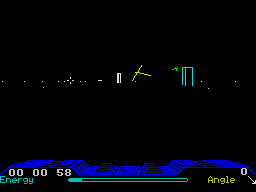
Passing a planet at Hyper-speed!
Personal Computer Games #13Dec 1984 · p.52PCG Hit9/106/106/108/108/108/10
Personal Computer GamesPCG Hit
Graphics 9/10
Sound 6/10
Originality 6/10
Lasting Interest 8/10
Overall 8/10
Bob Wade 8/10
Peter Connor
Steve Cooke
MACHINE: Spectrum 48K CONTROL: Keys, Curs, Kemp, Sinc FROM: Design Design, £7.50 In the wake of Elite for the BBC comes another 3D game about space exploration and conquest. Dark Star is much more in the way of a good old mega-zap but it combines it with outstanding graphics. In your Liar spacecraft you are faced with a 16 x 16 sector galaxy in which the Evil Lord's Empire controls a cluster of oppressed planets. These come in four types, the most heavily defended of which must all be wiped out in order to liberate the galaxy. In each sector you have a forward view into space and can encounter four varieties of object: planets, on which you can land, hyperspace gates, energy squares and enemy fighters. You control both directions of travel and firing by an on-screen cursor which has to be centred on gates and squares to pass through them or on fighters to destroy them. Centering the cursor on a planet will take you down to skim over the surface where enemy bases are located. These can be shown on a map which can guide you in on the target. The bases are protected by anti-aircraft fire from the tops of towers and force fields. The towers collapse when blasted and the fields have holes in them through which you can fly. Destroying the main bases on a planet will liberate it and allow you to leave it. That sector is then free and you can take a hyperspace tunnel to any of four adjacent sectors. Your craft has a fairly small energy supply which can be depleted by enemy fire, contact with force fields or straying outside a hyperspace tunnel. Energy supply boxes can be found both on planet surfaces and in deep space and are essential to a successful mission. These boxes are blue and pulsate forward and back as you approach them. You have to close with them at speed or they recede which makes them exceptionally difficult to pass through. A delightful, if somewhat weird, sense of humour runs throughout the game. The high score table contains either a poem or a conversation at the start and there are screen modes such as 'pretty', 'slimline' and 'wide angle which apparently only the programmer can play. An excellent feature is the ability to change various aspects of the game including the sound, difficulty, display and ship characteristics. The program can be moulded to the player's skill and there's plenty of galaxy to keep you hooked.
The Evil Lord's main base - destroy it to free the galaxy.
Sinclair Programs #26Dec 1984 · p.1768%68%
Rating 68%
June Mortimer 68%
PRICE: £7.50 GAME TYPE: Arcade Some software companies do not make it easy for you. Take the new program from Design Design, Dark Star, for instance. The on-screen instructions are brief to the point of absurdity, indicating little other than that you should shoot on sight, whatever happens. The four pages of tiny print on the inlay go to the other extreme. I takes so long to distinguish the instructions from the story line that it is tempting to just give up and play the game. Despite all complications, the rudiments of the game are quite straightforward. You fly through the galaxy, encountering enemy ships, which you destroy. A plan of the entire galaxy can be obtained by pressing key one. The next sector can be entered by flying through one of the squares which approach in groups. The object is to liberate all the planets in your galaxy. Reach a planet's surface by flying at the collections of yellow lines, check out the enemy by pressing one again, an then bomb all the bases before leaving the planet. Dark Star is produced for the 48K Spectrum by Design Design, [redacted].
Personal Computer News #84Oct 1984 · p.51PCN Star Game10/1010/10
Personal Computer NewsPCN Star Game
Overall 10/10
John Lettice 10/10
PRICE: £7.50 PUBLISHER: Design Design No sweat at all this one. In Dark Star you're the pilot of the spaceship Liar, an your goal is to 'liberate your galaxy from domination by the Evil Lord's tyrannical Empire'. The galaxy's divided up into a 16 x 16 grid of sectors, each sector containing an indeterminate number of planets. Now the planets in the lightly defended sectors have a couple of alien bases, the odd fuel dump, and maybe a spaceport. The bases are crawling with air defence towers, and all you've got to do to knock them out is fly through a skyful of flak, a particularly nasty force field and knock out the planetary defence system in the centre. Then it's on to the next base, and so on until you've liberated the planet. Then you deal with the other 200 or so planets in the galaxy - no problem... Having dealt with the pipe-dream section I suppose we'd best move on to the truth. The Liar is a relatively nippy but simple little point and shoot style ship. Your basic controls are up, down, left, right and fire, with the addition of a speed control and a toggle switch that allows you to view a map of the galaxy or the planet you're currently on. The initial screen display is a forward view of the space you're flying through, and you'll meet the odd enemy spacecraft here, but generally they're nothing to worry about. Your two major concerns at this level are the planets which you fly past and the hyperspace gates. You get to the surface of a planet by pointing the Liar at it, whereupon your flight computer does the rest. You then consult your tactical map and head for the nearest enemy concentration. Broadly speaking, these aren't really much of a problem - it's just a matter of flying low, dodging the missiles and knocking out the air defence towers. But the nasty part is the force field. You can't see the field, but your computer identifies holes in it. These are presented as, rectangles through which you must fly, and if you don't the field drains your power. Meanwhile, as you're holding a steady course you're a sitting duck for the aforementioned ack-ack. You seem to score extra points for flying through the field, but it's so hairy I counted myself lucky if I came out the other side at all, never mind in one piece. So really it's all still to play for. I've managed to wipe out one small spaceport on one small planet, and I reckon an hour's hard flying might just be enough to liberate the whole of the planet. Once you've done this it's back into space, find a hyperspace gate and fly through it to the next system. This is just as easy as the rest of the game - a series of rectangles forms a tunnel, and you have to fly through this. You lose energy points if you stray off course, but with practice I'm confident that I can survive the ordeal some of the time. If you've ever played Time Gate, you'll have some idea of what Dark Star is about, but Dark Star is more complicated, and much more difficult. It'll keep you busy for a long time, and try as I may I can't think of a better arcade game for the Spectrum. Right now I'm off to see if I can check out a heavily-defended system without getting killed. Stop press: John Lattice disappeared into Dark Star last Friday. He has not been seen since.
Dark Star carries this game and has 32 references of its own.
6 Computer Hits carries this game and has 2 references of its own.
Julian Rignall's All Time Top Ten carries this game and has 2 references of its own.
Advert6
- Popular Computing Weekly #49Dec 1984 · p.12
- Sinclair User #33Dec 1984 · p.100
- Sinclair User #32Nov 1984 · p.137
- Popular Computing Weekly #45Nov 1984 · p.14
- Popular Computing Weekly #42Oct 1984 · p.27
- Sinclair User #31Oct 1984 · p.40
Tips4
- Your Sinclair #81Sep 1992 · p.28
- Popular Computing Weekly #42Oct 1985 · p.36
- Popular Computing Weekly #14Apr 1985 · p.40
- Crash #14Mar 1985 · p.62
Letters3
- Crash #17Jun 1985 · p.58
- Crash #16May 1985 · p.85
- Home Computing Weekly #90Nov 1984 · p.33
Information2
- SSD-IISep 1999
- Die Speccy CDJan 1996
CoverGame2
- Your Sinclair #78Jun 1992 · p.4
- Crash #88May 1991 · p.6
News/Note2
- Your Spectrum #12Mar 1985 · p.3
- Popular Computing Weekly #47Nov 1984 · p.44
Review2
- Home Computing Weekly #87Nov 1984 · p.39
- Popular Computing Weekly #42Oct 1984 · p.68
Feature1
- Your Sinclair #90Jun 1993 · p.31
Preview1
- Crash #9Oct 1984 · p.91
Licensed from
- Dark StarMovieunofficialJack H. Harris Enterprises
Contains
Related
- Compilations
- Dark Star, 6 Computer Hits, Crash issue 88: Presents 24, Your Sinclair issue 78: Magnificent Seven, Julian Rignall's All Time Top Ten, ZX-Spectrum Vega
- Ports
- (Amstrad CPC)
- Elsewhere
- MobyGamesThe TipshopUVL
- Same entry at
- Spectrum ComputingZXInfo
Reviews from people here
Sign in to write about this, or make an account. It takes a minute and lets you correct the catalogue too.
Everything ZXDB can hold about this is here.
Sign in to correct or add to this.
Hold the rights to this and want it taken down?