
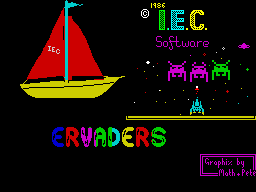
Ervaders
General: Education · ZX-Spectrum 48K · 1 players · English
I.E.C. Software · 1986 · Pound sterling 8.95
Discussion
Nobody has started a thread about this yet.
Play
- Ervaders.tzx.zipTape image English7 KB
Files and rights
Distribution permission is on record, granted to another archive rather than to this one. Screens and pictures are copied here; everything else links to the archive that holds it.
- AllowedI.E.C. Software → WorldOfSpectrum
Credits
- Jo Westwoodcredited
- Matthew Richard Wilkescredited
Sign in to credit somebody, or say what these people did.
In the magazines 1
Crash #27Apr 1986 · p.53
Rosetta McLeod
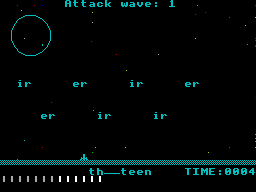
CRASH COURSE MATTHEW'S STORY To my mind, one of the most interesting educational applications of the micro lies in its potential for helping those with specific learning problems. Few publishers, however, have directed themselves to this area. Now IEC Software has come up with some programs useful both with children experiencing certain problems, and with very young children. IEC was set up by educational psychologist, Jo Westwood, who turned to computers to find ways of helping children affected by dyslexia, often known as word-blindness. Dyslexic children have great difficulty in learning to read, tending to confuse letters such as b and d. Jo decided her pupils needed practice in observing the differences between letters without being distracted by their similarity. A game involving discrimination between two letters linked to pictures and associated words beginning with the sound was needed, The game element had to be particularly strong to sustain the children's interest, so that they would practice. Jo, however, was not a programming expert, so the task of writing the game fell to teenager Matthew Wilkes. Matthew came to Jo's notice when, having been fooling around in class, his teacher asked him to write 50 lines - 'I must learn to use my good brain wisely'! The lines were duly done, but were not handwritten on school paper. They had been printed from a computer using an italic script! Jo seized the opportunity, and channeled Matthew's 'good brain' towards writing a program to her design, and so IEC Software was conceived. Unfortunately, the company is finding it difficult getting its games accepted by the retailers, who seem to turn down small software firms on principle, regardless of the quality of their product. I hope IEC succeed in their aim of getting on the shelves of the High Street stores, but if you have problems tracking down the games, they can be obtained direct from IEC at [redacted]. The retail price of each of the cassettes for the 48K Spectrum is £8.95. Rosetta McLeod LEFT RIGHT, LEFT RIGHT Although the games on this tape are specifically aimed at children with dyslexic problems, they may also be enjoyed by many young children who are not dyslexic. The first game, BeeDee gives children practice in distinguishing between b and d which are often confused. The aim of the game is to shoot all the letters which start the name of the object displayed, so that, if a dagger is drawn, all the d's must be shot away. Before the game begins, some useful hints are given which encourage the child to form a mental picture of the shape of the word. He is told, for instance, that 'the word for bed looks like a bed, and so to write b you put the bed post first', and 'the word for dog has a tail hanging down. The dog is very sad if you forget that his nose comes before his ears. So to write a d you put his nose first.' When the game begins, a mark is deducted from the score each time an incorrect letter is shot at. The seven pictures which appear on the screen are chosen randomly from 12, and the level of difficulty increases each time. City Maze is a game which requires directional awareness to anticipate the movement of a little car. The player has to drive the car across the city without crashing into a wall, and can choose between an easy and a difficult game. The words 'left' and 'right' are displayed clearly at the bottom of the screen, and an adult working with the child, could reinforce these words as the game proceeds. Doors is another program which reinforces the left/right concept. Behind each of the doors, clearly labelled Left and Right, may be found enemies (snakes, spiders, and skeletons), and these must be killed with the correct weapon axes kill skeletons, fly spray kills spiders, and daggers kill snakes. To be successful, the player must read the words which appear above each door, pay due care and attention to the words for the enemies which all begin with s. All of these games are extremely simple, with attractive and colourful graphics; BeeDee and Maze are particularly enjoyable to use. Doors is, perhaps, not so much fun, having less of an arcade-type approach. Having tried out these games both with very young children, and with older pupils with learning difficulties, I can vouch for their usefulness, and for their success in stimulating children to improve their performance. Control keys: BeeDee 2 move left, 9 move right, SPACE fire. City Maze 2 move left, 9 move right. Doors 2 opens the left door, 9 opens the right door, SPACE to go on. ERVADERS This game is aimed at children of 7 years and above and aims to teach eight different spellings of the sound 'er'. When a word appears at the bottom of the screen the player must shoot the invader which correctly fills the middle of the word. The player has only 13 bullets to shoot all the correct invaders, and can select from eight difficulty levels, beginning with 'er' and 'ir' at level 1, and progressing to 'ear', 'ir', 'ur', 'or', 'ar', 'our', and 'ure' at level eight. At the easiest level, words such as 'thirteen' 'mirth', 'serve' and 'term' must be completed correctly. The graphics and sound effects in this game are very appealing to children, and the ratings of performance range from 'Not bad' to 'Super-Hero' . This is an enjoyable program apart from an annoying bug which sometimes occurs when the player shoots from the edge of the screen, causing the game to crash. This bug appeared in my review copy, but I have been assured that it has been spotted and removed. The following 'testimonial' was written by one of Jo's dyslexic pupils: 'This game is not an average 'shoot them up'. It combines a space invader game with an education game. Most things which teach spelling are very boring but this is very addictive and is a joy to play.' Control keys: 1, 2 or 3 to move left; 8, 9 or 0 to move right; V, B or SPACE to fire A TO Z A to Z is suitable for very young children, or for older children with dyslexic problems. A series of colourful pictures appear on the screen in groups of 20, and the player has to shoot the correct initial letter from those shown under the picture. In use, the child should be encouraged to say the word aloud and then identify the initial letter sound, which can then be related to the correct lower-case letter selected. On side two of the tape, Common Confusions is particularly aimed at those children who confuse similarly shaped letters or similar sounds - letters such as b and d often cause problems, as do p and q. The game also allows a choice of the number of letters to appear on the screen: between 2 and 20 are possible. I was disappointed, however, to learn that the letters seem to be randomly selected more often than not, so that the common confusions are not in fact faced. For instance, under the drawing of a pen, the letters c j n p are shown if the 4-letter option is selected, and under a diamond, the choice must be made from k k n d. Another annoying feature for me was the irritating sound as each picture is drawn. I would have liked the option of turning it off. Control keys: 2 to move left, 9 to move right, SPACE to select the letter DAM AND BLAST All children who use a computer need to acquire the skills of letter recognition and keyboard familiarity, and it is those skills which this game sets out to teach. Each letter of the alphabet appears on the screen, first as a capital letter then in the second part of the game in its lower-case form; meanwhile a digger tunnels away at the bottom of the dam. The player must touch the appropriate letter on the keyboard to stop the digger, and thus prevent the water flooding the valley. The child can choose from 3 levels of difficulty which relate to the speed of reaction. Dam and Blast 2 uses the same game format to provide a further extension of keyboard skills covering the numbers and symbols on the keyboard. This is of use for aspiring programmers, but also for children who may be using a computer for word-processing. This game was particularly popular with the younger children I tried it out on - children who often become frustrated when their unfamiliarity with the keyboard spoils their enjoyment of a game. After a surprisingly short time, their responses became quite fast and this new skill was seen by them to have great relevance. Control keys: after both games have been played, all the letters, symbols and numbers on the keyboard will have been used. COMMENTS All of the IEC Software programs are very attractive and easy to use. Jo Westwood has used her experience as an educational psychologist to devise games which children will enjoy playing and which will keep them interested and motivated long enough to improve their skills. Children with learning difficulties often become bored and frustrated by their lack of success, but these games give them a real chance to do well. Matthew Wilkes, too, has used his talents to great effect, and I look forward to seeing more of his work in the future.
We all reckon this ERVADERS player should be blasting away at the ear. Search us if we're wrong...
Licensed from
- Space InvadersArcade coin-opunofficialTaito Corporation
Related
- Tags
- g030
- Same entry at
- Spectrum ComputingZXInfo
Reviews from people here
Sign in to write about this, or make an account. It takes a minute and lets you correct the catalogue too.
No description recorded.
Sign in to correct or add to this.
Hold the rights to this and want it taken down?