
D-Day
Strategy Game: War · ZX-Spectrum 48K · 1 players · English
Games Workshop · 1984 · Pound sterling 7.95
_Back.jpg)
.jpg)
_Front.jpg)
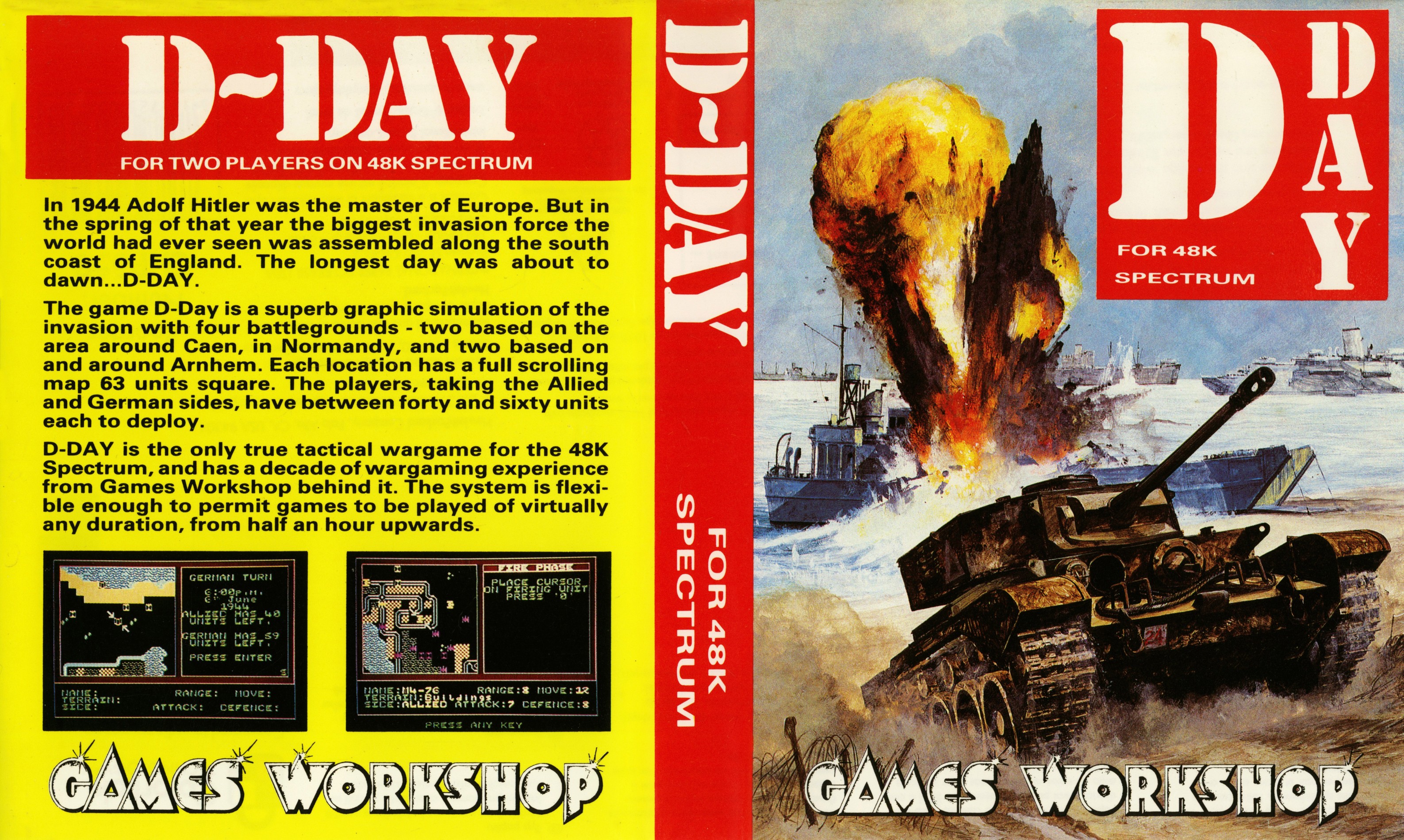
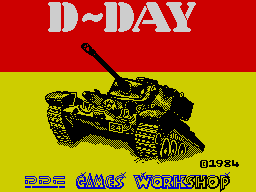
_Tape.jpg)
_Media.jpg)
Discussion
Nobody has started a thread about this yet.
Releases
- 1984Games WorkshopPound sterling 7.95
- UnknownEDOS
- 1984Serma SoftwareSpanish peseta 1900.00
- 1984Summit Software [1]
- 1984Aackosoft
Play
- D-Day.tzx.zipTape image English19 KB
- D-Day.tap.zipTape image English21 KB
- D-Day(SummitSoftware1).tzx.zipTape image English19 KB
- DDay(EDOS).tzx.zipTape image 20 KB
- D-Day(Aackosoft).tzx.zipTape image English19 KB
Documents
- D-Day.zipInstructions English46 KB
- D-Day(Aackosoft)(NL).pdfInstructions Dutch2,531 KB
- D-Day(EN).pdfInstructions English1,938 KB
Files and rights
No permission is on record either way. Screens and pictures are copied here on a take-down basis: if you hold the rights and want something removed, say so and it goes.
Credits
- Dagenham Design Cellcredited
- Brian SweetInlay/Poster Art
Sign in to credit somebody, or say what these people did.
Scores
In the magazines
- Crash #111984 · Overall83%
- Personal Computer News #881984 · Overall9/10
Elsewhere on the web
- WorldOfSpectrum 10 votes7.90
In the magazines 43
C&VG (Computer & Video Games) #40Feb 1985 · p.15
Mike Singleton
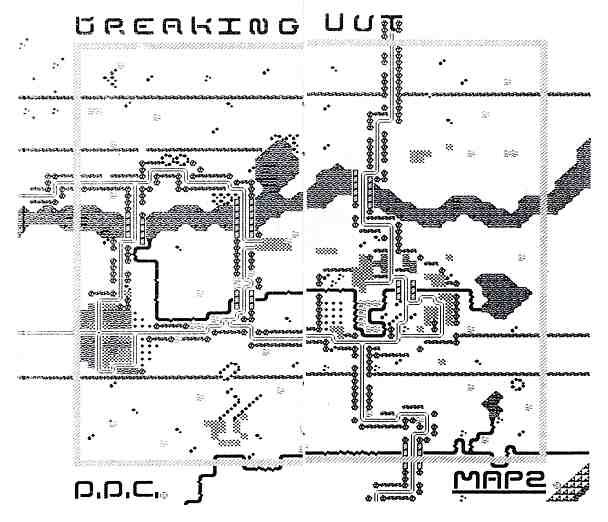
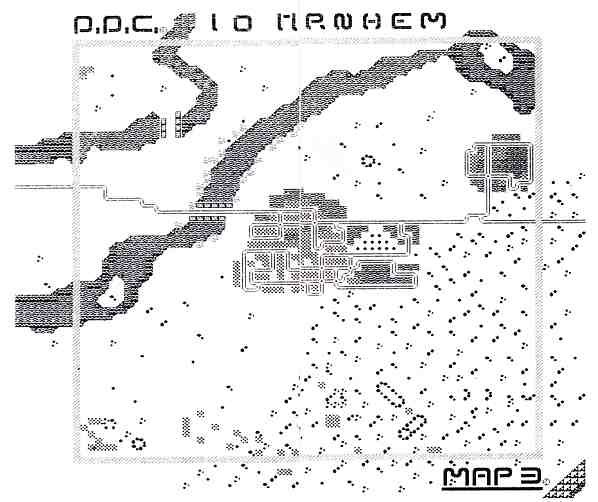
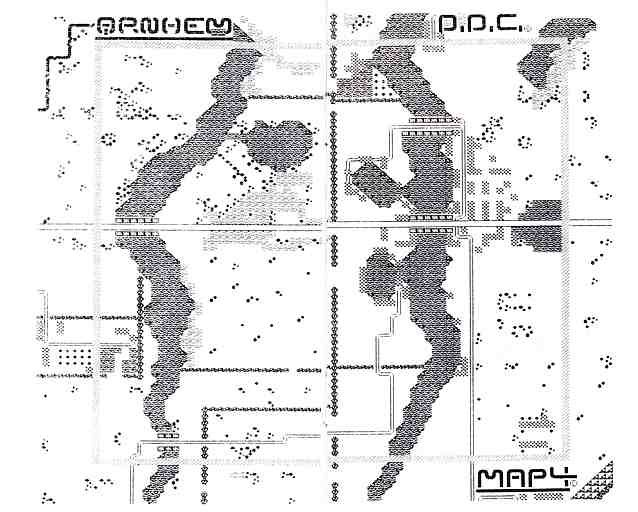
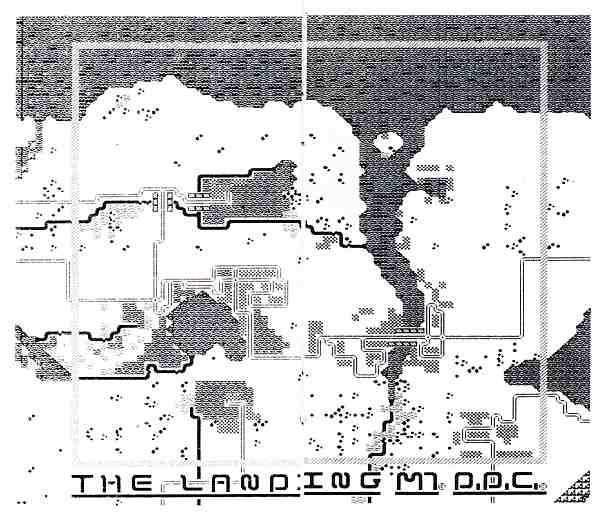
THE LONGEST DAY To those of you weaned on board wargames, the name Games Workshop will be as familiar to you as Farley's Rusks. Now Games Workshop have entered the computer software fray with four brand new games. D-Day is the one I got my hands on recently and I must admit I was suitably impressed by both the quality and the quantity. D-Day concentrates platoon-level warfare, with units being individual tanks, guns, trucks, landing craft and infantry groups. Four detailed scenarios are provided on the B side of the tape which represent "The Landing", "Breaking Out", "To Arnhem" and the "Arnhem Invasion". The presentation in this package of games is superb. The map is colourful AND clear, the order system, which depends on cursor control of your units, is easy to use and the textual information is both concise and informative. One drawback for some is bound to be the two players only format of the game - I know there are quite a number of strategy fanatics who can't find opponents to take the punishment they would dearly love to dish out and who have to resort to making mincemeat of their computer instead. For those who can find opponents and who have enough time to spare, D-Day is a must. Be forewarned, this is not a quick game to play. In the tradition of board wargames, half-an-hour per turn (for each player) is not unusual and D-Day is no exception. Just two things struck me as strange about D-Day. First, it is mostly in Basic and second, there is no anti-copying security at all. The Games Workshop manual even TELLS you how to save the entire game - not just the current data but the whole thing! I do hope no one takes unfair advantage of this but I do have my doubts!
Crash #11Dec 1984 · p.2175%85%87%79%N/A88%83%
Use of Computer 75%
Graphics 85%
Playability 87%
Getting Started 79%
Addictive Qualities N/A
Value For Money 88%
Overall 83%
Unknown
Unknown
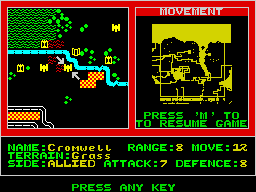
Producer: Games Workshop Memory Required: 48K Retail Price: £7.95 Language: Machine code Author: Various Games Workshop have long been in the business of seeing games across a wide range of interests. Now they have gone into software production with the aid, in this case of 'Demented Den, The Major, Macabre Mick and Einstein' and the corporate members of Dagenham Design Cell. D-Day is a sophisticated wargame set in the Second World War for two players. It contains four scenarios, each accessed via its own loader. These are The Landing, The Breakout, Road to Arnhem, Arnhem Landing. The loader asks to play, and then loads the appropriate Deployment program. In this stage the two players (Germans and Allies) deploy their forces' start positions on a map. The screen has two windows, map on the left, units and numbers to be on the right. A cursor selects the unit, while a set of cursor keys then move two white arrows over the map terrain to where you want the unit placed. When all the units have deployed, the second player deploys his or hers, and then the main program for the selected scenario is loaded. In play, the same screen layout is used, with messages and prompts appearing in the right window, units being moved by selection and the cursor system. The map of each scenario is quite large, the window only displays a small area, with the map scrolling over the total area as the cursor is moved. The map contains several terrain features such as, trees, rough ground, sea or lakes, grass, roads, buildings, sand, marshes, hedges and bridges over rivers. Logically, units may only be deployed or moved into terrain that is suitable, and the program takes account of movement speed depending on the terrain. To win a scenario, you must defeat the enemy's forces. There are three values related to destruction - Attack, Defence and Range. These three affect how effective a shot on the opponent will be and can result in four states - Undamaged, Damaged, Wreck or Destroyed. The distinction between wreck and destroyed is that a wreck, though out of the action, is not removed and so prevents another unit from occupying the square, whereas destroyed objects vanish altogether. In firing, logic is employed. A unit may fire if nothing blocks its way like towns, trees or hedges, and if it is within range of the target. If all the parameters are met, then the cursor is placed over the firing unit and confirmed, before moving the cursor to the unit being fired upon. The graphics actually show the attack and resulting explosion. The damage report is then displayed. Howitzers and mortars are allowed to fire on targets even if terrain intrudes, because of the high trajectory of shot. Since ships are very important in landings and on rivers, lakes etc, there is a large section devoted to them in the manual. As they make a large difference to the outcome of any game, it is worth reading this section carefully. The four scenarios each have different conditions for winning and varying amounts and types of units. COMMENTS Control keys: uses 8 directional cursor movement with keys: Q/W/E; A/S/D; Z/X/C; Joystick: none needed in this type of game Keyboard play: cursor selection is very fast and positive Use of colour: very good Graphics: varied, detailed and clear, smooth scrolling over map Sound: Skill levels: Lives: Screens: four scenarios with scrolling Special features: two-player only
Personal Computer News #88Nov 1984 · p.519/109/10
Overall 9/10
John Lettice 9/10
PRICE: £7.95 PUBLISHER: Games Workshop [redacted] When we hit the beaches we knew it was just the start of a long hard slog. Peering through the gloom I could make out hazy shapes - but what were they? Were they Allied or Axis? It was no good, I would obviously have to use the colour telly... D-Day from Games Workshop bills itself as 'the only true tactical wargame for the 48K Spectrum .' As a computer game it's something of a rarity, as its ancestry is the board game rather than the arcade, and although I'd dispute Games Workshop's outrageous-ish claim, there's no question that it's a serious attempt to simulate WW2 combat. Just loading the beast is a yomp. First load a bit of it, stop the tape, press a key for the scenario you want to play (a choice of the landing, breakout, pursuit to Arnhem, and Arnhem itself), load deployment data, stop tape, deploy, load last bits. Fortunately, there are clear on-screen instructions, so it's relatively easy to sort out. The screen display is split into three sections, the main one being a window on the computer's 'playing board.' This shows details of the terrain, which consists of beach, rough ground, road, woods, towns etc, and scrolls over a full map 63 units square. To the left of this is a window showing the phase you're in, and below there's space for details of the unit the cursor is over. I'd say this was a mistake, as there's no useful information in it most of the time, and the main window really is a bit cramped. The full map of the landing scenario gives a reasonable impression of the countryside around Caen, and you have two ways to populate this landscape. The slow way is for the two players to take turns distributing their forces, Allies at the top of the map, Germans at the bottom, while the fast way gets the computer to do it for you. This latter can make for some weird results, but considering the historical precedents there's a certain amount of logic in having the opposing forces thrown into combat any old how. They consist of infantry, tanks and armoured cars with the odd extra thrown in, and the objective for both sides is to knock off two thirds of the opposition. As a victory condition this strikes me as unsubtle - after all, wasn't the operation about establishing a beach-head in the short term, and liberating Europe in the long? The way the map's laid out, however, you tend to be sucked into a slogging match rather than being allowed to use cunning to take towns and road junctions. I'm also not too impressed by the way combat takes place. The procedure is as follows - first you place the cursor over the firing unit, then over the target, and all being well a little blob chugs its way across the screen in Basic. This isn't particularly slick, and quite often the program decides that things that seem to be in clear sight aren't. As an experiment I tried using a tank to fire on infantry, and to my surprise it appeared to kill off the lot. Now Games Workshop, with 'a decade of wargaming experience' behind it, should know that tank shells are relatively ineffective against infantry. Simulation schimulation. I'm also not too happy about the fact that the game's written mainly in Basic. Some excellent games have been written in Basic, and tactical games of this sort don't really need the speed of machine code, but a little compression might have allowed space for the computer to play one side, and this would have broadened the game's appeal. That said, it's not a bad try, and if you and a friend enjoy board games and fancy trying one implemented on a computer it's well worth buying.
Advert29
- Sinclair User #37Apr 1985 · p.13
- Your Computer #4Apr 1985 · p.27
- C&VG (Computer & Video Games) #42Apr 1985 · p.19
- Crash #15Apr 1985 · p.11
- Big K #12Mar 1985 · p.19
- Sinclair User #36Mar 1985 · p.55
- Your Computer #3Mar 1985 · p.63
- Crash #14Mar 1985 · p.11
- C&VG (Computer & Video Games) #41Mar 1985 · p.33
- Big K #11Feb 1985 · p.63
- C&VG (Computer & Video Games) #40Feb 1985 · p.105
- Games ComputingFeb 1985 · p.17
- Personal Computer Games #15Feb 1985 · p.92
- Sinclair User #35Feb 1985 · p.97
- C&VG (Computer & Video Games) #39Jan 1985 · p.105
- Personal Computer News #93Jan 1985 · p.51
- Big K #10Jan 1985 · p.58
- Crash #12Jan 1985 · p.123
- Personal Computer News #92Dec 1984 · p.36
- Sinclair User #33Dec 1984 · p.179
- White Dwarf #60Dec 1984 · p.55
- C&VG (Computer & Video Games) #38Dec 1984 · p.201
- Big K #9Dec 1984 · p.88
- Crash #11Dec 1984 · p.93
- C&VG (Computer & Video Games) #37Nov 1984 · p.173
News/Note9
- Micro Adventurer #16Feb 1985 · p.6
- Personal Computer Games #13Dec 1984 · p.24
- Big K #8Nov 1984 · p.6
- C&VG (Computer & Video Games) #36Oct 1984 · p.24
- Personal Computer Games #11Oct 1984 · p.14
- Sinclair User #31Oct 1984 · p.7
- Personal Computer News #82Oct 1984 · p.45
- Micro Adventurer #11Sep 1984 · p.6
- Crash #8Sep 1984 · p.33
Review2
- Home Computing Weekly #103Mar 1985 · p.17
- White Dwarf #60Dec 1984 · p.30
Related
- Ports
- (Commodore 64)
- Elsewhere
- Speccy Screenshot MapsThe TipshopUVL
- Same entry at
- Spectrum ComputingZXInfo
Reviews from people here
Sign in to write about this, or make an account. It takes a minute and lets you correct the catalogue too.
No description recorded.
Sign in to correct or add to this.
Hold the rights to this and want it taken down?