
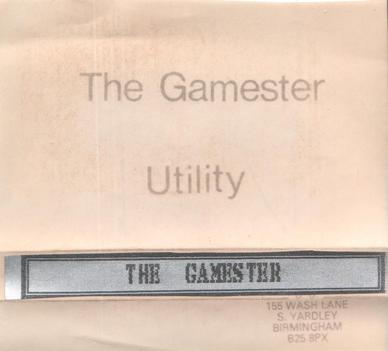
The Gamester
Utility: Hacker/Security · ZX-Spectrum 48K · 1 players · English
David R. Walton · 1987 · Pound sterling 9.99
MIA Missing in action. This is known to have existed, and no copy has ever been found. If you own one, the archives would like to hear from you.
Discussion
Nobody has started a thread about this yet.
Remarks
infinite lives hacker
Files and rights
No permission is on record either way. Screens and pictures are copied here on a take-down basis: if you hold the rights and want something removed, say so and it goes.
Credits
- David R. Waltoncredited
Sign in to credit somebody, or say what these people did.
In the magazines 10
Crash #41Jun 1987 · p.100
Simon N Goodwin
(Simon N Goodwin owns the copyright to this review. Please visit http://simon.mooli.org.uk to find original articles and updates, much new material and his contact details.) THE GAMESTER - LLOYD MANGRAM IN SOFTWARE This month I'm reviewing one of the strangest programs we've ever received: a utility intended to automatically give the player infinite lives 'on most types of games'! it comes with a list of 23 games - all recent hits - which the author has tested and found compatible; I've tried it on several other titles, with mixed but intriguing results. The Gamester is, as the author says, 'totally original and quite unique'. The Gamester is set up much like Genie, the £9.95 pop-up disassembler I reviewed in January. It's a small machine-code program that loads into the add-on RAM of Romantic Robot's backup interface, Multiface 1. This means that you can use it without encroaching upon the 48K used for normal programs, and can call it at any time, whatever else the computer is doing, by pressing the red button on the Multiface. The Gamester takes less than a minute to load from cassette; the computer than appears to reset itself, as if you'd just turned it on, and you can load games or other programs as normal. When you press the magic button a menu appears at the top of the screen. The menu indicates the amount of disk, tape or wafer space that's needed to save the program now in memory, and invites you to press one of five keys. Pressing R resets the computer, leaving The Gamester set up, so you can load a different game. Keys 1 to 4 tell The Gamester to search quickly through the loaded program, finding and modifying groups of instructions that look as if they keep track of the player's lives. The four options correspond to different groups of instructions; the author tells you which to choose for each of the 23 games on his list, but for other titles you must resort to trial and error. Once you've selected an appropriate option the normal Multiface menu appears, and you can restart, save programs or screens or make manual alterations to the code as if The Gamester weren't loaded. You mustn't use the WINDOW memory-display option, however, or The Gamester's code will be overwritten. I tried The Gamester on a couple of games from the supplied list. Uridium was patched for infinite lives with no trouble, but The Gamester seemed to corrupt other parts of the code of Jack The Nipper, the lower part of the screen filled with sprite components after I lost my first life, though play continued with infinite lives in the top area. Having loaded Wizard's Lair, a program not on the list, I found that The Gamester could alter the game but could not give me infinite lives. One option caused all the sprites to move back and forth along fixed diagonals; another stopped the animation. At this point I realised one major fault of The Gamester from the point of view of humble cassette-users such as myself - you spend a lot of time loading and reloading programs. If you don't find the right option at first, you must reload the program to be patched. You may have to try all four options - and you've no guarantee that any of them will work. I switched to 16K programs at this point, to save time and try The Gamester on a range of old titles. JetPac and Pssst were patched perfectly, using Option One, but I couldn't get quite what I wanted on other games. Option One gave a continuous explosion effect in Deathchase, so my first accurate shot was also my last. Option Two gave infinite lives, but also made the other bikes run away faster than any player could chase them - it was impossible to get within range! I was interested to see what The Gamester would do to Earth Defence - a missile-command variant which doesn't really use the normal idea of 'lives'. The Gamester zapped it so play didn't continue after the first screen. Using it on Meteor Attack I ended up with only one life, rather than the original three. AN INTERESTING TOY At a guess, The Gamester works by searching for indirect decrement instructions followed by tests for zero. This is a good rule to start out with when hacking programs by hand, but it's too crude to give reliable results. Frankly, I'm amazed it works as well as it does, and author D R Walton deserves credit for persevering in an area where most programmers would give up after a few minutes! As it stands, The Gamester is more of a toy than a utility, though it may be worth having if you've got several games on the author's list. It costs £5 from D R Walton, [redacted].
Advert6
- Sinclair User #75Jun 1988 · p.99
- Sinclair User #74May 1988 · p.90
- Popular Computing Weekly #3Jan 1988 · p.40
- Popular Computing Weekly #4Jan 1988 · p.38
- Popular Computing Weekly #49Dec 1987 · p.53
- Popular Computing Weekly #51Dec 1987 · p.37
Feature1
- Crash #50Mar 1988 · p.54
Classified1
- Sinclair User #70Jan 1988 · p.121
News/Note1
- Crash #44Sep 1987 · p.8
Reviews from people here
Sign in to write about this, or make an account. It takes a minute and lets you correct the catalogue too.
No tag recorded.
Sign in to correct or add to this.
Hold the rights to this and want it taken down?