
The Giddy Game Show
General: Education · ZX-Spectrum 48K · 1 players · English
Mirrorsoft Ltd · 1986 · Pound sterling 9.95
Discussion
Nobody has started a thread about this yet.
Remarks
Alphabet
Play
- GiddyGameShowThe.tzx.zipTape image English56 KB
Documents
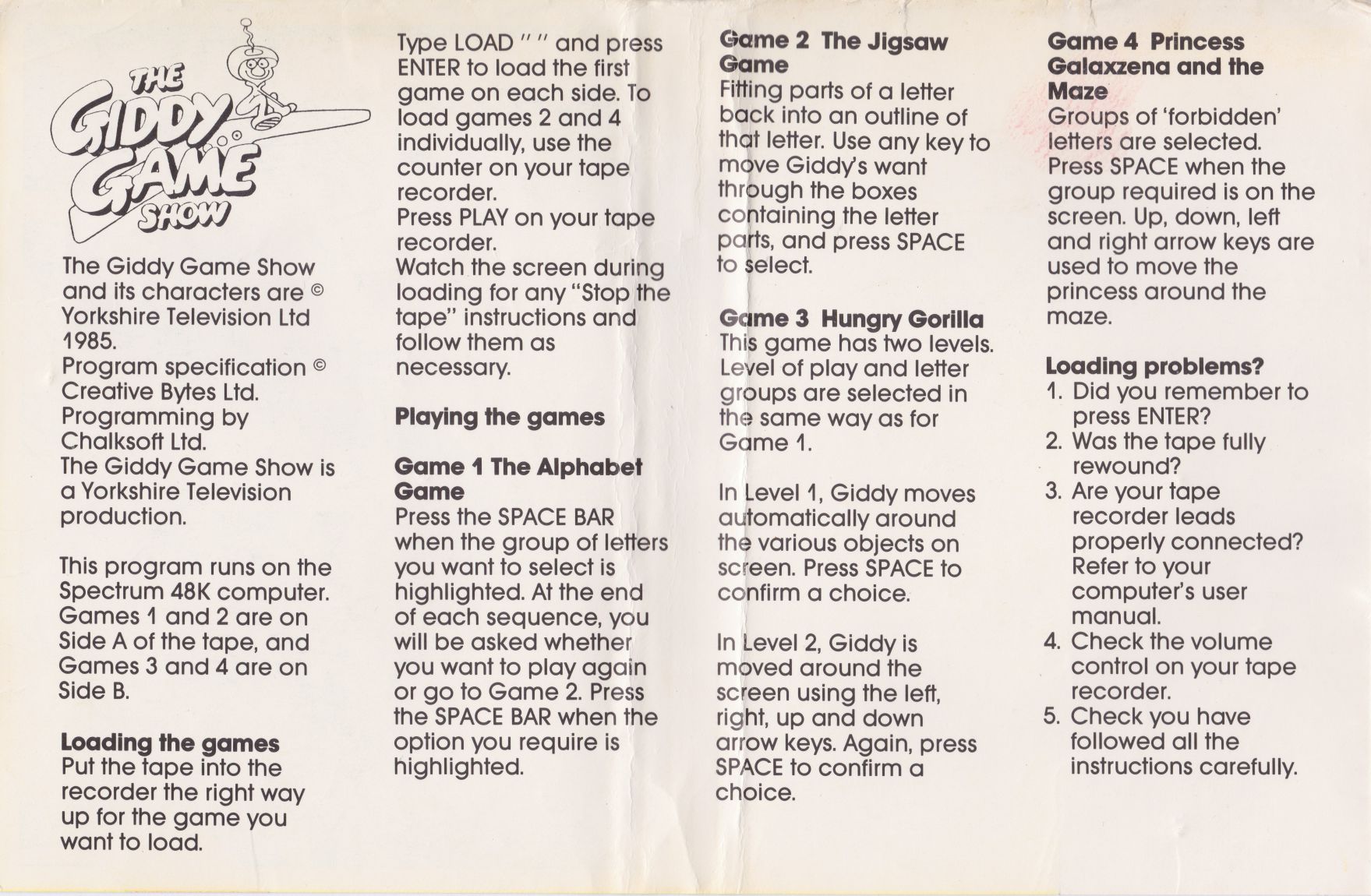
- GiddyGameShowThe(EN).txtInstructions English3 KB
Files and rights
No permission is on record either way. Screens and pictures are copied here on a take-down basis: if you hold the rights and want something removed, say so and it goes.
Scores
In the magazines
- Sinclair User #491986 · Overall2/5
Elsewhere on the web
- WorldOfSpectrum 2 votes6.00
In the magazines 5
Crash #34Nov 1986 · p.58
Rosetta McLeod
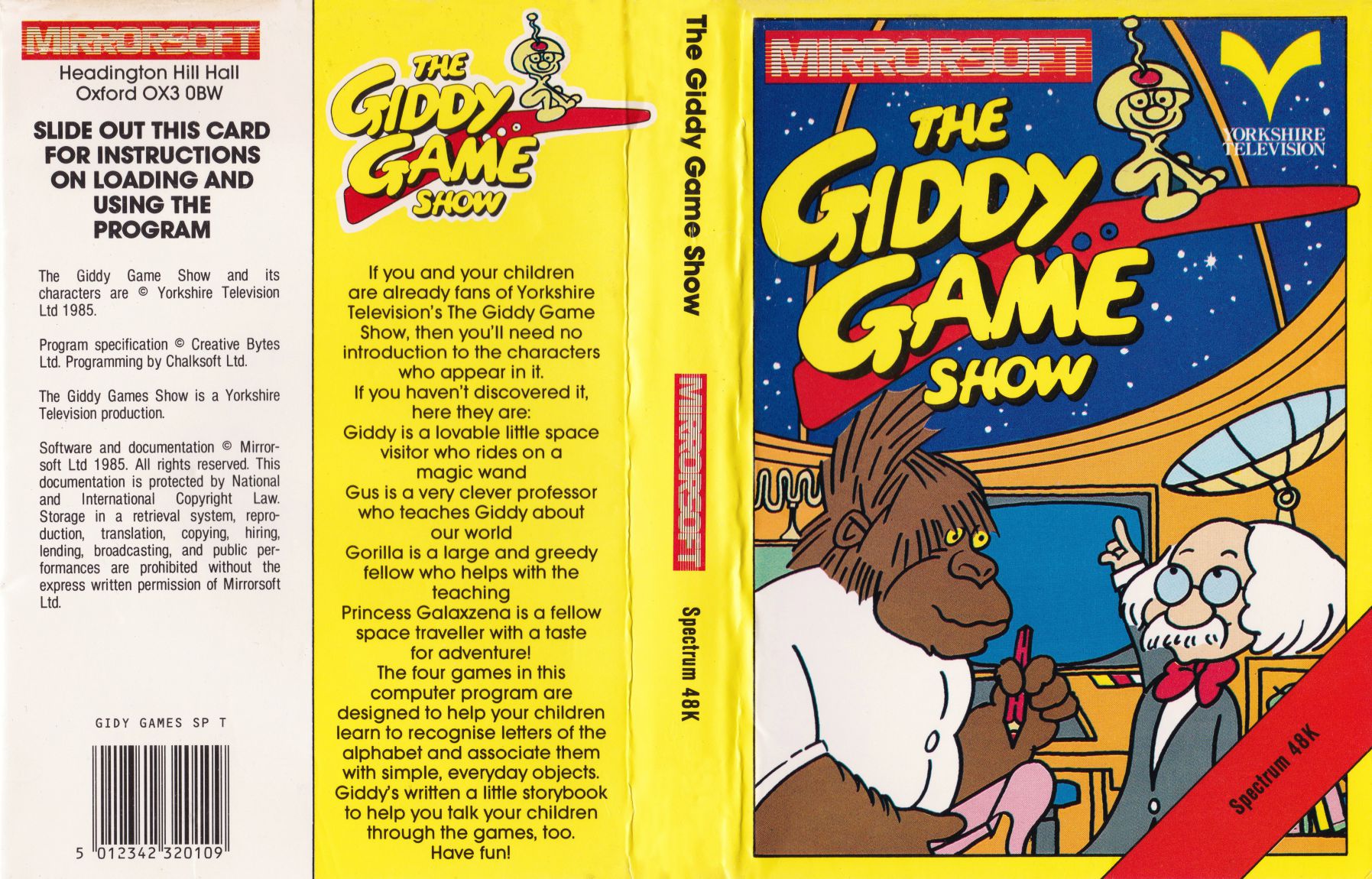
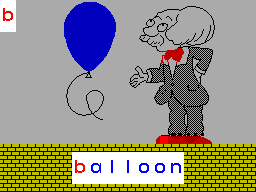
CRASH COURSE By Rosetta McLeod GIVE GIRLS A BREAK A few months ago, I mentioned the problems that schools and parents are facing in interesting girls in computers. The London Borough of Croydon has now published a fascinating document entitled Girls and information Technology which reports the results of a survey commissioned by the Equal Opportunities Commission. It discusses the observation that computers seem to be used more by boys and male teachers than by their female counterparts, and refers to a study carried by the MEP Primary Project which showed that twice as many boys as girls have access to a micro at home. Why should this be? Are girls intrinsically less interested in computers than boys are? If parents consider it more important to provide home computers for sons rather than daughters what implication does this have for the future of women in an age of technology? In many secondary schools, computers have been linked with the mathematics department and too much emphasis has been placed on programming and numerical uses rather than data-processing and other social implications. Another problem is that traditional stereotyping seems to occur very early with boys being perceived to have more interest than girls in new technology. Girls may be keen to learn word-processing but seem to have little curiosity about other computer uses. Perhaps the problem lies in the content of the commercial software available. Girls are not nearly so interested as boys in arcade-type games and even educational software tends to be directed towards male interests. Luckily though, the programs I've looked at this month are of a particularly high standard and will appeal equally to boys and girls. THE GIDDY GAME SHOW Producer: Mirrorsoft Retail Price: £9.95 Age Range: under 5 years This program is a spin-off from Yorkshire Television's Giddy Game Show for very young children, and uses the same popular characters of Giddy, Gus, Gonna and Princess Galaxzena. The tour games on the tape are designed to help children recognise the letters of the alphabet and associate them with everyday objects. The first game,'Alphabet', introduces the child to the various letters, which are sensibly split into four groups. For each letter, a picture appears on the screen showing one of the characters with an object which starts with the letter being taught. The letter is displayed in the top left hand corner, and the word for the object shown, with its initial letter in a different colour, is at the bottom of the picture. When the child can recognise the letters, he is ready to move on to game two, 'Jigsaw'. This time, nine squares are shown on the screen, with a letter in the middle one. The letter is then broken up into different pieces and the player has to put it back together again one piece at a time This is a very good way of drawing attention to the shape of a letter 'Hungry Gorilla'is a simple game with two levels of difficulty. Pictures of six sorts of foods are displayed with a word at the bottom of the screen. One letter of the word is highlighted, and the player has to select the correct letter and picture to match up with the highlighted letter, so that Gorilla can be fed. Al level one. Giddy moves round the screen from picture to picture, and when he is hovering over the correct food. the child simply has to press SPACE. At the second level, however, the letters of the alphabet are split into four groups - a to f, g to l, m to s, and t to z. In the final game, 'Princess Galaxzena and the Maze', the child has to help the princess to find her way to the castle to rescue the imprisoned king. On her way through the maze, she must avoid passing any objects beginning with one of the forbidden letters displayed on the screen. As acceptable objects are passed, their names are spelt out at the bottom of the picture. If the princess accidentally goes past three forbidden letters, she ends up in the dungeon with the king. This is a very enjoyable little game which motivates young children to succeed. A 12-page colour story book accompanies the game, explaining what to do, and reinforcing the skills being taught. COMMENTS Control keys: SPACE and arrow keys Keyboard play: good Graphics: excellent Use of colours: bright and clear
Sinclair User #49Apr 1986 · p.502/52/5
Overall 2/5
Nicole Segre 2/5
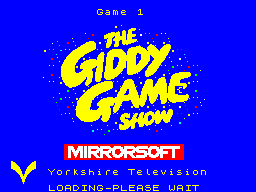
Publisher: Mirrorsoft Price: £9.95 Memory: 48K Based on the Yorkshire Television programme, Mirrorsoft's Giddy Game Show is designed to help parents teach very young children to recognise the letters of the alphabet. The obvious question to be asked in such cases is whether the game does the job better than the traditional picture books on which we have all relied for so long. The answer here is that unless infants are absolutely crazy about the Yorkshire TV characters, the Giddy Game Show holds little to stimulate their interest, thus making it hardly worth the considerable trouble of loading the four separate games on the tape - not to mention the equally considerable expense. Game 1 consists of reasonably jolly graphics showing the Giddy Game Show heroes Giddy, Gorilla and Gus the Professor, with a variety of objects such as an apple, a balloon or a xylophone, with the name of each underneath highlighting the a, the b or the z. The objects appear in four groups - Aa-Gy, Hh-Mm, and so on - and each picture in the group is displayed for a second or two before an instruction appears telling the child and its parent to press the space bar to move on to the next picture. When the complete sequence has come to an end, but not before, the child can go back to the menu and choose a new group of letters. There is no way to alter the sequence of each group of objects, or to speed up their painfully slow appearance and disappearance. Nevertheless, the child is assumed to have sat patiently through the entire sequence, without falling asleep or tipping Ribena onto the carpet, and to have learned the entire alphabet by the end, thus being equipped to play the other games on the tape. Game 2 is a letter jigsaw, consisting of a grid with a letter - lower case - in the middle, with pieces of the letter scattered round the other squares of the grid. Pressing any key highlights each of the pieces in turn, and a section of the letter in the middle is also highlighted. When the two pieces are the same, the child presses the space bar, and hey presto, the missing portion of the letter is inked in. Once again, the child cannot move round the grid at random, but has to plod round the pieces of the puzzle in strict rotation - a defect from which genuine wooden or cardboard jigsaws are free. Nor is there any way back to the menu until a complete sequence of letters has been filled in. Game 3 features the Hungry Gorilla and a series of edible objects, displayed six at a time. The name of one of them, say banana, is spelled out at the bottom of the screen. Giddy, travels round the objects, once more in strict rotation, and when he perches above the one whose name is spelled out, the child presses the space bar causing the word to disappear - far too slowly once the initial novelty has worn off - into the gorilla's munching jaws. The same game can also be played using the cursor keys to select objects at random - an improvement in flexibility, but it is a pity that the instructions don't mention that Giddy must be positioned right on top of the object rather than above it before it can be selected. Game 4, which refused to load on our review copy, again uses the cursor keys, this time to move Princess Galaxzena round a maze in a happy reversal whereby a damsel has to rescue a king in distress. The maze is littered with objects - most shown in earlier games - and the Princess must avoid landing on objects beginning with the forbidden letters displayed on the screen. The game is accompanied by a cheerful little booklet, and there is enough colour and sound in it to amuse a child for a while. One fairly serious flaw is the fact that the space bar does not always respond as it should, but what really mars the game is that it treats the child as a passive spectator. Perhaps computer games should only teach about computers, while teaching to read is best left to books. This game does nothing to prove the contrary.
Advert2
- Sinclair User #45Dec 1985 · p.29
- Popular Computing Weekly #48Nov 1985 · p.7
News/Note1
- Your Computer #3Mar 1986 · p.20
Licensed from
- The Giddy Game ShowTV showYorkshire Television Ltd
Related
- Tags
- g047
- Elsewhere
- UVL
- Same entry at
- Spectrum ComputingZXInfo
Reviews from people here
Sign in to write about this, or make an account. It takes a minute and lets you correct the catalogue too.
No credit recorded.
Sign in to correct or add to this.
Hold the rights to this and want it taken down?