Death Chess 5000
Game: Board · ZX-Spectrum 48K · 1 players · English
Artic Computing Ltd · 1984 · Pound sterling 6.95
Discussion
Nobody has started a thread about this yet.
- Control Option
- Kempston Joystick
Play
- DeathChess5000.tzx.zipTape image English19 KB
- DeathChess5000.tap.zipTape image English21 KB
Documents
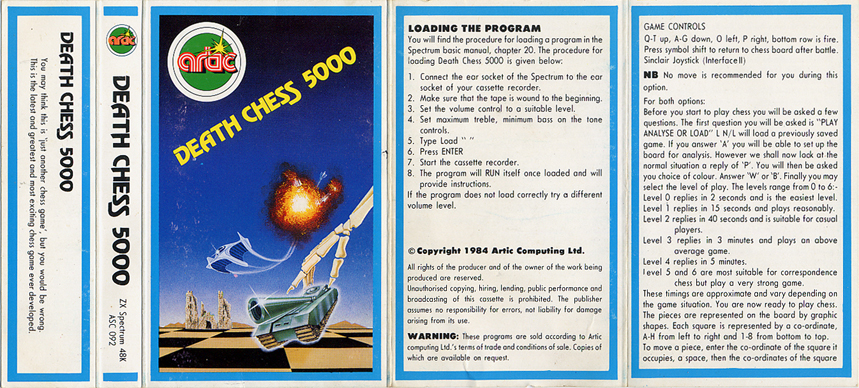
- DeathChess5000.txtInstructions English13 KB
Files and rights
No permission is on record either way. Screens and pictures are copied here on a take-down basis: if you hold the rights and want something removed, say so and it goes.
Credits
- Anthony Adamcredited
Sign in to credit somebody, or say what these people did.
Scores
In the magazines
- Sinclair User #301984 · Gilbert Factor7/10
- Crash #71984 · Overall69%
- Personal Computer Games #101984 · Overall5/10
Elsewhere on the web
- WorldOfSpectrum 6 votes5.00
Awards and competitions
Crash Readers Awards 1984
- 2Best Board/Card/Puzzle Game
In the magazines 15
Sinclair User #30Sep 1984 · p.367/107/10
Gilbert Factor 7/10
Richard Price 7/10
Ky x B, kerBOOMM!! Memory: 48K Price: £6.95 Joystick: Kempston When is chess not quite chess? When it is the Artic Death Chess 5000. Purists will shudder to hear that Artic has produced a chess-playing program in which the result of piece taking piece is decided by an arcade action sequence and not by the immutable laws of the game. The program consists of two main options. The first is to play a normal chess game with the standard rules. Both castling and en passant moves are acceptable. There are seven levels of play. Pieces are moved by entering the usual number/letter grid references. Invalid moves will not be permitted and if you are confused the computer will suggest a move. Choose the death chess option and you are in for a shock. In that mode any attempt to take a piece, by either side, shifts the action to an arcade-style battlefield. There are six settings depending on what pieces are involved. Those are over quickly and swift reactions are needed to win.
Personal Computer Games #10Sep 1984 · p.605/103/105/105/105/10
Graphics 5/10
Sound 3/10
Strength of Play 5/10
Overall 5/10
Peter Connor 5/10
MACHINE: Spectrum 48K CONTROL: Keys, Sinc FROM: Artic, £6.95 Artic make no mean claims for this game: 'It is', they modestly say, 'the latest and greatest and most exciting chess game ever developed.' It may possibly be the latest, but the other two adjectives certainly do not apply. In effect, you get two games. Option 1 gives you straightforward computer chess: six levels and a reasonable game. What gives you a hint about the nature of Option 2 is the pieces: pawns are tanks and knights look particularly ferocious. The gimmick is that every time one side or another proposes to take a piece an arcade sequence ensues, with the loser also losing his piece. Pawn x pawn produces a scene in which the computer's helicopter tries to bomb your tank before you can reach a city. The graphics are pretty, but the gameplay is minimal. Piece x different piece results in a dire version of Galaxians. I'm afraid I can't see Karpov and Kasparov taking it up.
Crash #7Aug 1984 · p.3870%72%70%67%64%70%69%
Use of Computer 70%
Graphics 72%
Playability 70%
Getting Started 67%
Addictive Qualities 64%
Value For Money 70%
Overall 69%
Unknown
Unknown
Unknown
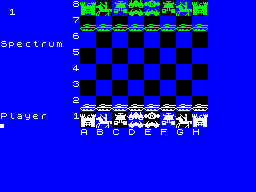
Producer: Artic Computing Memory Required: 48K Retail Price: £6.95 Language: Machine code Author: Anthony Adam Artic have made claims in the past to being the producers of the best computer chess games for the Spectrum - it's obviously a matter for argument! Death Chess 5000 is a novel departure from the chess format and certainly no ordinary chess game as it incorporates arcade sequences within the framework of normal chess. For a start off the chess board, although traditional, has quite different looking pieces. Pawns are represented by tanks, kings and queens resemble lethal looking missile combinations, bishops look like high powered science fiction wind surfers, only knights and rooks are instantly recognisable. In all respects the strategy and rules of chess apply. But what makes Death Chess 5000 really different is that when you challenge the computer's pieces or vice versa the screen cuts to an arcade sequence. Winner of the arcade game retains status quo on the board. So, if you move to take a computer operated piece, before you can you must fight it out. The computer may win, in which case you will loose your challenge piece instead. There are six different games. Pawn takes pawn: you must drive your tank forward to save the city whilst avoiding the bombs raining down from an over-flying helicopter. Bishop takes bishop: escape from the vaults of the enemy avoiding the ghosts. Knight takes knight: hit the enemy horsemen before they reach your edge of the screen. Rook takes rook: scale a tower avoiding the falling barrels of oil. Queen takes queen: navigate the star trench and hit the enemy flagship. Piece takes different piece: shoot through the galactic barrier to hit the opposing ship. Additionally it is possible to select a normal game of chess without the arcade sequences. On either game there are seven levels of play from 0 to 6. The easiest level replies in 2 seconds, level 4 in five minutes and levels 5 and 6 play a strong game and take a long time. Input is with the traditional chess notation. In the straightforward chess mode Death Chess will recommend a move if desired. Castling is allowed with the King's move entered, and capturing en passant by pawns. Games may be saved or sent to hard copy if you have a printer. COMMENTS Control keys: chess - alphanumeric input, Q-T/A-G up/down, O/P left/right and bottom row to fire Joystick: ZX 2 Keyboard play: responsive Use of colour: generall quite good Graphics: well detailed and recognisable, generally very large Sound: not much Skill levels: 7 Originality: chess isn't exactly original, but this version is very different
Rescue the city and save your piece, just one of the many arcade treats.
Unusual pieces in Death Chess.
Advert5
- Your Spectrum #9Nov 1984 · p.90
- Personal Computer Games #12Nov 1984 · p.54
- Your Spectrum #8Oct 1984 · p.82
- Personal Computer Games #11Oct 1984 · p.106
- Sinclair Answers #1Sep 1984 · p.103
Review4
- ZX MagazínMar 2001 · p.8
- Home Computing Weekly #70Jul 1984 · p.14
- Popular Computing Weekly #28Jul 1984 · p.18
- Popular Computing Weekly #24Jun 1984 · p.57
News/Note2
- ZX Computing #15Oct 1984 · p.15
- Your Spectrum #2Mar 1984 · p.54
Information1
- SSD-IISep 1999
Licensed from
- ChessBoard/Tabletopunofficial
Related
- Compilations
- ZX-Spectrum Vega
- Elsewhere
- UVL
- Same entry at
- Spectrum ComputingZXInfo
Reviews from people here
Sign in to write about this, or make an account. It takes a minute and lets you correct the catalogue too.
No description recorded.
Sign in to correct or add to this.
Hold the rights to this and want it taken down?