
Magpie
General: Education · ZX-Spectrum 48K · 1 players · English
Flexibase Software · 1988 · Pound sterling 5.00 · Pound sterling 5.00 microdrive
Discussion
Nobody has started a thread about this yet.
Play
- Magpie.rzx.zipRZX playback file 23 KB
- Magpie.z80.zipSnapshot image English10 KB
Files and rights
Distribution permission is on record, granted to another archive rather than to this one. Screens and pictures are copied here; everything else links to the archive that holds it.
- AllowedFlexibase Software → WorldOfSpectrum
Credits
- David Wornhamcredited
Sign in to credit somebody, or say what these people did.
In the magazines 1
Crash #56Sep 1988 · p.109
Rosetta McLeod
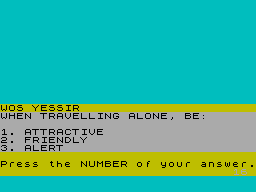
CRASH COURSE By Rosetta McLeod FLEXIBLE PETS This month CRASH Course winds its educational way over the latest offerings from two of the smaller software houses. Now it's over to that media megastar of The Highlands, the one and only Rosetta McLeod... Teachers Pet Software originally started as a mail order supplier in May 1987. They drew their inspiration from ideas suggested to them from the schools in their area. TPS make a point of writing all their programs in BASIC - allowing their products to be examined and modified for specific uses. All the software is available on cassette or microdrive cartridge and each program costs £3.50, or £15.00 for a pack of five (a media conversion service is also available). Teacher's Pet are keen to hear from teachers or parents who have suggestions of subjects for new programs. You can contact Teachers Pet Software at [redacted]. ABBREVIATIONS 1 This is is a simple little program aimed at the 9-12 age group, which tests children's knowledge of a variety of abbreviations. Solve all the abbreviations correctly and Colin Clever will reach the top of the class, before Dennis Dunce reaches the bottom. In the first of two programs most of the abbreviations are simple: pto, mpg, AD and BC. But there are also a few testing ones like BEM, FO, RUC, and OHMS. When there is more than one answer to an abbreviation, for example PC could mean Police Constable or Privy Councillor, the computer will accept all the possible responses. Abbreviations II uses slightly more difficult teasers like PAYE and WRNS, and this time the characters are Kati Clever and Denise Dunce! I felt that, although the presentation in Abbreviations I and II was quite attractive, the programs offered little enjoyment value. However, it does provide an alternative means of testing knowledge, and for some pupils it may act as a helpful resource for reinforcing abbreviations. WORD LIKENESS Many, many words, although sounding the same in pronunciation, are spelt differently. In this program, the pupil has to identify the correct spelling of a word in a given context. A sentence appears on the screen: 'Umbrellas are used in rain/reign'. The pupil then has to type out the chosen alternative. If correct, a relevant picture appears on the screen and a tune is played - in this case an umbrella is shown and we hear a few bars of Raindrops Keep Falling On My Head! The graphics and sound make this an enjoyable program and the children who tried it out for me had fun predicting what picture and tune would follow their correct response. Pupils in the 9-12 age range should enjoy and benefit from Word Likeness. LETTER WRITER 1 As the name suggests, this program teaches users how an informal letter should be set out. In these days of word processors and other sophisticated office equipment. I tend to find that many of the rules of both formal and informal letter writing no longer apply. But this program, quite rightly, follows the standard conventions. First we are shown a sample layout, highlighting six important features of the letter. Each feature is then shown in isolation, and the pupil must select the correct multi-choice response for inserting in that part of the letter. At the end of the program, the whole letter is compiled on the screen. Aimed at the 11-12 age group, this program provides a useful aid for reinforcing letter writing skills. Letter Writer II covers all the requirements of a formal letter. BIRDS OF BRITAIN Birds of Britain teaches bird recognition for the 8-12 age group. From a number of clues, the user has to identify one of thirty birds. The user might be given the information 'I live beside farms. For 5 points, what am I?'. If a wrong answer is given, another piece of information is revealed: 'I nest in trees, holes and chimneys'. Five tries are allowed before the answer, in this case tawny owl, is displayed. Birds Of Britain is a program which will slot into the curriculum of every primary school. Its only deficiency is in the graphical department - no illustrations at all! Bird Spotter is also available. It basically runs along the lines of a word search using bird names. COUNTRIES AND CAPITALS Countries and Capitals is a basic flag/country recognition program. The user is presented with a flag, and asked to identify the represented country and its capital city. If the incorrect response is typed in (and spelling is important here), the correct answer is displayed. The program shows a total score at the end of the round. Countries And Capitals would have been better if clues had been given about the countries, so that the user could have several attempts at identifying it. I found this a restricting program in that it seems to test rote learning of flag, country and capital, without providing any other information (such as the location of the country). But in a classroom context, where the rest of the curriculum fills such gaps, it might provide a useful resource for the testing of a limited body of knowledge. SCOTTISH TOWNS 1 As the title suggests, Scottish Towns I tests the user's knowledge of Scottish towns ranging from the cities of Edinburgh, Glasgow and Aberdeen to smaller places such as Tobermoray and Oban. The computer gives various clues about a town, and the user has to identify it as soon as they can. They might be told'it is in the Highland Region; it is a fishing town; it has an airport which runs services to the mainland; it is on the Outer Hebrides '. The answer is Stornoway (of course). Information is held on 21 towns (Scottish Towns II holds another 21). Again, I would have liked to have seen the program extended by the inclusion of a map showing the location of each place. OUR CLASS What a useful little program this is! Designed to show the user how statistics can be gathered and represented, the program invites the pupils of a class to answer questions about themselves. A pupil is asked for his (or her) name, sex, date of birth, height, hair and eye colour, and whether they wear spectacles. After all the pupils have completed the questions, the computer displays textual information, eg 'One person in our class always wears glasses' and then depicts each piece of information in the form of bar charts (which can be printed out). The program represents a helpful and relevant teaching aid for use with the 7-10 age range. PLANET MATHEMATICS This multi-level maths test program is aimed at the 7-10-year-olds and allows addition and subtraction in the bands 0-10, 0-20 and 0-1000. Multiplication or division can also be selected in levels of 1-5 or 1-10. The user assumes the role of captain of the TP1 Starship, who is stranded, along with his crew of eight, on the planet Mathematicus. Unfortunately, the spaceship has been dismantled by the Mathems, and the object of the game is to answer the questions correctly in order to rebuild the craft and escape. For added interest, occasional surprise attacks take place, so you have to keep your wits about you all the time. I found the sound effects in the game exceedingly annoying, and would have welcomed the chance to switch them off. I cannot imagine teachers in a busy classroom taking kindly to the irritating noise. WHO HELPS? Many adults would be surprised at the difficulty children have in distinguishing between authoritative figures, such as policemen and coastguards. This simple program, for very young school children, presents the user with a series of problems and asks which person would be best suited to solve the problem. The list of people includes policemen, postmen, firemen and doctors. Problems like, 'I have seen a red rocket in the sky above the sea. Who can help me?' (a psychiatrist? - Ed) and 'My cat had four kittens today and I want them examined', are displayed. If the user gets the answer wrong the correct solution is displayed. MURDER MOST FOUL Here we have a Killed Until Dead for youngsters. The user takes the part of Inspector Nickem. A murder has taken place and the Inspector has arrived at the gate of the house. His task is to move around the various locations and find all the important clues. The computer accepts single letter directional commands, eg N and S, but in response to the 'What are you to do?' prompt, a verb/noun command is expected, eg EXAMINE WINDOW, TAKE FINGERPRINT KIT. I am a great believer in the use of adventure programs as a way of stimulating discussion and problem-solving skills, and for upper primary children this adventure is an enjoyable and motivational resource. The graphics are attractive, and my one criticism would be that at times the response to a command can be rather slow. Due to a save game option, it is possible to keep the adventure as an ongoing class project. Now we come to a couple of programs from Flexibase Software. Magpie and Police Patrol Quiz are from a suite of police/public programs which have been produced by police officers for use at shows, fetes, schools, police stations and shops. A compilation disk can be obtained including both of these programs, together with Strangers and Say No, both of which reinforce the SAY NO TO STRANGERS message. Further information can be obtained from Flexibase Software at [redacted]. MAGPIE The first of Flexibase's police programs aims to promote crime prevention to all age ranges. Each time the program is used, the computer selects five questions from a bank of over forty, each with a choice of three answers. The user might be asked: What can attract a burglar? 1 Window Lock 2 Burglar Alarm 3 Newspapers in Letter Box Or another question might be... When leaving your car even for a few minutes, should you... 1 Lock The Doors 2 Shut The Windows 3 Both? If the correct answer is chosen, a picture of a thieving magpie slow generates onscreen. At the end, a total score is given together with the message LOCK OUT CRIME. Although laudable in its aim, I felt that this program needs to provide much more of an incentive for the user to be correct than the creation of a picture (the content of which can be quickly guessed). Magpie is priced at £5 on cassette or microdrive, or as one of four programs including Police Patrol Quiz on a compilation disk for £10. POLICE PATROL QUIZ Flexibases's second program invites the user to assume the role of a patrolling constable who comes across a series of problems. The computer chooses five questions from a bank of over seventy on crime prevention, road safety and general policing. The constable might come across a house with newspapers in the letter box and bottles of milk on the doorstep. The decision has then to be taken whether he ought to push the papers through the letter box, place the milk in a fridge, or ask about the occupant. A range of different problems are covered, and if the user answers successfully a picture of the Neighbourhood Watch Group is displayed. At the end, a total score and assessment is given, together with the message POLICE AND PUBLIC WORKING TOGETHER TO PREVENT CRIME. The colour and graphics in this program are quite attractive, but the sound effects tend to be uncontrollably irritating. Like Magpie, Police Patrol is priced at £5.00.
Related
- Compilations
- Cop Shop
- Elsewhere
- ZXAAA
- Same entry at
- Spectrum ComputingZXInfo
Reviews from people here
Sign in to write about this, or make an account. It takes a minute and lets you correct the catalogue too.
No description, tag recorded.
Sign in to correct or add to this.
Hold the rights to this and want it taken down?