
Phantasmagraphics
Utility: Visual/Screen · ZX-Spectrum 16K · 1 players · English
Saxon Computing · 1982 · Pound sterling 6.95
Discussion
Nobody has started a thread about this yet.
Play
- Phantasmagraphics.tzx.zipTape image English6 KB
Files and rights
No permission is on record either way. Screens and pictures are copied here on a take-down basis: if you hold the rights and want something removed, say so and it goes.
Scores
Elsewhere on the web
- WorldOfSpectrum 1 votes6.00
In the magazines 5
Sinclair User #7Oct 1982 · p.7
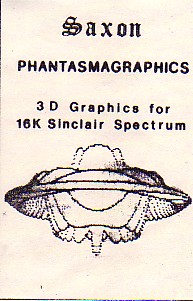
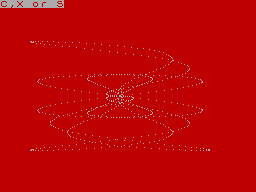
COMPLEX PATTERNS The graphics capabilities of the Spectrum take a good deal of exploring and getting used to. With a good knowledge of them you can produce very detailed pictures on the printer or the screen. Until then you could use Phantasmagraphics. The program demonstrates just what can be done with the Spectrum graphics. It produces 2D and 3D shapes on the screen according to the dimensions you enter at the start. The program also gives you control over the Ink and Paper and Border colours. The display build-up of the 3D shapes is slow but that is the fault of the Spectrum graphics system and net of the program. It is interesting to see how the shapes build slowly and how they are formed. Phantasmagoraphics can be obtained from Saxon Computing, [redacted], for £6.95.
Your Computer #9Sep 1982 · p.28
Boris Allan
SURVEY SPECTRUM SOFTWARE Boris Allan examines the first software offerings designed specially for your Spectrum. Although the Spectrum was announced in April the machine has only become available in large numbers recently. For software suppliers it is still early days. We were therefore relieved to find that most of the programs we received worked first time and reasonably well even if some of them lacked originality. Most of the software we sampled was based on ZX-81 or arcade games but we also tried out some educational and utility programs. Loading the Spectrum was far less frustrating than the ZX-81. The machine performed well, producing particularly good colours but disappointing sound. The limitations of the internal speaker can at least be bypassed by taking the cassette out of the recorder, connecting the two Mic sockets and switching on the recorder. Tone and volume can then be controlled with the recorder's own controls. Games programs are strange things. Long complex programs can be much less enjoyable than a short snappy one incorporating a good idea. So long as the programs are relatively bug-free, as most of these Spectrum games were, then evaluation of any particular cassette is bound to be subjective. To give as objective an assessment as possible we tried out the games on all age groups - even a class of five-year olds. Both Bug-Byte's Spectral Invaders and Quicksilva's Space Invaders approach the standard of real arcade games. Spectral invaders is almost an exact copy of Space Invaders, complete with four different colours for invaders, a flying saucer and high score. Some effects are slightly slower than the Atari original but the graphics quality and the use of colour and sound is excellent. Quicksilva's Space Intruders also had a mutant invader that wobbled and was worth extra points and a hold facility to allow you to stop the game at any point. While the invader programs were written in machine code, Alien Command was written in Basic and was too slow and crude for a space game. Winged Avengers from Work Force is a Galaxian-type game in which waves of attackers move down the screen towards the player's missile firer, break formation, circle about and then attack again. Six speeds are offered and the action is fast. But with the exception of a formation of birds, which appear in the second attack phase flapping their wings very effectively, the display is a little dull. Chromasoft's three programs varied from the sublime to the ridiculous. Worm is a simple but clever idea. A worm on the screen has four segments, and the player has to direct the worm around the screen, eating up numbers. Each time a number is eaten, they flash up randomly, the length of the worm increases by that amount. As the worm gets longer, it becomes more difficult to navigate, because you are not allowed to leave the screen or to cross over yourself. One player reached about 125 segments, and could not find any space. The program is as simple as the display but the idea worked. Defined colours and graphics for the segments would be improvements but only cosmeticBomber is an uninspired rendering of Blitz. Golf is not only unexciting but bug-ridden. Amongst other things the game was unwilling to play the right number of holes. AVC's Fortune could be a useful stand-in for the crystal ball at children's parties. The company's Tables has a more educational objective. The tests of multiplication tables are quite competent but the program would be more useful as a means of generating interest and enthusiasm for mathematics rather than for teaching the tables themselves. Whoever designed it has a keen appreciation of the minds of primary school children, although AVC is stretching a point when it claims the program can be used to the age of 16. One clever ploy to generate interest was the use of the ZX-Printer to give each child a permanent record of its achievement. One kid described it as 'space-age paper'. This theme is reinforced by a countdown to the launch of a rocket each time you play. Time Bandits from Newsoft comprises six separate games on side 1 all combined in an Adventure-style game on side 2. Most of the games have pretty graphics but are rather elementary. Minotaur's Labyrinth is a matter of collecting objects in a maze and Napoleon's army is similar - but without the maze. In Titanic you rely on luck to avoid being sunk by an iceberg while Tower of London is at least distinguished by the appearance of random Beefeaters. Combination is just a matter of remembering a number but Castle of Evil is a little more out of the ordinary. You have to work out the best strategy to cross a web with hostiles converging on you - rather like the Adventure game which used to be shown on BBC 2. Most of the games had not been carefully thought out. It was sometimes possible for instance to offer bribes of minus amounts of money, and thus become richer. Backgammon from Keith Archer worked well enough but was easy to beat and again vulnerable to cheating. There was nothing to prevent you putting more than five counters on a point for instance. Richard Altwasser's Cambridge Colour Collection costs £9.90 for a book of 64 pages and a cassette. Though some of the programs are original, in that they use specific features of the Spectrum, many are not: Maze is marred by a poor algorithm. There is also Breakout, Nim, and most others, including a version of King called Kingdom. The cassette was unfortunately unloadable - the company has had to replace many of the cassettes. We reviewed two graphics packages. Phantasmagraphics plots 2D and 3D patterns and allows you to modify the patterns by entering height, width, perspective and distortion variables. The program is written in Basic and takes up to six minutes to draw a shape. The program contains a bug which causes it to be interrupted by an 'integer out of range' error message for large height and width values. Superdraw 16 is an exceptional program. For £5 you are supplied with an instruction booklet, a pad of screen design pads, and a cassette with a spoken commentary on one side, all in a polythene bag. No other program gave such value for money. The program is written in Basic and allows the user to design screens which can then be saved for incorporation in other programs, which make use of high- and low-resolution graphics, text, and user-designed alphabets of large letters. The 'slide-show' option automatically toads successive screens. High-resolution pictures of a bicycle and southern England among others flash up in turn very much like a slide-show for the unemployed. Two simulation games are available from Case Computer Simulations. Autochef allows you to work your way up as manager of a small catering company. At first you have to avoid being taken over by Trust House Forte - later if you survive you can try to take over Forte yourself. Airline is exactly the same as Autochef except that you are running a small airline.- The two assemblers were useful because they save you money by not buying at inflated prices books which disassemble the Spectrum ROM. Of the two the Campbell version is more attractive as it is written in Basic, and one can learn from studying the program listing - warts and all. The Artic version was difficult to follow, as the documentation had not been prepared, but if the Spectrum documentation is as good as the ZX-81 documentation then it will be terrible. Given the incomplete nature of both offerings, the cheaper price, and the ability to convert from hex to dec and vice versa, sometimes with amusing results, the Campbell Systems offering may be better value.
Phantasmagraphics.
Classified2
- ZX Computing #5Feb 1983 · p.130
- Sinclair User #7Oct 1982 · p.58
Review1
- Your Computer #9Sep 1982 · p.30
Reviews from people here
Sign in to write about this, or make an account. It takes a minute and lets you correct the catalogue too.
No credit, description, tag recorded.
Sign in to correct or add to this.
Hold the rights to this and want it taken down?