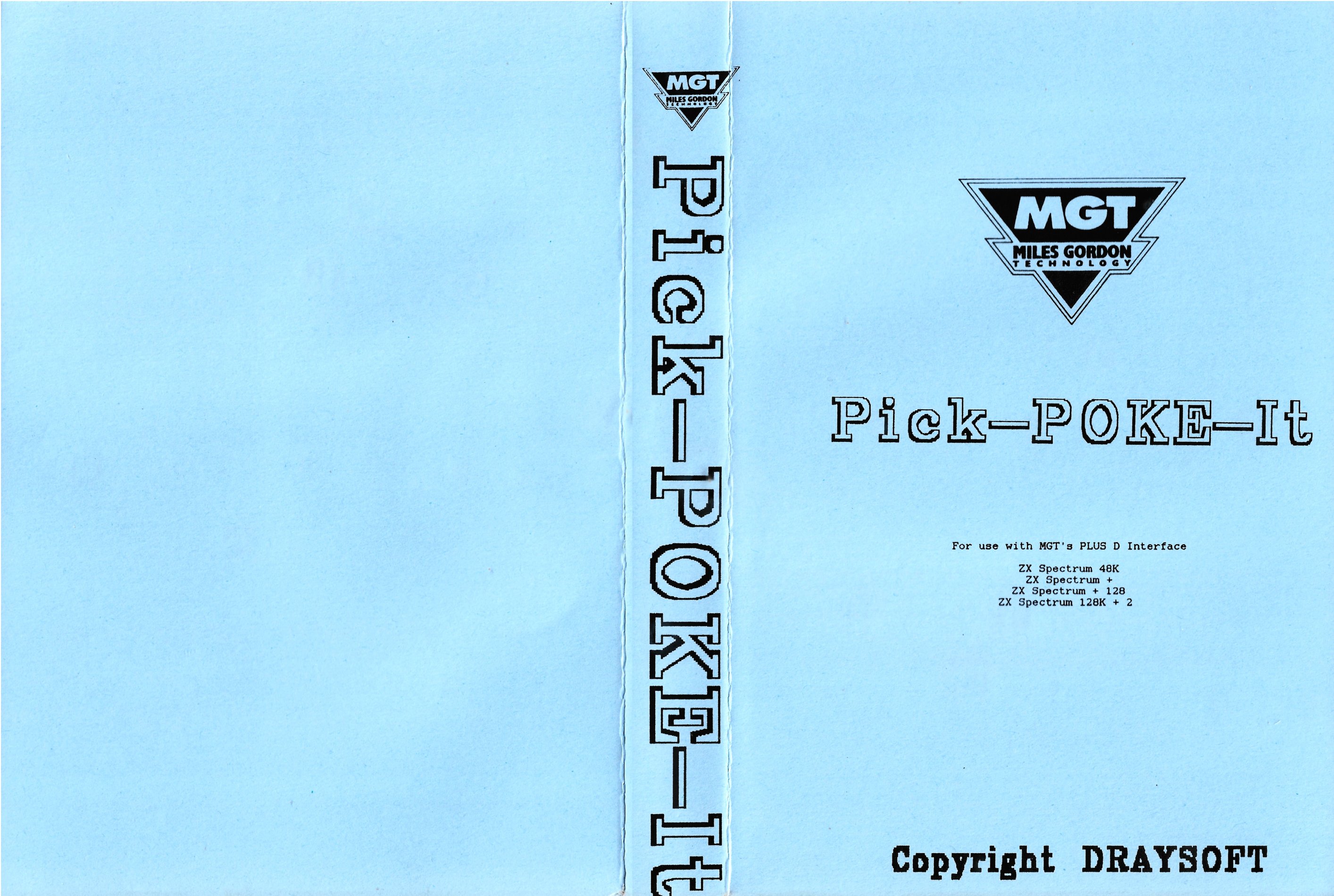
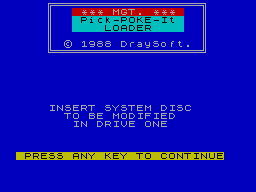
Pick-Poke-It
Utility: Hacker/Security · ZX-Spectrum 48K · 1 players · English
Miles Gordon Technology · 1989 · Pound sterling 14.95
Discussion
Nobody has started a thread about this yet.
Remarks
hacker program for Plus D
Play
- Pick-Poke-It.mgt.zipDisk image English13 KB
- Pick-Poke-It.tzx.zipTape image English8 KB
Documents
- Pick-Poke-It.pdfInstructions English1,037 KB
Files and rights
No permission is on record either way. Screens and pictures are copied here on a take-down basis: if you hold the rights and want something removed, say so and it goes.
Credits
- Draysoftcredited
Sign in to credit somebody, or say what these people did.
In the magazines 1
Crash #62Mar 1989 · p.56
Ian Cull
After last months unveiling of Miles Gordon Technology's alternative Spectrum SAM - IAN CULL now reviews MGT's alternative to the +3, the Plus D disk drive add-on. Deepening Amstrad's woes further Ian also disparages the +2A, while updating his DICE review and looking over yet more techie mags. To make best use of the Plus D, additional hacker programs are needed since it has few functions apart from the 'snapshot' one. Genie, for all Multifaces except the +3, has for some time allowed hackers to stop a game or other program in mid-flight, call up a disassembler/editor, then continue the stopped program as if nothing had happened. Now, two programs for the Plus D allow similar tasks to be carried out. The 'official' Pick-Poke-It (PPI) from MGT themselves and Plus D Hacker (PDH) from INDUG, [redacted]. PPI costs £14.95, against PDH which costs just £3.95! Both programs are supplied on tape, so that they can be configured onto any Plus D set up. In both cases, a new Plus D system file is created on disk, which will auto-initialise the hack-program whenever the disk is booted. Other necessary files take 15K of disk space for PPI and 20.5K for PDH. Genie fits totally into the Multiface RAM, so is instantly available when the magic button is pressed. Both PPI and PDH, however, store their code on disk, and take some time to appear when the button is pressed - PPI takes 6 seconds, PDH takes 7.5 seconds. However, PDH has a second mode, in which the screen is not saved (useful in some cases) which appears almost instantly! Once loaded, both programs offer similar facilities (though PDH offers some unusual additional routines), but the routines are also called in from disk as required (eg 2 seconds to call up the disassembler) - PR is quicker here, but PDH is smart enough to not reload the routine if you have just used it. One problem with both programs is that some of the Spectrum RAM is taken up with the hack-program itself (just the screen on PDH, but all memory up to 23755 on PPI). PDH does not deal with this, indeed it is possible to disassemble/edit PDH itself for crash it, if you're not careful). PPI, however, allows the 'missing' memory to be loaded into the 48K section, and examined there - this is detailed under the 128K bank functions as an appendix, so 48K users may miss it! Both of the programs have a poor keyboard interface; there is a tendency for double registering of keys, etc. This is particularly annoying in PDH, since there is no delete function. You have to let the selected function begin, then abort it (very dangerous if the selected function was a fill memory, or similar). PPI offers, once the button has been pressed, the normal snapshot functions, as well as a disassembler; memory editor; search routine; access to Z80 registers; (128K) bank switch and search: block find and fill, and graphics search. Output can be sent to the printer with both. Of the two packages, PPI is far easier to use. When disassembling or displaying memory, one page at a time is given, then the menu can be recalled, the same function restarted, or the following page displayed. PDH simply disassembles/displays until ENTER is pressed (to pause the display), SPACE (which restarts) or M (to recall the main menu). PDH only uses the bottom third of the screen, whereas PPI uses the whole screen. POKEing is also simpler with PR, allowing entry of message strings as well as decimal/hex numbers - PDH has a POKE facility within a general Z80 register page and only accepts decimal numbers. However, PDH offers additional facilities to PPI - in particular, semi-automated infinite life POKE searches (though nowhere near as sophisticated as the Multiface Lifeguard program), and a graphics search mode. This is quite intriguing, as it allows memory to be scrolled around onscreen in many ways, giving a reasonable chance of finding where a games graphics are held in memory. Another PDH bonus is an additional program that can be loaded into the Plus D over the top of the hack-program (but taking no main Spectrum memory), which gives the Spectrum some graphics drawing functions. For example, RUN*1 (followed by 7 arguments!) allows an area of memory to be defined as a graphic; RUN*d will delete lines of BASIC etc. One problem is that these routines use information from the hack-program, which cannot be run at the same time. In summary, both programs do their job reasonably well. PPI is a well written program, with excellent documentation - but it is very expensive. PDH is less 'professional', but offers a number of unusual additional functions, and is very good value. Documentation for PDH is not too good (and there is a warning of possible crashes on 128K Spectrums). The average Spectrum user would be quite happy with Plus D Hacker, but serious game hackers may wish to pay the additional money for Pick-Poke-It, to get a more reliable product.
'Both programs have a poor keyboard interface'
'PDH has semi-automated infinite life POKE searches'
'PDH offers some unusual additional routines'
Reviews from people here
Sign in to write about this, or make an account. It takes a minute and lets you correct the catalogue too.
No tag recorded.
Sign in to correct or add to this.
Hold the rights to this and want it taken down?