
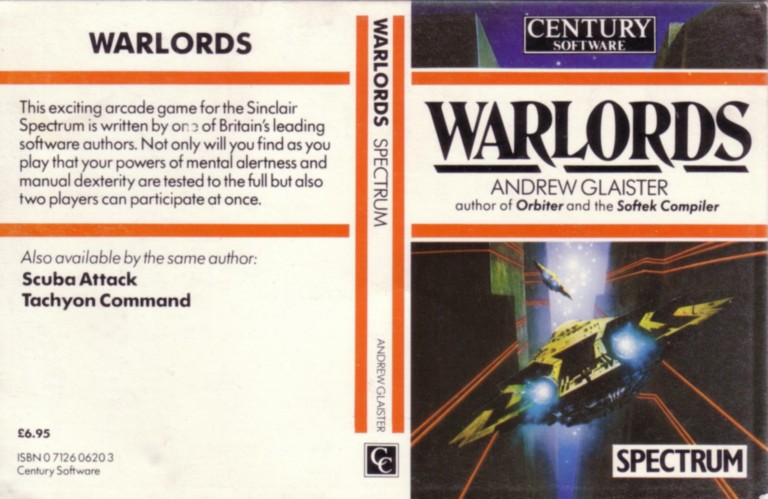
Warlords
Arcade Game: Shoot-em-up · ZX-Spectrum 48K · 2 players · English
Century Software [UK] · 1985 · Pound sterling 6.95
Discussion
Nobody has started a thread about this yet.
Play
- Warlords.tzx.zipTape image English8 KB
- Warlords.tap.zipTape image English8 KB
Files and rights
No permission is on record either way. Screens and pictures are copied here on a take-down basis: if you hold the rights and want something removed, say so and it goes.
Credits
- Andrew J. Glaistercredited
- John HarrisInlay/Poster Art
Sign in to credit somebody, or say what these people did.
Scores
In the magazines
- Crash #201985 · Overall Value7/10
Elsewhere on the web
- WorldOfSpectrum 4 votes5.25
In the magazines 2
Crash #20Sep 1985 · p.926/106/105/107/107/107/10
Atmosphere 6/10
Vocabulary 6/10
Logic 5/10
Addictive Quality 7/10
Overall Value 7/10
Derek Brewster 7/10
DEREK BREWSTER'S ADVENTURE TRAIL ARE YOU BEING SERVED? If you were to sit down and try and write a TV comedy show you would no doubt find it difficult. To make the task a little easier you would be wise to consider who the main characters in the comedy were, how they were likely to behave in any given situation, and what relationship they had to each other. Watch any TV comedy program (Taxi, say) and see this writing skill in action. If the characters are too wooden, or the characters behave too often in an uncharacteristic manner, the comedy will fail. In adventuring the same rules apply. The Hobbit attempted to bring some different characters into its plot, but too often Thorin can only sing about gold and Gandalf is generally found making a nuisance of himself closing doors and taking useful items from you. This is largely due to The Hobbit concerning itself more with complex vocabulary and graphics, leaving a small amount of memory for real characterization. Sherlock, on the other hand, devoted itself more fully to meaningful characters but I couldn't help thinking the complex vocabulary was not so much a help than a hindrance. A standardised vocabulary would have removed the need for substantial amounts of memory to be devoted to word analysis and would have smoothed considerably the player's introduction to the intricacies of the game. Playing word games should only be a small part of adventuring. So where might characterization in adventuring lead? Clearly, some method of supplying additional memory to the Spectrum is needed. Once this problem is solved, the adventure author must carefully consider each character before the main code is written. What are the character's temperament, skills (eg archery, climbing, lock-picking) and allegiances? This should remove most of the discrepancies which creep into games attempting complex character development. What will result from good planning are believable, intelligent characters - the sort woefully absent from the likes of Are You Being Served? WARLORDS Producer: Interceptor Micros Retail Price: £5.50 Language: Machine code Author: David M Banner & Terry Greer First there was Message from Andromeda, then Forest at World's End followed by Jewels of Babylon, the review of which caused a bit of a stir in the Interceptor camp. The reason for this last was probably that game's wonderful graphics which would seem to warrant a favourable review no matter what. For my taste the game was far too similar to its predecessors. Warlord, the fourth game to be produced for the Spectrum by Interceptor and written by David Banner, is again similar in style to Jewels of Babylon but might just have the edge with its interesting Roman/mythical gods theme and superlative graphics. In the middle of the first century, Roman legions led by the feared Vesparian, pushing northward toward the Celtic hill-fort tribes are confident of victory as they advance, but abruptly find their progress halted at the Scottish border by a powerful Northern Warlord. Both sides call upon their gods, but such is the ferocity of their fighting another solution is sought. The warring factions decide to transport a champion from each army through time and space to one of the Celtic Otherworlds. The side whose champion returns to the real world first is the victor. The Romans choose their finest centurion, the Celts their Warlord. You take on the role of The Celtic Warlord and you must find your way back to the real world before your equally determined Roman opponent. You begin with a picture postcard graphic of a wooded vale at the foot of a mountain. Impressive pictures such as this are scattered throughout the adventure and are of the highest standard certainly some of the best I have seen on a Spectrum. They appear instantaneously and only on your first visit to a location. On pressing a key the picture is taken from the screen to leave you with the curious text organisation seen in the rest of this series where input at the bottom causes the location description (with details like exits) to scroll up and off the top of the screen. The thing is, there is not a jot of text in the middle - makes me laugh every time I see this. The location descriptions are as terse as ever eg 'A Mountain Slope', 'A Woodland Path', 'The Rocky Path', occasionally blossoming out into the likes of 'The Vale of Kells. Sunlight filters through the leafy canopy made by ancient, towering oak trees.' Hence it would be more accurate to say many locations are represented by location names rather than location descriptions. Again, as in the rest of the series, the vocabulary is off-beat with the likes of ENTER POOL or GO POOL spurned in favour of CLIMB INTO POOL. How much you think this a good/bad point depends on how long you like to spend in your adventures guessing words at each problem. How logical you perceive the problems to be will depend upon your grasp of the Roman/Celtic mythology which drives the game. What can be said is that few of the problems are especially difficult. The plot of this adventure is a shade stilted. Examining things which are not thought relevant always reveals nothing, and if there's no point in say, climbing a tree, then the program will not let you do it. Some of the objects you find create no mental imagery whatsoever. Take the piece of iron you pick up: examining it reveals nothing, as it is just a lump of metal another boring artefact to be picked up and discarded along the way. So much for creating and sustaining the atmosphere. A few changes have been made since Jewels of Babylon: two which I noticed were the addition of a score and the absence of a maze in the forty percent I completed (which suggests you might just get away with the one maze). What can most certainly be concluded is if you liked the predecessors in this Interceptor series you will like this one. All in all I thought it an interesting diversion if only for the graphics which are worth seeing in their own right. Difficulty: quite easy and not that many problems Graphics: not many but those which appear are excellent Presentation: colours OK but screen could have been better utilized Input facility: often requires sentences Response: instantaneous
Review1
- Home Computing Weekly #97Jan 1985 · p.17
Licensed from
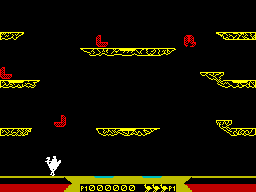
- JoustArcade coin-opunofficialWilliams Electronics Inc
Related
- Tags
- Alternating
- Elsewhere
- Centre for Computing HistoryUVL
- Same entry at
- Spectrum ComputingZXInfo
Reviews from people here
Sign in to write about this, or make an account. It takes a minute and lets you correct the catalogue too.
No description recorded.
Sign in to correct or add to this.
Hold the rights to this and want it taken down?