Linkword French
General: Education · ZX-Spectrum 48K · 1 players · English
Silversoft Ltd · 1984 · Pound sterling 12.95
Linkword, 1 of 4
Discussion
Nobody has started a thread about this yet.
Play
- LinkwordFrench.tzx.zipTape image English62 KB
Files and rights
Distribution permission is on record, granted to another archive rather than to this one. Screens and pictures are copied here; everything else links to the archive that holds it.
- AllowedSilversoft Ltd → WorldOfSpectrum
Scores
In the magazines
- Sinclair User #281984 · Gilbert Factor6/10
- Personal Computer News #571984 · Overall Value3/5
In the magazines 31
Sinclair User #28Jul 1984 · p.866/106/10
Gilbert Factor 6/10
Theodora Wood 6/10
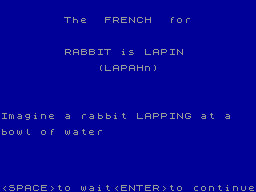
LA PLUME DE MA TANTE EST DANS LE PETIT MICRO Theodora Wood assesses the value of software which helps you learn the lingo SPELLING BEE Machine: Spectrum 48K Company: Image Systems Price: £6 EIFFEL TOWER Machine: Spectrum 48K Company: Chalksoft Price: £9.95 LINKWORD Machine: Spectrum 48K Company: Silversoft Price: £12.95 MDA-PCSS Machine: Spectrum 48K Company: MDA Assoc. Price: £29.95 The best way to learn a foreign language is undoubtedly to live in the country where that language is spoken, preferably in a part of the country where English is not spoken much and the learner is required to understand and use the language for survival. That option is available only to those who work or study overseas, or have sufficient funds to stay there while learning the language. In England, the market for language courses caters for adult students who, for career or other reasons, wish to acquire a modicum of fluency in the language of their choice. Such organisations as Berlitz provide the opportunity for people to have intensive private courses with a native speaker of the language chosen. That can be expensive and the alternative, a course at an adult education institute, usually takes a year and requires attendance at fixed times. There is obviously a demand for home-based courses - Linguaphone is still very much in business - which allow students to study at their own pace. The BBC also broadcasts language lessons on radio and television. Language teaching in schools generally is academic in nature, relying on textual rather than aural translation at examination level. With all that provision, how can computer programs help in this area? A computer program generally can help most in the context of textual rather than the aural level, testing vocabulary and grammar by interactive marking and correcting mistakes made immediately. Spelling programs designed specifically for English spelling are not really suitable for foreign languages, which may require accents and other special inflexions to be totally correct. Spelling Bee - Image Systems, Spectrum 48K, £6 - has attempted to deal with the problem by offering either an English or a French version of a spelling tester. The English version is aimed at the age range from four to six. Spelling is tested by showing a picture and the child has to ENTER the correct spelling. The French option obviously is intended to appeal to older junior children who may have just started learning the language. If the French option is chosen, all the instructions are in French. Like the English versions, there are five options, with 10 words tested in each. There is no HELP screen for accents and when one is required the user has to press 'i' and ENTER for a table of accents, which seems unnecessarily complicated. Two programs are provided in the package, EASY and HARD, so that a total vocabulary list of 100 words may be learned. The French words must be entered with the definite article le, la and l'so a knowledge of gender is required. In the simpler testing section, the child has to ENTER the word for the whole picture - a picture of a fish requires 'le poisson'. In the more difficult sections a part of the object must be named like the scale of the fish or the ear of the pig. That can be confusing, as the question mark for the appropriate word could refer to either the pig's head or the pig's ear. Spelling Bee, although appealing to spelling beginners because of its graphics, is obviously limited since there is no opportunity to change the vocabulary. It is also limited in its range of nouns and there is no opportunity to learn phrases. The English section has the same limitations and, compared to such programs as Castle Spellerous - Sinclair, Blackboard Software - has very little appeal. Eiffel Tower - Chalksoft, Spectrum 48K, £9.25 - allows entry of new vocabulary lists which extends the usefulness of the program. There are up to 10 word lists on both sides of the tape. The program begins with a picture of the Eiffel Tower and asks how quickly can you build the Tower and can you become a master builder? The menu appears next with the 10 given choices grouped generally in subject areas, such as about the house or medical, as well as mixed vocabulary lists. Option 11 allows the user to add a new word list and 12 allows the new word list to be used. After a particular option has been chosen, the student is asked to guess a word, with an English clue given - for example, Guess this word, clue, a cup. If the word is ENTERed incorrectly there is a help section simultaneously on the screen containing the coding for accents - in this case on the numbers one to eight. Typing errors can be corrected by pressing 0. Each time a correct entry is made a part of the tower is completed and when building has finished a small section of the Marseillaise is played, together with the time taken to build it, although 32 days seems a little unrealistic. At the end of each section there is a choice of the same words or returning to the menu to make a new choice. If option 11 is chosen - make your own word list - a secondary menu is presented on-screen which sets out the procedure for entry of new words and SAVEing the new list. Eiffel Tower is a useful program within its limitations; it is what it sets out to be, a French vocabulary test reminiscent of all those vocabulary tests given in school language lessons. Being an interactive program, it not only tests knowledge of vocabulary but also corrects and provides answers when words are not known. In that respect it is successful. It has to be said, however, that testing foreign words in isolation from the spoken context is not a particularly good method of learning a language, especially as there is no sound input and the acquisition of vocabulary by this means is highly dependent on rote learning. Nevertheless, Eiffel Tower provides a facility which would be impossible without the power of a computer and could prove a useful aid to children from nine upwards, bearing in mind its overall limitations. Chalksoft also produces a German version, Das Schloss, on similar lines, the object being to build a German castle. A Spanish version is due shortly. The Linkword series of language learning programs covers French, Spanish, Italian or German - Silversoft Ltd, Spectrum 48K, £12.95 - and shows a new approach to acquisition of a foreign language. The course is designed for holidaymakers, businessmen and older children and is not intended as an academic course. Based on Dr Gruneberg's theory that memory retention is enhanced by mnemonics, the course provides a cassette with 10 programs and an audio cassette containing the spoken words. Nouns are dealt with first with the name in Spanish, followed by the English name and then a phrase which fixes the word in the user's memory. Examples include the Spanish for onion is Cebolla (Thebolya) - imagine an onion leaning to another and saying "They boil you in this place"; and the Spanish for cheese is Queso (Keso) - imagine a Case a Cheese. After memorising the list of words in each section, the user is asked to ENTER first the English equivalent of Spanish words and vice versa. Accents are not used in the exercises but are given in full in the booklet accompanying the tapes. Correct answers are shown after each word has been entered. Grammar is presented at the end of each lesson but is not the most important aspect of the program; it is stated categorically that the main aim of the package is for the user to become fluent and to be able to comprehend the language rather than have the minutiae of grammar correct. The use of imaginative mnemonics makes the Linkword series exceptional in the field of language learning and it certainly is an aid to remembering words which would otherwise be learned in rote fashion. Programs of this kind could be used by the whole family with children from 10 upwards and, if persistent, a vocabulary of about 350 words and simple grammar could be learned. MDA Modon Associates has a much higher learning profile in its language packages, covering French, German and Spanish - Spectrum 48K, £29.95 each. Called the Personal Computer Superlearning System, great claims are made for this way of learning. The theory underlying the package is that, to complete a successful learning operation, the user needs to be completely relaxed. The booklet provides a clue to that viewpoint: "PCSS employs well-tried and tested techniques for relaxing the body and mind so that enhanced concentration is placed on memory and recall". Not only will the student find languages easier to learn in that enhanced state but should also discover increased confidence and composure, reduced stress, fewer headaches and ailments, better performance at work and more vigour. The key to this wonderful panacea for all ills is the relaxation tape provided with the course. It is a combination of deep breathing exercises, together with tension/relaxation of the muscles from the toes upwards. Physical relaxation is covered first, where the even tone of the speaker urges the listener to relax first one part of the body then another. Mental relaxation is induced by imagining walking on a sunny beach. Then the user is asked to recall a moment when the memory really worked, such as a tough word in a crossword puzzle or an exciting learning experience he might have had as a child, recalling the exact feelings and attitudes. Synchronised breathing is described in the last section of the tape, where the user is asked to breathe to a rhythm and finally to synchronise breathing with the learning package. If, by that time, the user is fully relaxed he should continue to the lessons - if not asleep. PCSS provides 12 audio lessons on three cassettes; they run through all the most-used tenses of the regular verbs, pronouns, genders, possessive pronouns, reflexive verbs, together with vocabulary to cover such contingencies as the doctor's, the dentist's, restaurants, the office and the car. Dialogue is introduced a la BBC after lesson three. The complete transcript of the audio lessons is printed in the literature accompanying the package, for revision purposes. Audio cassettes one to eight can be used with the two computer programs provided and are synchronised so that a page-turning exercise can be performed. The audio tapes have an annoying hiss accompanying them, indicating that perhaps the "finest" of recording studios was not used, as stated in the literature. That was particularly obtrusive when used on a personal system with headphones, suggesting that the possibility of using spare time, on bus rides for example, which could be used gainfully by learning a foreign language would not be such a pleasant experience. The choice of music as background to the spoken language is mainly classical in tone, so it depends on personal preference whether that is conducive to learning. The main bulk of the computer section of the package is concerned once more with using the computer to correct textual entries. Called "interactive lessons", they work for translation both from and to the foreign language concerned. There is a help screen for accents and inflexions. Correct answers are given after each entry and the user is asked to assess his score, from three to correct to 0 for not close. The PCSS learning system is a Linguaphone-type course without high fidelity and, at its price, is slightly disappointing. The computer programs provide a more rigorous examination of grammar and vocabulary than any of the other programs reviewed, building to a vocabulary of about 1,500 words and phrases. Compared to Linguaphone prices for European languages - French, German, Spanish - the price is fairly reasonable, as those courses are £135 for eight cassettes and four books with written exercises together with answers, building to a vocabulary of 1,500 to 3,000 words. The computer programs obviously are more useful than written exercises in that repeated use can be made of them. MDA Modon Associates is releasing versions of its language programs specifically for retail outlets at £19.95. Other language programs available are French is Fun German is Fun - CDS Microsystems, Spectrum 16/48K, £5.95 - a vocabulary tester with graphics, and Tense French - Sulis Software, Spectrum 48K, £9.95 - a French verb tester, both reviewed previously in Sinclair User. None of the programs prepares the user for the encounter with a native speaker who speaks three times as fast as the recordings with a strong regional accent, but they provide to a greater or lesser degree a basis from which to start. Vocabulary and grammar testers can be useful in their limitations to school children aged nine to 13 in rote learning their vocabulary lists at home. Image Systems, [redacted]. Chalksoft Ltd, [redacted]. Silversoft Ltd, [redacted]. MDA Modon Associated Ltd, [redacted]. CDS Microsystems, [redacted]. Sulis Software, John Wiley & Sons Ltd, [redacted].
Eiffel Tower
Spelling Bee
Your Spectrum #3May 1984 · p.14
Peter Shaw
JE PARLE SPECCY Silversoft Ltd has announced the release of Dr Michael Gruneberg's Linkword System for the 48K Spectrum. Designed by Gruneberg, the language learning system was first released in 1982 and received wide media acclaim the following year when Thomson Holidays - Gruneberg's first client - published figures that showed 98 per cent recall had been achieved during management training. This impressive figure led the company to implement Linkword in parallel with its own in-house language courses. Silversoft claims that in little over 10 hours you will be taught a vocabulary of more than 350 words, plus a basic knowledge of grammar. The words the system teaches are obviously aimed towards the holidaymaker, although it could quite possibly be of some help to the reluctant pupil - or just about anybody who wants to learn a language without too much fuss. The package includes two cassettes, one audio and the other containing the program itself. The audio tape is there to help you pronounce the words correctly. When the YS team was let loose on the Linkword Spanish system, it did seem that we picked up some words a lot easier than we expected. So we asked Andre Posumentov of Silversoft why he thought the Linkword system was so good. With great enthusiasm he replied "In Linkword we have a properly structured and field tested course which gives someone a grasp of the language very quickly. Linkword doesn't just present the information, it teaches you." As with most of the other educational packages, it's hard to say whether the computer is really necessary. Wouldn't it be just as good if you were reading it all out of a book? But the main idea behind the Gruneberg system is vivid images which you create in your own mind. There are no pictures or graphics included in the programs. Of all the language programs currently available for the Spectrum, this one seems to come out on top. It's available in three different versions at the moment - French. Spanish and German - and Italian. Greek and Portugese are on the way. Each course costs £12.95 and should be widely available from most software shops.
Personal Computer News #57Apr 1984 · p.482/52/53/52/53/5
Usefulness 2/5
Features 2/5
Performance 3/5
Documentation 2/5
Overall Value 3/5
Andy Green
Bryan Skinner
FRENCH LANGUAGE LESSON Bryan Skinner brushes up his French with a Spectrum and an Oric. NAME: French Is Fun PRICE: £5.95 SYSTEM: Any Spectrum OTHER VERSIONS: German Is Fun PUBLISHER: CDS Microsystem, [redacted] NAME: Linkword PRICE: £12.95 SYSTEM: Oric 48K OTHER VERSIONS: German, Italian, Spanish PUBLISHER: Tansoft, [redacted] 2261/2/3/4. Also for Spectrum 48K, Silversoft, [redacted] Making your hols abroad this summer? Whether you'll miss your micro, or be glad to see the back it for a couple of weeks, between now and then it could help you learn a foreign language. Several packages are now available to help you learn a foreign tongue. There are many aspects to language, but Tansoft's 'French' and CDS Microsystems' 'French is Fun' both concentrate on vocabulary. Now. It's one thing to learn a few words, but to claim this is adequate to 'understand and be understood' (Tansoft) in a foreign language is pushing things a bit far. More realistic is CDS's aim to present the French language in a stimulating way. THEORY 'French' makes use of the Gruneberg Linkword system for vocabulary learning. Linkword is the brainchild of Dr Michael Gruneberg of University College, Swansea. Its basis is that visual association is a powerful mnemonic tool. Some famous mnemonists used techniques of remembering things by imagining them in places they were familiar with. To recall the information, they'd take an imaginary walk around the location, noting the things they'd 'left' there. This is a effective way to memorise bits of apparently unrelated information and the Linkword system exploits this psychological fact by suggesting situations to imagine which link an English word with a French one. IN USE For example, the French word for cat is 'chat' which sounds like Shah (as in Iran), so you're asked to visualise 'The late shah of Iran with a cat on his lap', to help you recall the French equivalent for the English word. Some of the 'linking' phrases used are strange, to say the least. How about 'Imagine driving your chevi to the levi with a goat in the back"? This is supposed to help you remember that the French for goat is chevre. There are ten sections to 'French', each concentrating on a different area of vocabulary such as business, travel and restaurants. There is a fair glossary for the tourist, with some intriguing inclusions: ugly, worker and mouse, for example. Over all you get some 350 words, and 'a basic grammar'. Basic is an appropriate adjective. With gender, for instance, you are told to imagine masculine nouns associated with a boxer, and feminine nouns with perfume, eg 'Imagine pouring a bottle of perfume over a goat to stop the smell'. Apart from the blatant sexism, the former is not useful because the subject of the masculine mnemonic is always the boxer, not the item itself. CDS also takes the pictorial route, but doesn't ask you to do the imaging. Making use of the Spectrum's graphics. 'French is Fun' builds up pictures, labelling items with the corresponding English and French words appearing at the top of the screen. There's a main menu to which you can return during any of the sub-sections by pressing Enter. This allows you to swap about eg Seaside to Cafe, quickly and easily. Each situation can be run in four modes: - Picture display with corresponding words. - Test of spelling/translation. - Phrases. - 1 & 3 together. The main problem is that the words are displayed at the top of the screen for only three seconds - hardly long enough to get a good look at them, let alone memorise spellings, so it would have been nice to have had control over this. Whenever you select a picture, the things in it always appear in the same order. This might make the words easier to learn, but it ain't half boring. One major advantage of this program over Tansoft's is that it has phrases, 15 per section. One nicely done section tells the time: you enter a time in standard 12hr notation, and the program writes up the time in French, then depicts it on a clockface. One of the best features of 'French is Fun' is that you don't ever press Enter. The program clearly isn't using INPUT (which Tansoft's does) and in test mode even buzzes if you try to enter an incorrect spelling. It also keeps a tally of your mistakes, unlike 'French'. In Tansoft's favour is that you get spoken words to listen to on the tape, but 'The pronunciation given in the course is only approximate'. And indeed, the words are not spoken by a native French speaker. Mind you they're not bad, and quite clear. While the Linkword system may help you remember roughly what a word sounds like. It's unlikely either to help you understand or be understood, unless you spend some considerable time practising listening and pronunciation. VERDICT I preferred 'French is Fun', largely because it uses graphics, which are well done, while 'French' is text-only. I found 'French' boring, but there's no doubt that it works. Pictorial association is an extremely powerful learning tool. Nevertheless, learning simple vocabulary is only a small part of learning a language. Both programs are a bit of a gimmick, just using a micro for the sake of it. A good text book gives you more pictures and phrases, where you also get details of grammar as well as important cultural information. A modern phrase book offers far more than either of these programs and at more or less the same cost. Better still, with a record or cassette-based course you could learn to say useful French phrases. However, the programs would be ideal for second or third year pupils because learning word lists is one of the hardest and dullest parts of French at school. Both of them will make the task easier and more fun.
Au bord de la mer.
Dans la rue.
Herisson (hedgehog) = hairy son...
Quelle heure est-il?
Advert14
- Your Computer #12Dec 1984 · p.120
- Popular Computing Weekly #49Dec 1984 · p.52
- Home Computing Weekly #93Dec 1984 · p.31
- Home Computing Weekly #92Dec 1984 · p.9
- Home Computing Weekly #91Dec 1984 · p.35
- Personal Computer News #90Dec 1984 · p.24
- Popular Computing Weekly #48Nov 1984 · p.27
- Popular Computing Weekly #45Nov 1984 · p.23
- Home Computing Weekly #88Nov 1984 · p.39
- Personal Computer News #87Nov 1984 · p.28
- Home Computing Weekly #87Nov 1984 · p.27
- Home Computing Weekly #86Oct 1984 · p.13
- Popular Computing Weekly #25Jun 1984 · p.46
- Popular Computing Weekly #23Jun 1984 · p.32
Full-page ad5
- Sinclair User #29Aug 1984 · p.114
- Your Computer #7Jul 1984 · p.107
- Your Spectrum #5Jul 1984
- Personal Computer News #63Jun 1984 · p.12
- Popular Computing Weekly #21May 1984 · p.29
Feature4
- Home Computing Weekly #120Jul 1985 · p.35
- Sinclair User #28Jul 1984 · p.86
- Popular Computing Weekly #19May 1984 · p.15
- Your Computer #4Apr 1984 · p.80
News/Note4
- ZX Computing #13Jun 1984 · p.97
- Your Spectrum #3May 1984 · p.14
- Your Computer #11Nov 1983 · p.54
- Popular Computing Weekly #34Aug 1983 · p.5
Review1
- Home Computing Weekly #71Jul 1984 · p.5
Reviews from people here
Sign in to write about this, or make an account. It takes a minute and lets you correct the catalogue too.
No credit, description recorded.
Sign in to correct or add to this.
Hold the rights to this and want it taken down?