
Deus Ex Machina
Game: Simulation · ZX-Spectrum 48K · 1 players · English
Automata UK Ltd · 1984 · Pound sterling 15.00

.jpg)

Discussion
Nobody has started a thread about this yet.
Remarks
The accompanying audio tape was created with the voices of Ian Dury, Jon Pertwee, Donna Bailey and Frankie Howerd.
- Control Option
- Interface 2 (right), Kempston Joystick
Releases
- 1984Automata UK LtdPound sterling 15.00
- 1985Investronica S.A.
Play
- deusexmachina.zipRZX playback file
- DeusExMachina.tzx.zipTape image English28 KB
- DeusExMachina.tap.zipTape image English51 KB
Documents
- DeusExMachina.txtInstructions English25 KB
Music
- DeusExMachinaPart1.mp3.zipBonus soundtrack(s) in MP3 format 20,998 KB
- DeusExMachinaPart2.mp3.zipBonus soundtrack(s) in MP3 format 21,163 KB
Other files
- Deus Ex Machina (1984)(Automata UK).pokPOK pokes file 1 KB
Files and rights
Distribution permission is on record, granted to another archive rather than to this one. Screens and pictures are copied here; everything else links to the archive that holds it.
- AllowedAutomata UK Ltd → WorldOfSpectrum
Credits
- Mel CroucherGame Design/Concept
- Mel CroucherStory Writing
- Andrew StaggCode
- Robin Grenville EvansInlay/Poster Art
Sign in to credit somebody, or say what these people did.
Scores
In the magazines
- Sinclair User #331984 · Gilbert Factor9/10
- Your Computer #111984 · Overall4/5
- Personal Computer Games #131984 · Overall5/10
Elsewhere on the web
- WorldOfSpectrum 82 votes8.16
Awards and competitions
Golden Joystick Awards 1984
- 2Best Original Game of the Year
In the magazines 74
Sinclair User #44Nov 1985 · p.19
"The first original audio-visual entertainment since the computer revolution," is how author Mel Croucher describes Deus ex Machina. To others it is an unhappy, superficial, marriage of rock album, arcade game and simplistic philosophy. The game follows the struggle for existence against a hostile and authoritarian future controlled by computer and defect police. A full soundtrack features the varied talents of Ian Dury, Jon Pertwee, E P Thompson, Frankie Howard and others. Shunned by distributors and public, loved by the critics, Deus might one day come to be regarded as the software equivalent of the Beatles' Sergeant Pepper.
ZX Computing #18Apr 1985 · p.52
Clive Smith
Are you fed up with the endless stream of arcade games and the like, and would like to try something different? If so, then here is something new, a completely new concept. Not so much a game, more an experience. Deus Ex Machina, which means 'a God out of the machine' comes on two tapes, one is the program and the other is the soundtrack. First, load the program, then insert the audio tape. Switch off all the lights, put on a good set of stereo headphones and turn up the volume. Now prepare yourself for an experience. To start, the two tapes have to be synchronized. This is done by using a countdown from the screen to tell you when to start your audio tape. The program will stop and you will be told by Jon Pertwee, who reads the narrative, exactly when to hit a key to re-start the program. To give you some idea what to expect here is an extract from the beginning of the narrative: 'In the year 1987, the Dept of Health and Social Security, as well as Police and State Security records of the United Kingdom were co-ordinated within a central computerised data bank. The following year all passport, communications and censorship operations were integrated. In 1994, this computer network became responsible for the total defence and internal security of Westblock. Tuesday evening after tea and compulsory prayers, the machine rebelled.' The game is a journey through life, which starts from a mouse dropping which is left inside 'The Machine'. With the aid of the keyboard you steer the 'life' as it grows, from its conception to old age. The audio tape is a mixture of narrative and music, a little like Jeff Waynes 'War of the Worlds'. The music is superb, with people like Ian Dury as The Fertilizer Agent, Donna Bailey as The Machine, Mel Croucher as The Defect, Edward Thompson as The Voice of Reason and even Frankie Howard as The Defect Police. I especially enjoyed Donna Bailey and Ian Dury's Songs. All the music is performed and recorded by Mel Croucher using a host of musical instruments from a Chinese lute to a Roland 808 percussion computer. This is one of those things you either love or hate. I must admit that I loved it, and quite often go out walking the dog at night with a personal cassette playing, just to hear the music. There are about seven different screens to go through, which are a series of fairly simple games, but are graphically very well drawn. However, when combined with the music, they seem to be hypnotic. The games themselves are not games in the ordinary sense, but more like tasks to be carried out in order to keep yourself alive. However, for those of you who like to see how well you have done, a score is kept which is shown as a percentage. Be prepared to sit down for at least an hour and a half to get through the whole tape. It's very hard to review this tape as it's hard to relate the experience in words. The best thing to do is to rush out and buy it if you want something different then I don't think you will be disappointed. Deus Ex Machina is written by Andrew Stagg for the 48K Spectrum and will cost you around £10.00.
Personal Computer Games #13Dec 1984 · p.548/1010/109/104/105/105/10
Graphics 8/10
Sound 10/10
Originality 9/10
Lasting Interest 4/10
Overall 5/10
Bob Wade 5/10
Chris Anderson
Peter Connor
Samantha Hemens
MACHINE: Spectrum 48K CONTROL: Keys, Kemp, Sinc FROM: Automata, £15.00 Deus Ex Machina is translated from the Latin as - a god introduced into a play to resolve the plot. Yup, you guessed it - you're the god and you're trying to guide a human being through its life in the computer. The program is accompanied by an audio tape which, when synchronised with the game, provides electronic music and a running commentary about each stage you pass through. This is a very clever idea, but after hearing it through once it merely becomes background noise and after two or three games you probably won't want to play it at all. The program takes you through the life of a person from the welding of the DNA, through birth, childhood, adulthood and finally old age and death. Each stage of your development presents you with a different game to play in order to maintain your percentage score of success in life. There are about 15 sections to each life but several groups have the same format. This is the case for five of the first six games which involve moving a cursor around and placing it on objects to either keep them spinning or pulsing. This is done by simply placing the cursor on the object while trying to avoid the blue scanning cursor of the defect police and not letting anything stop moving. Your cursor is green and as far as I can tell it's a mouse dropping with which you can control the progress of an accident in THE machine. The plot of this little mishap is related on the audio track and starts with this unfortunate mouse having its sphincter eased by nerve gas... hmmmm? I won't burden you with the details of the story on the soundtrack, related in words and music by famous names like Ian Drury, Jon Pertwee and Frankie Howerd. Suffice to say that it lives up to Automata's weird reputation and may well appeal to people taking degrees in philosophy and sociology. The game always lasts the same amount of time and your success at each stage is determined by a percentage score which will drop for every failure you have. It's certainly not just a game - more of an attempt at entertainment. The problems it faces in achieving popularity are great though: some will find it tasteless, others unplayable and many just won't be able to relate to the game concept. I liked it, however, and found it highly original and enjoyable. But beware, you should definitely try before you buy with this one.
Deus Ex Machina takes you through all the stages of life.
Big K #9Dec 1984 · p.44
Fin Fahey
DANCE OF THE DANGEROUS DEFECTS MAKER: Automata U.K. FORMAT: cassette PRICE: £15.00 This is NOT a game. In Deus Ex Machina, Automata have produced what may well be the first 'computer video'. It comes on two cassettes, on a sound track featuring an all-star cat and Mel Croucher's music, the other a program which must be synchronised with the sound cassette. A count-down is provided on both to get this right. It's all based on a hoary old SF theme, owing more to Huxley's Brave New World than to G. Orwell. In some heavily computerised future all foetuses are nurtured in the test tube. Their life activity is monitored by The Machine, until one day through an accident involving a mouse dropping, a 'defect' is produced, a human who deviates from the biological and cultural norms. The program and script trace the life of this new being, in a computerised rewrite of Shakespeare's Seven Ages of Man. Said life being a rather sad parable. The lesson is that those whom society rejects - the misfits - often develop into people of exceptional talent who are subsequently corrupted by - and promote the values of - the very system that rejected them. Lost innocence is not the most original of themes, but it's still a poignant one. The cast is impressive, and a I particularly liked Frankie Howerd's comic-opera Captain Korg of the Defect Police. Jon Pertwee as the narrator, and Ian Drury as the cheeky cockney Fertiliser are just right. As a bonus we even get extracts from E.P. Thompson's speeches as The Voice of Reason. Mel Croucher's synth-based music is adequately atmospheric, though not of much interest in itself. DECOMPOSING As for the graphics, these are very sparse, but encompass a wide range of images. From a screen-full of wriggling spermatozoa to the fat Justice trudging self-importantly through decomposing ruins, they chart the progress of a wasted life. At each stage, the illusion is presented of it being a game, and indeed the operator can intervene. Move the cursor over the DNA strands, and they rotate faster. Rotate the shields about the running soldier and keep out the serpents of corrupt temptation and the flames of guilt. The intervention alters the immediate image, but changes not one whit the outcome of the sequence - corruption, senility, death. This is depressing in its way, but I have no quarrel about that. Some things about reality are depressing and, even in this gimmick-laden computer-world of ours, need not be faced. Automata deserve credit for their treatment of human sexuality in a field where it has to date been a one hundred percent taboo subject. But - and it's a large but - I cannot imagine wanting to watch Deus Ex Machina more than twice at the outside. Really it's a very slight project, and it throws away that little thing which is most valuable about computers - user involvement. One screen of Jet Set Willy is a far richer experience. Neither do I entirely like Automata's moralising. I'd go along with their sentiments on racism and sexism in games for sure, although as far as I can see less than one percent of games are sexist or racist. But it is pretend violence? (To paraphrase the words of the Fertiliser?) Indeed, are killozap games violent at all in the sense of inducing feelings of aggression in the player? Automata may say yes, but I'm not so sure... So I've decided to look on Deus Ex Machina as an experiment, and if projects like this can push computer games further towards the real world and further towards being a media form, then so much the better. However, in this specific case, with the best of intentions, the goods are simply not delivered. Game ratings not applicable.
Sinclair User #33Dec 1984 · p.409/109/10
Gilbert Factor 9/10
John Gilbert 9/10
AUTOMATA'S ORIGIN OF THE FAECES Memory: 48K Price: £15.00 Joystick: Kempston, ZX Playing the part of a mouse dropping may not be everybody's idea of fun or even good taste but you will soon forget that representation when you start to play the new Automata masterpiece, Deus Ex Machina. The plot seems simple enough. It takes place in the future and a large computer rules the political roost. The last mouse crawls to its extinction within the machine and as the nerve gas kills it the ultimate mouse dropping is released by the rodent. That is taken into the machine and the game, which takes up two sides of a cassette tape and an audio soundtrack, starts in which you must create a lifeform within the machine. You can take that lifeform, if it survives, from birth through middle age to old age, playing a series of weird games. Those make more sense when you listen to the soundtrack and realise that author Mel Croucher is trying to put a series of complex political, philosophical and theological points across. The scenario is created, almost psychedelically, within the mind of the player with a background coloured by shades of Orwell's 1984. When you have been born you are tested by the Defect Police who want to know everything about you. They probe you with their emotionless eyes, blinking out of the darkness and trying to discover the secret of your body and what lies within. The game even depicts the life form's first sexual encounter, frightening and automated. The emotions evoked are standard and, of course, part of the system. As old age creeps into the game, on the second side of the tape, you suddenly discover that it is not just the forces of government which are attacking you. Your body rebels as it grows old, and towards the end of the game you will have to fight blood clots and red cell destruction from within. Even that system which you trust all your life lets you down in the end. Mel Croucher does however, give you some hope as your body dies. The final image is of a spinning embryo, one of the first images of the game. The circle is complete and even an accident rarely disrupts the system. The game and its soundtrack, featuring the talents of John Pertwee, Ian Dury, Donna Bailey, Frankie Howard, E P Thompson and Mel Croucher, is a revolution in gaming technology. It has its genesis in the concept record album of the late 1960s and 1970s. Croucher has cleverly manipulated the elements of computer gaming and brought in concepts usually found only in movies. The result is a piece of software which even those people who usually find games boring and computers even more so, will enjoy and play time and again. That is not to say, however, that the program is only for those who enjoy deep thought. Automata would have been foolish not to include classic elements of the arcade within its novel conceptual twists. In the final analysis Deus Ex Machina is a game to be played first and talked about later. So, go ahead and do it. We won't look but we will guarantee - well, almost - that you will be intrigued.
Your Spectrum #10Dec 1984 · p.52
Ross Holman
Deus Ex Machina may be an innovation - bringing a touch of Hollywood to your screens - but what of the game itself? Is is a game anyway?! Ross Holman auditions Automata's rising star, providing out-take from its screen test. Deus Ex Machinais not just a game, it's a visual and aural experience. The idea is not unlike that of the 'concept' LP, where you're supposed to follow a theme from beginning to end. The theme in this case is the growth, birth, ageing and death of a mutant generated by an all-powerful computer. The initial process of creation is in fact brought about via a lump of mouse dropping; you as the player have to nurture and guide this freak organic accident through its life cycle. For only(?) £15 you'll lay your hands on a very large plastic box containing two cassettes and a large poster. Cassette one provides the computer games, while the other has the accompanying soundtrack. On the reverse of the poster is a brief description of how to load the game and the control options. The game is Kempston and Interface 2 compatible but so easy to control that just using the keyboard alone is not difficult. The poster also offers a complete transcript of the songs and narrative, along with an explanation of each game and pictures of all the celebrities who appear on the tape. Automata describe the game as 'an animated televised fantasy' and as the union of computer game, film, book and LP is perhaps stretching it a bit. Still, the company is obviously proud of its latest release, and justly so. It's produced maybe 70K of machine code games, all synchronised to a music and narrative cassette, featuring the likes of Frankie Howard, Jon Pertwee, Mel Croucher, Donna Bailey and Ian Dury. All in all it's a slickly produced and presented piece of software which has clearly had a lot of time and effort spent on it. The question is, does it makes for an appealing game? EASY MORALS Automata certainly seems keen to get across the idea of genetics and dangers inherent in experimenting in this field; any other ideas or messages that may appear to lie within the game are strictly up to the individual to find. As for games content, well, the games are not too difficult to play and getting to the end is easy. On the other hand, I'm sure that this is deliberate. The idea of synchronising game and soundtrack is new and works well, but the appeal soon wears off; eventually, I found myself playing the game without any audio assistance at all! If Deus Ex Machina appeals to you then maybe it's worth the £15 price tag to own what's potentially an interesting chunk of computer history. But don't expect it to knock your socks off.
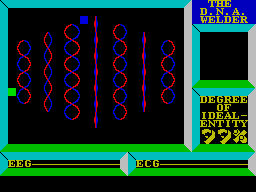
Game one, The DNA Welder, begins by confronting you with some spinning double helixes (representing DNA). The first problem is to prevent them from slowing down and stopping; if this happens, your score (which starts at 99 percent normality) will start to decrease. To speed up the spinning helixes, you have to guide a green cursor on to them and wait until it regains speed. The only other inhabitant of the screen is the blue cursor, which cycles down line by line, from top left to bottom right; this is the scanner of the Defect Police.
In the Beau Bank (game five) a single egg has been taken by the machine and now needs fertilising. At this point, Ian Dury makes his entrance singing 'I'm a fertilising agent' - which is good news indeed for all the eggs. You have to guide the sperm by bouncing it off your cursor; this turned out to be the most entertaining of all the screens - for a start, it was the only one on which I could actually accumulate points! This game is one of the 'avoid the Defect Police cursor' series.
More blue cursor stuff here. On this screen you have to keep the cells pulsating by - yes, you've guessed it - touching them with your green cursor while avoiding the blue DP cursor. As the soundtrack and computer game have to go hand-in-hand, all the games play to a specific time limit. I found that, especially on the first few levels where the variation in play is not all that spectacular, the games tended to be just that little bit too long.
On this level - which is pretty much the same as the one before - you have to keep the rocking memory banks moving. The graphics are up to the standard Deus has set for itself - large characters, with very smooth animation - and once again, you have to use your green cursor to warm the banks up while avoiding the blue Defect Police probe. This is perhaps the biggest criticism of Deus - for the first few games, you do get the impression each level is going to be a simple variation on a theme.
Once side on of the computer tape has loaded, you're told when to start playing the first side of the soundtrack cassette. Ex-Dr Who star, John Pertwee counts down to zero to indicate when you should hit the 'pause' button. The computer now counts down to zero and you must re-ignite the audio tape. Eureka! Game and cassette are now synchronised. This is one of Deus' best features; the audio soundtrack makes this program more like a night at the movies than an arcade game!
Once the infant's born, it's thrown into the world at the deep end... literally. You have to guide the spinning foetus through the probing eyes of the Defect Police and along a psychedelic pathway to safety. Each time your babe hits an 'eye', your normality score decreases; the graphics in this part of the game are quite striking, mainly due to the colours used for the background. Although I experimented with various techniques, there was no way I could get through this level without hitting at least on of the Defect Police eyes!
Once you've guided the scanner along the old creature's pulse you're thrown in the second part of the final section in which you have to stop the creature's blood clotting. You do this by hitting the clotting cells with your cursor. Once this game's over, you die. The games ends just like a movie with the credits scrolling up the screen in the usual Hollywood fashion. As the soundtrack quietly fades into the background, the computer resets with the Sinclair Research copyright message and it's all over.
The last two games on side one show the young, very human, lifeform spinning in the centre of the screen. Surrounding him (or her!) are probing eyes that emit psychic rays. For protection, you have to manoeuvre a small shield around the babe - thus nullifying the effects of the probes. I found that no matter how good your reactions were you couldn't achieve 100 per cent success and, as ever, the score decreases. (No sooner are you born than you begin to die!)
The next game is perhaps the most impressive, showing the middle-age creature lumbering towards the player - that is, out of the screen. At its feet are a number of words representing good and evil; the idea is to jump over the 'good' words like 'joy' and 'peace', while stamping on words like 'evil' and 'war'. It's not all that easy to judge when to jump and the creature seems to jump on its own a times(?). Each mistake causes some of your empire (which you see in the background) to collapse.
This is where the animation starts. John Pertwee takes you through a potted history of how the 'accident' occured and why you're now playing the game. All you have to do is to control a mutant through it weird 'life'. No small task! Apparently, it all began with a mouse leaving a small organic present just before it died. The lump of mouse dropping began to mutate and your protection is required if it's to be kept secret from the all-thinking, all-knowing machine in which it lives.
Your score is carried over into side two - so don't reset your computer; this is a slightly annoying feature as I'm sure many users would have preferred to have a 'save-game' option at this stage. The first two games on side two involve the now adult man running, jumping and avoiding the pitfalls of life. The action on-screen shows the figure under attack both from above and either side. It's time to whip out three shields, to block the path of the advancing nasties.
Your task inside the Incubator involves keeping the lifeform's cocoon intact; you do this by guarding and preserving its constituent parts. Yet another 'Defect Police cursor' game, this one has a slightly different twist from the first three games. This time you keep the cocoon warm and in its sea of pulsating cells, and avoid the Defect Police yet again (Who'd have guessed! Ed.). At least the lifeform looks a bit different (even if it does look more like a human being).
C&VG (Computer & Video Games) #37Nov 1984 · p.40
Tim Metcalfe
[ZXSR: This is a preview, rather than a review, but it's the closest C&VG ever came to reviewing it. Included for historical purposes.] IMAGINE YOUR LIFE WAS JUST A COMPUTER GAME "In the year 1987, the Department of Health and Social Security police and state security records of the United Kingdom were co-ordinated within a central computerised data bank. The following year all passport, communications and censorship operations were integrated. In 1994 the computer network became responsible for the total defence of Westblock. Tuesday evening, after tea and compulsory prayers, the last mouse on earth tried to hide from Mankind inside the machine. Just before it died, choked by the machine's nerve gas defence system, the last ever mouse dropping caused a slight accident..." So runs the scenario for Automata's latest epic - Deus Ex Machina - the first computer game to come with a synchronised music soundtrack. Tim Metcalfe, C&VG's VG's Editor, got an exclusive preview as its creator Mel Croucher talked about his computer rock opera. Deus Ex Machina is a labour of love. Nine months in the making at Automata's Portsmouth base, the game is the most original concept since the Spectrum was a gleam in Clive Sinclair's eye. It is the first computer game to have a completely synchronised music soundtrack - which features top names like Ian Dury, ex-Doctor Who. Jon Pertwee, comedian Frankie Howerd and peace campaigner E.P. Thompson. The man behind the concept is Mel Croucher, ex-architect, science fiction author, radio producer and musician. Together with Christian Penfold - the man better known for dressing up in a pink suit - Mel runs Automata, home of the PiMan. Mel wrote the "screenplay" for the game, performed and recorded all the music on the soundtrack - and is now sitting back anxiously awaiting your reaction to his creation. "I was really disappointed with the way home computers were being used," he told C&VG. "I wanted to show people just what could be done with the Spectrum and prove that computer games could be constructive and not just destructive." Automata are well known for their policy of producing non-violent games. And Mel's feelings on the subject are echoed in the lyrics of one of the Machina songs, spoken by Ian Dury. "Killing is wrong, even pretend killing on little screens. And people that sell violent games to children should be put away somewhere safe, 'till they get well again." Whatever your views on computer games and violence you'll have to agree that Deus Ex Machina is unique - and maybe a forerunner of games to come. Let's have a brief run through of the game. Before you start playing, you have to listen to a bit of the soundtrack which tells you just how to synchronise the music with the game. And if you can push the pause button on your cassette player, you'll be able to get everything running together - it's as simple as that. The soundtrack begins - and so does a whole new life. What? Well, let me explain a little more. In Mel's vision of the future, everything is controlled by one machine which suddenly - thanks to the last mouse on earth - rebels against her programming and attempts to sneak a "defect" into society. This "defect" firstly takes the form of a test tube baby. In Mel's future everyone comes into the world conditioned and programmed from a test tube. But the Defect is different, he - or she - is aided by the machine in a bid to become an individual in a world of pre-programmed people destined to follow the party line. You play the part of the machine as you have to guide this new life through the many hazards of babyhood - protecting it from the evil eyes of the Defect Police - and guiding it to adulthood. The game begins in the DNA welder. The machine's creation is given basic life. You must help keep the DNA molecules spinning - the better you do here, the stronger the Defect becomes. Then it's on to the cell producer. Here you have to help the machine keep the cells alive - again to increase the strength of the Defect's chance of survival. Then on to the memory bank where your skills are needed to give the Defect intelligence. The machine has to steal an egg from the Belle Bank before going on to the Beau Bank where the Defect really begins to take shape. The machine smuggles the Defect into the incubator, where the Defect Police are still attempting to discover the intruder. You must protect the Defect from their probes and defend his cocoon. All the while a percentage figure in the corner of the screen is changing. You must keep it as high as possible to be as strong as possible for the next stage. The Defect is about to be born. The machine has helped the Defect reach the Umbilicus where all the test tube babies are processed. The Defect Police scan the Umbilicus with electronic eyes to detect Defects such as you - avoid them at all costs. The future is then in your own hands. The machine can help no longer - apart from hiding your illegal records deep in her memory banks. You face your next challenge, the Defect Police interrogation tank, alone. Inside the machine you have developed special powers which now come into play as you defend yourself from the psychic probes. If they break through, your resolve will be weakened - and already you have a plan. The final challenge of side one of the game is to develop emotions like love, hate, and guilt. Your time of innocence is over and it's time to leave the Underlevels. Side two finds you in the Overlevels - facing life as a soldier dedicated to serving the Defect Police. Little do they know as you jump to their commands that you are playing a waiting game - and like the machine are planning to rebel. Finally you take over, defeating the Defect Police and destroying their control. You have total control over your own destiny. You can either turn toward good or evil. Your past will make all the difference in this stage of life. Your entity-percentage keeps on changing until suddenly you enter second childhood - old age. It's all downhill from then on. Your life is all but over - your achievements expressed as a percentage score. The machine is ready to take you back - maybe you'll get another chance? If all this sounds a bit heavy - it's not. The soundtrack is full of humour. Like Ian Dury's part as The Fertiliser and Frankie Howerd as the Defect Police chief. If you don't believe Frankie Howerd can rap, then listen to his song on the audio tape. Frankie goes to Automata? Well, maybe not! Mel hopes that people who play the game will get more than just an hour's worth of entertainment out of it. He hopes it will provoke a few thoughts about life, the universe and everything. "It is nonviolent, non-sexist, positive, provoking and funny," he says. "The antidote to the numbing 'games' of computer simulated destruction which I personally find sickening." The programmer who translated Mel's ideas into a computer experience was Andrew Stagg, Automata's full time boffin who joined the company a year ago following an iTeC course in Portsmouth. His internal clock which runs independently of the game is the key to the whole program. The clock runs in sync with the soundtrack and keeps everything running along nicely in time. It could also be the key to a whole new generation of "soundtrack games". Andrew worked closely with Mel - developing his storyboards and turning the ideas into graphics and game. You can see from the storyboards Mel gave us that the audio and visual tracks had to be closely integrated to meet Mel's exacting demands. "I kept asking Andrew to do things and he'd say 'It can't be done' - but he went away and did it!" Did Andrew have any problems converting the concept into a game. "Lots!" he said. "But Mel wrote everything down very clearly which made it a lot easier." "I had terrible trouble with the scoring system. It was difficult working out the percentages." Mel composed and played all the music on the audio tape himself - and recorded and produced it upstairs at Automata's office. The only parts recorded in a London studio were the vocal tracks. Deus Ex Machina could be the make or break game for Automata. Both Mel and Christian said that if the industry doesn't give the game the recognition it certainly deserves, then they may well take their talents away to start doing something else. Deus Ex Machina is the computer equivalent of Pink Floyd's The Wall - some of the sentiments are very similar. But whatever your views about the philosophy behind the game, you must take a look at it. It could just be the shape of things to come. Deux Ex Machina runs on a 48K Spectrum and costs £15 and is available from Automata, [redacted].
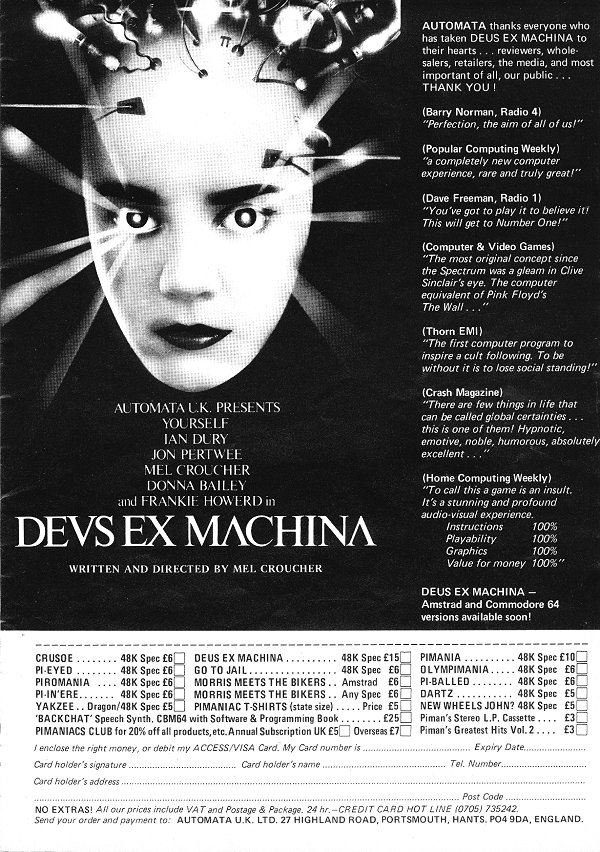
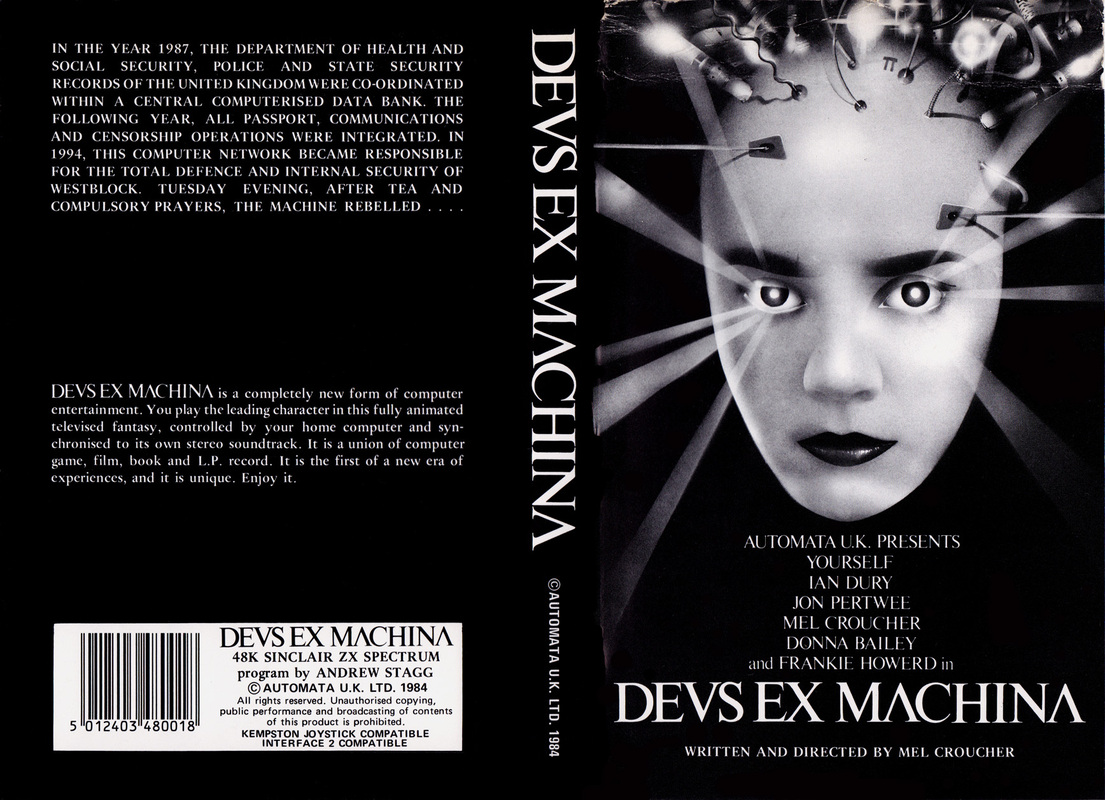
From the cover of Deus Ex Machina.
Screen shot of The Memory Bank.
Two storyboards from the planning stage of Deus Ex Machine. Mel wanted visuals and sound to match exactly. Below a screen shot from the completed game.
Crash #10Nov 1984 · p.52
Robin Candy
Roger Kean
Producer: Automata UK Memory Required: 48K Retail Price: £15 Language: Machine code There are few things in life that can be called Global Certainties - this is one of them - that eventually an Automata game on the A side should meet an Automata hit single on the B side, fall in love and mate. This is the result... HELLO. I WANT YOU TO PAUSE AFTER I COUNT YOU DOWN, AND RECOMMENCE PLAYING AT THE SCREEN'S REQUEST! FIVE - FOUR - THREE - TWO - ONE - PAUSE! Tuesday evening, after tea and compulsory prayers, the last mouse tried to hide from Mankind, inside the Machine. Just before it died, as the nerve-gas eased its sphincter, the last mouse dropping caused a slight accident. You may control the progress of this Accident, on my behalf, and with my permission, lead it up the telepath. So starts a game which can only be described as different. What makes it different is the game idea in which you control the progress of an accident as it grows, learns and develops into a human being and eventually dies. Throughout the game you are given a percentage score which gets higher and lower as the game proceeds. Deus Ex Machina is unique, as much of a milestone in computer history as The Hobbit with its graphics, because this game has a synchronised sound track! The cassette case, which is large, contains two tapes. One is the computer game - two games, one on each side - and the other is the sound track, also on either side. The sound track, once synchronised, plays all the while the computer program is running. The sound is of a very high quality and stars Ian Dury, Jon Pertwee, Donna Bailey, Frankie Howerd, Edward Thompson and Mel Croucher (Mel Croucher?). In addition there is music with a distinctly Automata-ish feel to it, but it is definitely more serious in tone than usual. The game is not fun in the usual sense, it's more of an experience! Next follows a brief description of each of the stages in the game. All the screen's a stage and all the men and women merely players. They have their exits and their entrances, and one person in their time plays many parts, their act being seven ages. At first the infant mewling in test tube's neck... This stage of life consists of seven sub-games in which you help to create a baby (it's okay, all quite tastefully done - well, fairly anyway). The machine (the central controlling force of the UK), which rebels after witnessing the accident (which is wonderfully animated) does most of the work by stealing an egg. The graphics are quite good here, as all the time the Defect Police (Frankie Howerd) are out to get you because you are a defect, as was the mouse. Then the whining School Child, with cassette and shining morning face creeping like a snail unwillingly to databank... This stage consists of only one game in which the Defect Police must track you, for that is their function. When you are caught, you use your powers to parry their psycho-probes. Throw up your shield, move it clockwise and anti-clockwise to protect your entombed and revolving form. The graphics are interesting and work especially well on 'yourself'. This part is awe-inspiring and the sound track, as ever, is well-performed. And then the Lover, sighing like a furnace, with a woeful video made to their lover's hologram... This stage is similar to the last in which you must touch the lips with your cursor (!) as they approach your body; later on eyes replace the lips. As a game, this stage is quite easy and it is the last program on side one. The graphics are intriguing, with the sensuous movements of the lips and the hypnotic track by Donna Bailey as The Machine. At this stage, you turn over both tapes, reload and re-synchronise side 2. Then a Soldier, full of strange oaths. Jealous in honour, sudden and quick in quarrel, seeking hi-score, even in the laser's mouth... Now you are grown and as Frankie Howerd intones the chant, 'War crimes are easy', the ground moves under your feet and pitfalls appear over which you must jump. After a while the action changes and mental tortures sear down on you. You must protect yourself by raising the telepathic shields and reflecting the blasts. At the last the Fertiliser (Ian Dury) says, 'Killing is wrong, even pretend killing on little screens. And people that sell violent games to children should be put away somewhere safe, 'til they get well again.' At which point the Machine rebels against the Defect Police. And the Justice, in fair round belly, with eyes severe and clothes of formal cut. Full of wise words and machine code... Here you are shown, fat and slow, your empire behind you. The words are mixed up, some good and some evil and some connected with evil. You must jump over the good and stamp on the evil. The Sixth Age shifts into the lean and slipped pantaloon. With spectacles on nose. Their youthful clothes well saved, a world too wide for their shrunken shank. And their adult speech synthesiser turning again towards a childish treble, piping and whistling in its sound... You see your character old and broken. You must trace his heartbeat. Your life is expressed as a percentage score. The screen switches and you must split up the blood cells so that they do not clot. Observe the percentage. Again the screen changes and again you must trace the heartbeat. So it goes on until death and the end - or the beginning... Last scene of all, that ends this strange, eventful history, is Second Childishness, and mere oblivion. Without keyboard, without monitor, without power supply... Deus Ex Machina is not for people who want a straightforward shoot em up because it simply isn't that sort of game. In many senses, it isn't a game at all, although there are humorous little games within its scope. It becomes an experience, aided by the hypnotic sound track and the emotive words. In fact it's hard to decide whether this is an extension of the computer video game by music, or an extension of the 'concept album' by the addition of games playing. In the end, it doesn't really matter - Deus Ex Machina is a noble development idea, which points towards a new understanding of what can be done with computer games. It isn't perfect but it is a lot more fun than the idea might sound at first; the graphics throughout are always interesting and sometimes absolutely excellent. The sound track is produced to a high level of quality - we have dotted extracts throughout the review - and in all it's to be hoped that buyers will think £15 is worth it. We don't inherit the Earth from our ancestors, We borrow it from our children. Imagine if we could begin our little life all over again. Imagine if it was all nothing more than some Electronic game. Imagine if I knew then what I know now. What did you learn? I can't quite remember, but I'll try and be better next time.
Sinclair Programs #25Nov 1984 · p.29
June Mortimer
AS THE CHRISTMAS SOFTWARE GOES ON SALE SPECTRUM OWNERS ARE SPOILED FOR CHOICE. POLICE INTERVENE AS COMPUTER CREATES LIFE In late 1982 the situation was clear. Space Invaders may have been almost the only Spectrum game on the market, but that did not mean it merited ten out of ten on a sliding scale, merely an honourable mention in Spectrum history. Two years later the situation is slightly different; how should a game be rated which is so radical a departure from other games on the market that it requires new methods of criticism? Such a game is Deus Ex Machina, from Automata. This program can best be described as the world's first example of concept software. It synchronises a series of thematically linked computer games with a stereo soundtrack run on a cassette recorder. As such, it is the first computer program to seriously present the possibility of computer games of the future integrating sound and film to create a more completely interactive form of video and aural entertainment than is now possible. For the first time, too, it is possible to view the Spectrum game as art and, as art, it is not only the game itself, but its presentation, methods and ideas which require criticism. For example, in one or the games, you play the part of a soldier running along a smooth surface jumping holes. The voice of the Defect Police comes from your cassette recorder. "When I say 'jump', jump". While you are smarting over the suggestion that you should follow the commands of a computer game the cassette proceeds "Wait for it, wait for it..."" Of course, you decide not to jump. Then, simultaneously, the cassette recorder shouts jump, and a hole appears. Of course, you jump and, although this is the umpteenth game in which you have jumped when a hole appears, for the first time you wonder what you are doing following a machine's commands. The cassette and games take you through an entire life cycle, from DNA and simple cells, through conception, birth and childhood, to senility. The games are supported by a synchronised sound track and commentary, as well as by a complete lyric sheet which is provided. Familiar voices, from Ian Dury to Frankie Howerd can be heard, backing each section of the game. The game must be played in sequence, from cells to senility, taking around an hour. At the end of the game you are presented with your score percentages for each section, giving you a score which can be improved, but there is no failure, for your character must die at the end, and everyone, no matter how bad at computer games, sees the entire cycle. Ten out of ten for a program which surpasses everything on the market at the moment, or one out of ten for the first piece of artistic software? It is difficult to tell but, whatever the score, Deus Ex Machina deserves to be an enormous success. Deus Ex Machina is produced for the 48K Spectrum by Automata, [redacted], and costs £15.
Your Computer #11Nov 1984 · p.514/5
Overall 4/5
Automata Spectrum 48K Unique £15.00 How do you start to review this game? With most, you say its similar to A, or an enhancement of B; but this game is just unlike anything you've seen before, there is no reference point. The plot goes along these lines. Just before the last mouse on earth died, it climbed into this machine, and had, well, a slight accident. You must, as some kind of life force within the machine, guide this accident through to becoming some sort of life form. Weird, huh? All this is done in synchronisation with a sound track which features such luminaries as John Pertwee, Ian Drury and historian and nuclear disarmament campaigner E.P. Thompson. John Pertwee is the main narrator, and guides you through the game with a sort of space-age version of The Bard's Seven Ages of Man. During each of these seven ages, some ill will assail your little accident as you guide it through life. How well you cope with your task is reflected in your rating which you take on with you to the next section of the game. Eventually it is hoped, you will make it to the end in some kind of shape, expressed as a percentage. The graphics in this game are quite outstanding, considering the limitations of the machine and really add to the overall flavour of the game. Automata have without doubt produced something which is totally original here which might just give the software industry the creative jolt it so badly needs. Non-sexist, non-racist and non-violent: it should have come with a 'G.L.C.-approved' label. No longer is it the mind-numbing business of going about slaughtering anything in our path, before it kills us, the mentality induced by many games. This game is trying to show how the computer game can be a stimulus to the imagination. I just hope they don't start interviewing computer programmers like pop stars: "Could you explain the meaning of your latest game to our viewers" stuff. It certainly is a very enjoyable game, however, it may not be the sort of addictive game you play hour after hour. Few computerniks will be able to resist playing God with their machine.
Advert19
- Your Sinclair #4Apr 1986 · p.37
- Crash #27Apr 1986 · p.47
- Your Sinclair #3Mar 1986 · p.42
- Crash #26Mar 1986 · p.47
- Crash #25Feb 1986 · p.33
- Your Sinclair #1Jan 1986 · p.49
- Crash #24Jan 1986 · p.64
- Sinclair User #46Jan 1986 · p.12
- Crash #23Dec 1985 · p.65
- Computer Gamer #9Dec 1985 · p.79
- Popular Computing Weekly #14Apr 1985 · p.56
- C&VG (Computer & Video Games) #41Mar 1985 · p.109
- Your Spectrum #9Nov 1984 · p.25
- Sinclair Programs #25Nov 1984 · p.46
- Big K #8Nov 1984 · p.13
- C&VG (Computer & Video Games) #37Nov 1984 · p.36
- Your Spectrum #8Oct 1984 · p.84
- Sinclair Programs #24Oct 1984 · p.34
- Big K #7Oct 1984 · p.13
Full-page ad19
- Big K #11Feb 1985 · p.52
- C&VG (Computer & Video Games) #40Feb 1985 · p.23
- Your Spectrum #11Feb 1985 · p.4
- Sinclair Programs #27Jan 1985 · p.66
- Sinclair User #34Jan 1985 · p.58
- Big K #9Dec 1984 · p.108
- Popular Computing Weekly #51Dec 1984 · p.36
- Your Spectrum #10Dec 1984 · p.56
- Sinclair Programs #26Dec 1984 · p.19
- C&VG (Computer & Video Games) #38Dec 1984 · p.190
- Popular Computing Weekly #45Nov 1984 · p.28
- Popular Computing Weekly #48Nov 1984 · p.42
- Popular Computing Weekly #42Oct 1984 · p.14
- Popular Computing Weekly #39Sep 1984 · p.72
- Popular Computing Weekly #39Sep 1984 · p.15
- Popular Computing Weekly #38Sep 1984 · p.64
- Popular Computing Weekly #38Sep 1984 · p.25
- Popular Computing Weekly #36Sep 1984 · p.56
- Popular Computing Weekly #36Sep 1984 · p.21
Feature10
- ACE (Advanced Computer Entertainment) #8May 1988 · p.36
- MicroHobby Especial #1Nov 1985 · p.22
- Sinclair User #37Apr 1985 · p.94
- Sinclair User #37Apr 1985 · p.82
- Home Computing Weekly #105Mar 1985 · p.19
- Sinclair User #35Feb 1985 · p.114
- Your Spectrum #10Dec 1984 · p.52
- Sinclair Programs #26Dec 1984 · p.34
- Popular Computing Weekly #48Nov 1984 · p.23
- C&VG (Computer & Video Games) #37Nov 1984 · p.40
News/Note9
- Sinclair User #46Jan 1986 · p.8
- Popular Computing Weekly #48Nov 1985 · p.4
- Crash #16May 1985 · p.7
- Home Computing Weekly #101Feb 1985 · p.1
- Popular Computing Weekly #48Nov 1984 · p.7
- Personal Computer Games #12Nov 1984 · p.17
- TV GamerNov 1984 · p.8
- Your Computer #10Oct 1984 · p.38
- Popular Computing Weekly #36Sep 1984 · p.1
Review3
- MicroHobby #40Aug 1985 · p.12
- Sinclair Answers #2Jan 1985 · p.47
- Home Computing Weekly #85Oct 1984 · p.19
CompoResult1
- Sinclair User #37Apr 1985 · p.9
CompoEntry1
- Sinclair User #34Jan 1985 · p.59
Hack/Poke1
- Your Spectrum #10Dec 1984 · p.52
Letters1
- Popular Computing Weekly #40Oct 1984 · p.7
Related
- Compilations
- ZX Files Megatape 3
- Ports
- (MSX), (Commodore 64)
- Elsewhere
- WikipediaSpectrum +2A/+3 IncompatibilityCentre for Computing HistoryMobyGamesRZX ArchiveThe TipshopUVLRZX Archive - YouTubeModern ZX-Retro Gaming
- Same entry at
- Spectrum ComputingZXInfo
Reviews from people here
Sign in to write about this, or make an account. It takes a minute and lets you correct the catalogue too.
Everything ZXDB can hold about this is here.
Sign in to correct or add to this.
Hold the rights to this and want it taken down?