
Dix Mille
Casual Game: Gambling · ZX-Spectrum 48K · 6 players · English
CCS · 1984 · Pound sterling 2.99
Discussion
Nobody has started a thread about this yet.
Play
- DixMille.z80.zipSnapshot image English11 KB
- DixMille.tzx.zipTape image English9 KB
Documents
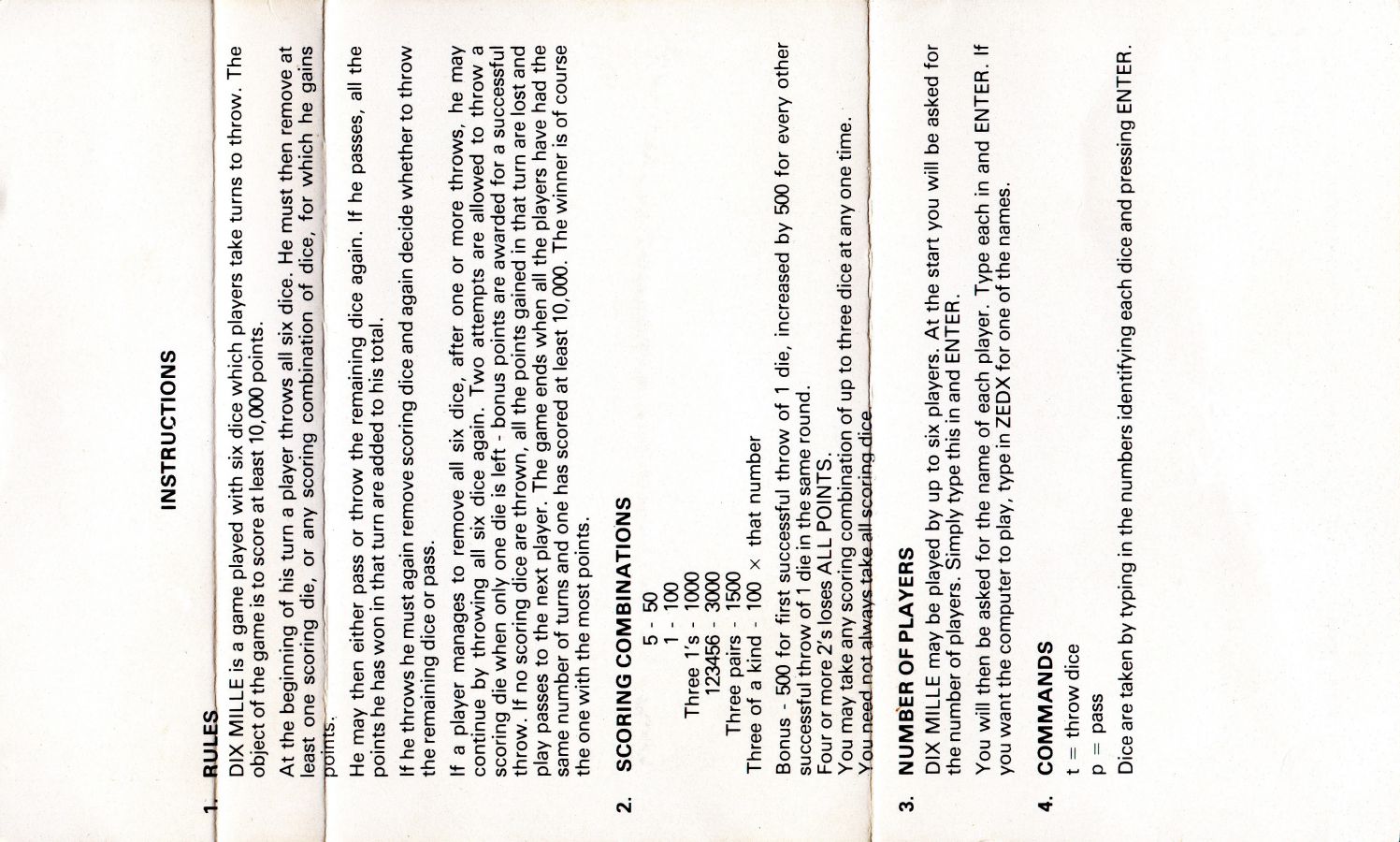
- DixMille.txtInstructions English3 KB
Files and rights
Distribution permission is on record, granted to another archive rather than to this one. Screens and pictures are copied here; everything else links to the archive that holds it.
- AllowedCCS → WorldOfSpectrum
Credits
- G.W. Lewthwaitecredited
Sign in to credit somebody, or say what these people did.
Scores
In the magazines
- Crash #91984 · Overall65%
- Sinclair User #301984 · Gilbert Factor5/10
Elsewhere on the web
- WorldOfSpectrum 5 votes5.80
In the magazines 7
Crash #9Oct 1984 · p.10063%49%72%68%68%70%65%
Use of Computer 63%
Graphics 49%
Playability 72%
Getting Started 68%
Addictive Qualities 68%
Value For Money 70%
Overall 65%
Unknown
Unknown
Unknown
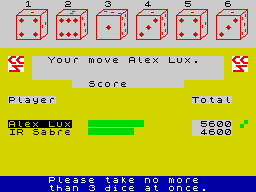
Producer: C.C.S. Memory Required: 48K Retail Price: £2.99 Language: BASIC & Machine code Author: G.W. Lewthwaite Another game from the Charlie Charlie Sugar budget range, an another board style game - this time with dice. For experts in the foreign tongue Dix Mille should present no problems, but for those who don't know that Calais is only forty minutes from Dover by hovercraft, it means ten thousand, and that's the points you're expected to score in this dice game. It can be played by one person against the computer or by up to six players with the computer looking after the dice and scores. Each player is given six dice to 'throw' and the object is to score points by getting winning combinations of dice. You score 50 for any five, 100 for any one, 1000 for three nes, 3000 for a combination of 1-2-3-4-5-6, 1500 points for three pairs and 100x the face value for three of a kind. Should you score a flush or three pairs your six dice are thrown again. After the first throw the player must 'take'at least one scoring dice and then throw the remainder or pass to the next player. Any scoring combination (eg a one a five and a five) may be removed before throwing or passing on. Obviously the less dice there are to throw the less likely the chance of getting a second scoring combination. If a player manages to remove all six dice successfully, then he may throw the six again. There are bonus points for successfully throwing only one die. The game ends when all players have had the same number of turns and one has scored at least 10,000 points. The screen display has a strip at the top for the six numbered dice, and below it an information and scoring area which prompts the players. Players names can be entered at the start of play. Incorrect or invalid entries are error trapped and an explanation of the fault given. If a winning combination happens to be the first, third and fifth dice in the row, the entry is simply made as '135'. COMMENTS Control keys: numerics plus 1 for throw and 'p' for pass Joystick: not needed Keyboard play: very responsive and fast despite BASIC entry routine Use of colour: very limited Graphics: simple, but effective 3D dice and throw Sound: simple beeps Skill levels: 1
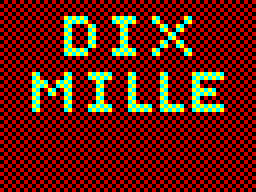
Nicely drawn and animated dice are a surprise treat in Dix Mille.
Sinclair Programs #23Sep 1984 · p.33
June Mortimer
Dix Mille is a dice game at which you can play the computer or your friends. The aim is to score ten thousand, and various combinations of dice produce different scores. It is neatly laid out and looks good, but surely anyone wishing to save money would simply buy six dice and play the game without the computer? Both cassettes are adequate, although far from spectacular. They are produced by C.C.S. Ltd, [redacted] and cost £2.99 each.
Sinclair User #30Sep 1984 · p.45/105/10
Gilbert Factor 5/10
John Lambert 5/10
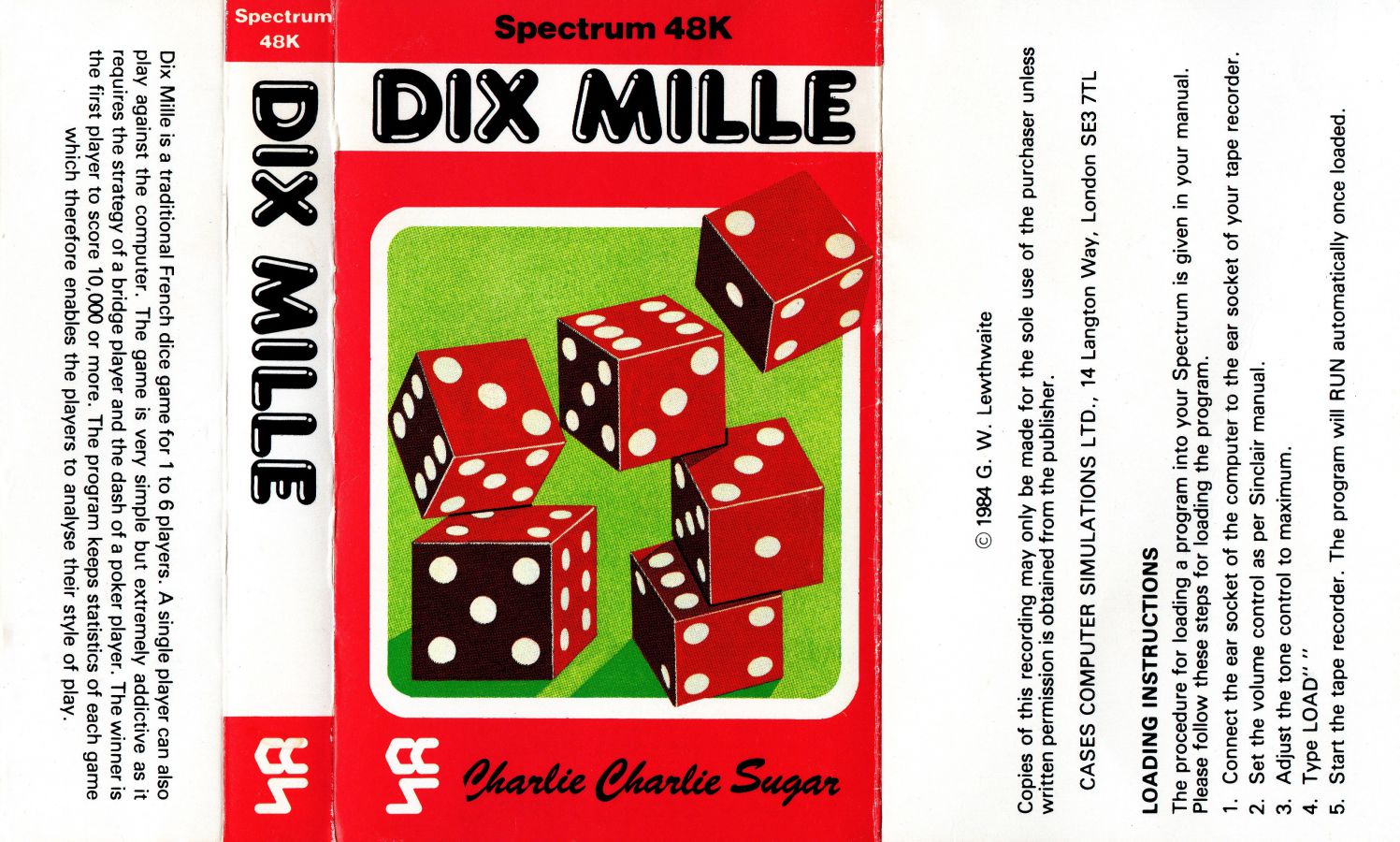
Memory: 48K Price: £2.99 Dix Mille, from CCS, is based on an old French dice game which is broadly similar to the English game of Poker Dice, although it uses six dice. The principle is very simple. You throw the dice, various combinations are allotted scores, and you then decide which dice to retain, which to throw again, or whether to pass them to the next player. It can be played by up to six players, of which the computer may or may not be one. The instructions on the cassette insert are not entirely clear but by playing with the computer for a few throws the process becomes simple. The dice are portrayed graphically but that is the only graphic content to the game. Therefore the screen is not particularly attractive. It seems to be the kind of game which is better played with real dice; the computer adds nothing and even seems to take away some of the potential excitement. The makers claim that it requires the "strategy of a Bridge player and the dash of a Poker player" but it is a little difficult to see the game in those exalted terms.
News/Note2
- ZX Computing #15Oct 1984 · p.14
- Personal Computer News #69Jul 1984 · p.5
Review2
- Home Computing Weekly #77Aug 1984 · p.6
- Popular Computing Weekly #31Aug 1984 · p.17
Related
- Same entry at
- Spectrum ComputingZXInfo
Reviews from people here
Sign in to write about this, or make an account. It takes a minute and lets you correct the catalogue too.
No description recorded.
Sign in to correct or add to this.
Hold the rights to this and want it taken down?