
Horace Goes Skiing
Arcade Game: Action · ZX-Spectrum 16K · 1 players
Sinclair Research Ltd · 1983 · Pound sterling 5.95
Also known as Horacio Esquiador (English)
Horace, 2 of 4

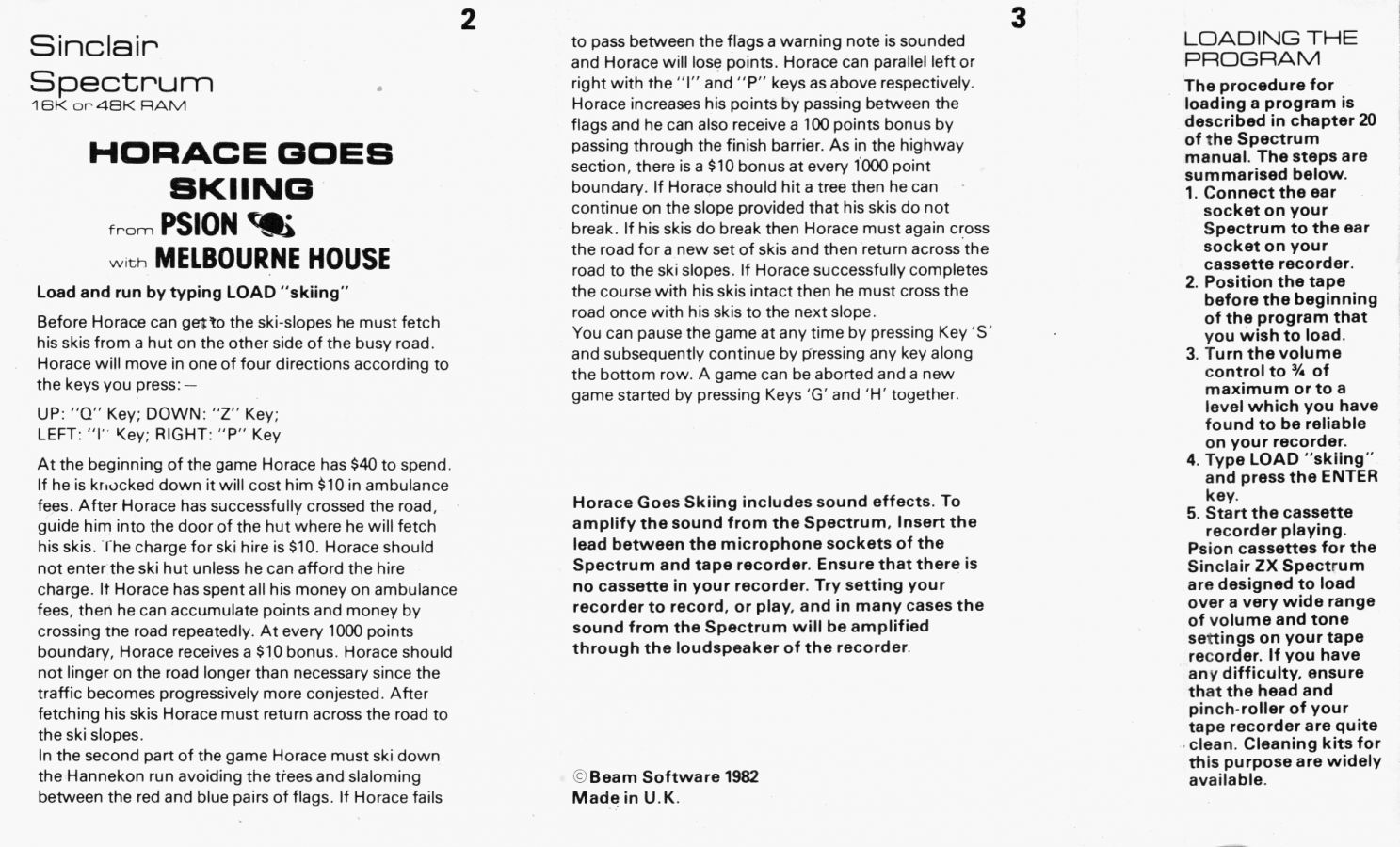
.jpg)
(InvestronicaS.A.).jpg)
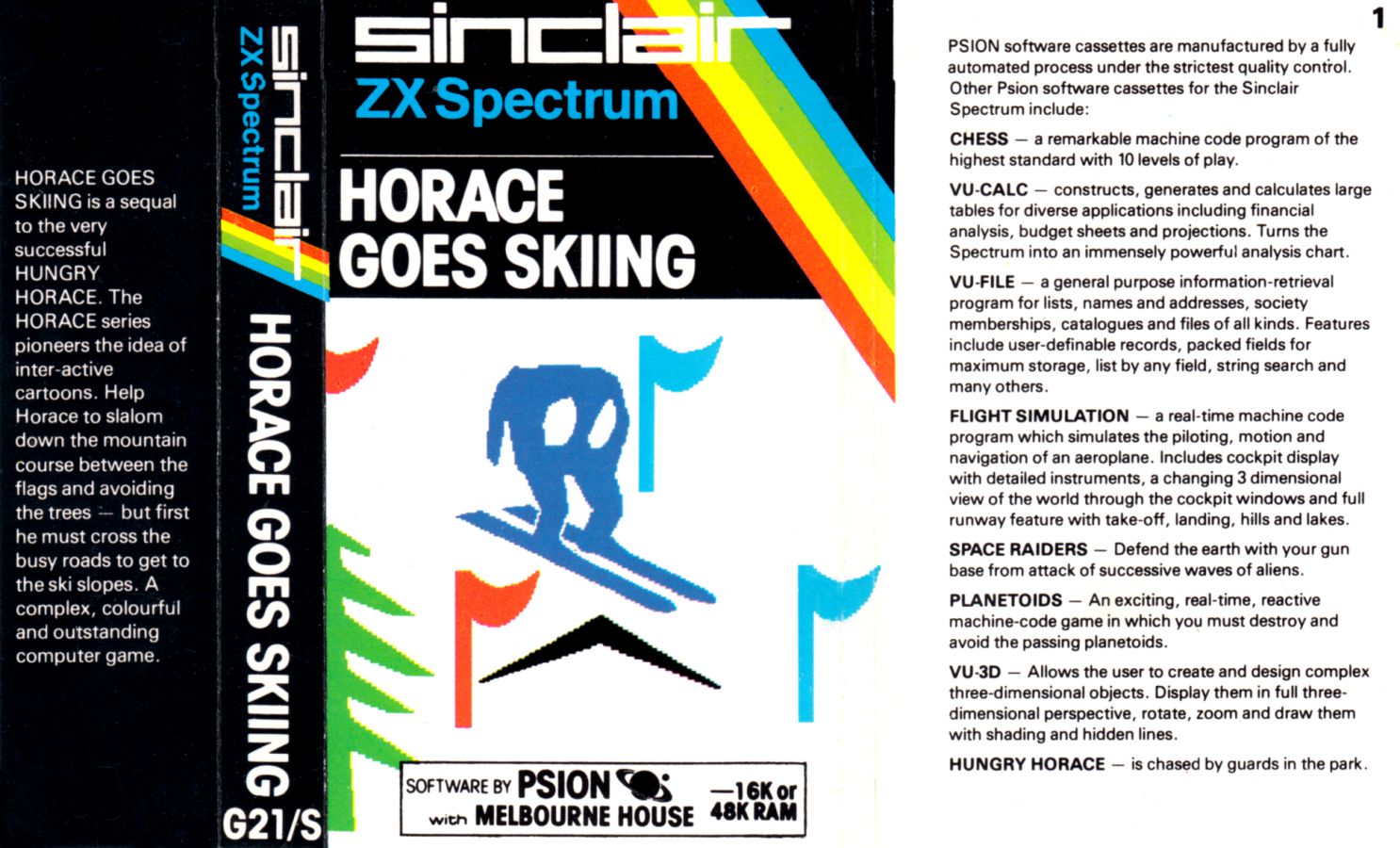
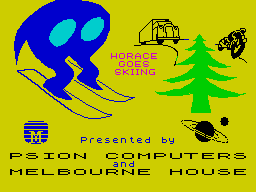
Discussion
Nobody has started a thread about this yet.
Remarks
ZXSR: Available on ROM cartridge. Featured on the SoftAid compilation.
Releases
- 1983Sinclair Research LtdPound sterling 5.95
- 1983Investronica S.A. Sold as Horacio Esquiador
Play
- horaceski.rzxRZX playback file
- HoraceGoesSkiing.tzx.zipTape image English8 KB
- HoraceGoesSkiing(InlayMisprint).tzx.zipTape image English8 KB
- HoraceGoesSkiing.tap.zipTape image English12 KB
- HoraceGoesSkiing(HoracioEsquiador)(InvestronicaS.A.).tzx.zipTape image Spanish8 KB
Documents
- HoraceGoesSkiing.txtInstructions English4 KB
- HoraceGoesSkiing(HoracioEsquiador)(InvestronicaS.A.).pdfInstructions Spanish10 KB
Other files
- Horace Goes Skiing (1982)(Sinclair Research).pokPOK pokes file 0 KB
Files and rights
Distribution permission is on record, granted to another archive rather than to this one. Screens and pictures are copied here; everything else links to the archive that holds it.
- AllowedSinclair Research Ltd → WorldOfSpectrum
Credits
- William Tangcredited
Sign in to credit somebody, or say what these people did.
Scores
Elsewhere on the web
- WorldOfSpectrum 94 votes7.49
In the magazines 30
ZX Computing #7Jun 1983 · p.214/54.5/55/54.5/54.5/5
Documentation 4/5
Addictive Quality 4.5/5
Use of Graphics 5/5
Programming Achievement 4.5/5
Value 4.5/5
James Walsh
PRICE: £5.95 MEMORY REQUIRED: 16K It looks rather as if Uncle Clive is taking Horace as a sort of semi-mascot, as this is the second in the series of programs in which he has starred. In the first part, Horace must cross the road and buy his skis without getting run over by the on surge of traffic. He then pays $10 for a pair of skis (yes dollars, what have they got against the pound sterling?). Horace then re-crosses the road, and if he is still alive, a skiing game commences. The graphics all the way through are excellent. Though both these have been done before separately, never before have the graphics been so good on one tape. Because they have managed to bring extra life and enjoyment into these games, they must be the best representations of either on a low-budget computer. Using the two games in conjunction produces one of the most addictive packages I have yet encountered. Horace Goes Skiing definitely helps set the new higher standard for Sinclair distributed software.
Personal Computer News #2Mar 1983 · p.614/55/54/55/5
Lasting Appeal 4/5
Playability 5/5
Use Of Machine 4/5
Value 5/5
David Tebbutt
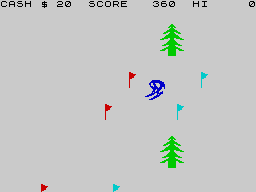
NAME: Hungry Horace, Horace Goes Skiing APPLICATION: Animated games SYSTEM: ZX Spectrum, 16K PRICE: £5.95 each PUBLISHER: Psion FORMAT: Cassette LANGUAGE: Assembler OTHER VERSIONS: Vic 20, £7.95 OUTLETS: WH Smith, all Sinclair dealers HORACE STORIES Just when you thought microcomputer games had nothing more to offer, Psion and Melbourne have come up with the electronic equivalent of the Mr Men books. The idea is that one cartoon character - in this case Hungry Horace - is central to a whole series of games. Hungry Horace has been around since September, and now the first successor, Horace Goes Skiing, has been launched. The Horace games seem suitable for seven-year-olds and upwards, and run on the 16K or 48K Spectrum. OBJECTIVES The objectives in both games is to amass points while attempting to prolong Horace's life. Hungry Horace gives you four lives, and you run round a succession of maze-like parks eating flowers while park-keepers try to catch you. Horace Goes Skiing gives you $40 to spend on skis and ambulance fees. The idea is to cross a busy road to the ski hire shop. If you run out of money, you can earn more by pushing your points over pre-set thresholds, or by deliberately crossing and recrossing the roads without mishap. FIRST IMPRESSIONS Both Horaces come in attractive packaging. The instructions are clear, although the spelling leaves a little to be desired . Both games are easy to learn, but hard to master as they become progressively faster and/or more difficult. IN PLAY The controls used are 'I' and 'A' for vertical movement and 'I' and 'P' for horizontal. Since you must use a keyboard, these are sensible letters to use. The idea is to negotiate Horace round a park eating the flowers and being pursued by up to four park-keepers, who are portrayed as ferocious-looking disembodied heads. If a park-keeper drops his lunch of cherries or strawberries, Horace earns extra points by eating it. Somewhere on each screen a bell is tolling. If Horace gets to the bell, the parkies turn white with fear and their hair stands on end. 'Skiing' uses similar controls, although vertical movement is controlled by the 'Q' and 'Z' keys. First, Horace has to cross a very busy road in order to get to the ski shop where he buys skis for $10. Then he has to cross back to get on to the ski slope. If hit by a vehicle, Horace has to stump up a $10 ambulance fee and then attempt to cross the road again. Once on the ski slope, Horace has to negotiate the usual nags, hillocks and trees. If he hits a tree, he can break his skis. But sometimes he gets away with it. A hillock can send him in any direction and passing between flags increases the points. VERDICT Neither game is completely original, but both are a lot of fun. Horace, like ET, is a lovable little chap and I think £5.95 is a reasonable price to pay for each of his adventures.
C&VG (Computer & Video Games) #17Mar 1983 · p.148/108/107/10
Getting Started 8/10
Value 8/10
Playability 7/10
Eugene Lacey
If you like pretty pretty graphics then Horace Goes Skiing may be just the game for you. The cute comic book character was first introduced to Spectrum owners last year when Psion Software launched their Hungry Horace game. In that episode the mischievous little gobbler ate the park attendant's sandwiches and prize winning daisies. The game begins with Horace attempting to get across a busy road as lorries, vans and cars thunder by. You must get him to the other side of the read without getting him killed. You have three lives in which to do this. Once he is safely across the read he can pick up his skis from his shed, put them on, hobble back across the road and then begin his attempt on the slalom. The first few flags are widely spaced and can be taken nice and gently. The game gets progressively difficult. Splendid graphics, an addictive game, and a lovable character in the shape of Horace all for £5. Horace Goes Skiing runs on a Spectrum in 16 or 48K and is distributed by Psion in W. H. Smiths.
ARTFUL ANIMATIONS Most computers acquire a library of sports simulations after they have been around for some time. The Atari now has several sports titles from standard soccer and basketball type games to more unlikely indoor sports such as darts and snooker. Graphics are important in sports simulations. Look for accurately marked pitches, thoughtful scaling, and authentic movements of the ball. In games that involve a lot of running, look for authentic simulation of the running motion of the players. Nothing is more ridiculous than a player moving around a sports field without moving his legs. Of course, computers are not yet sophisticated enough to reproduce all the elements of a game on a TV screen but they are easily capable of giving an enjoyable game if the cartridge has been well thought out. It should have two player options and also the facility to play against the computer when your friend is not around. The two player option if it is to be really effective should allow for simultaneous participation.,by two players. Finally, sound effects are also important in sports simulations. Check to make sure the computer produces some audible signal whenever the ball is struck or kicked and also when a goal or point is scored. Some of the better sports simulations have authentic sounding effects such as a leather ball being kicked, or the sliding of skis, even the cheering of the crowd has been incorporated in some games. All these things help to make a good game. The golden rule, however, as with buying all computer games, is to play them first whenever possible. Eugene Lacey
GAMES GLOSSARY If you can tell a Pacman from a Defender and a Galaxian from a Space Invader you probably know your way around computer games. But if some of the game terms we have used in this supplement, or in the issue itself, are new to you, then this page should supply the answers. In it we take some of the best known types of computer game and describe how they are played and what features these games normally incorporate. So, if we claim that Penetrator is a "Scramble-type game" and that leaves you just as much in the dark about what to expect, then below there is a full description of Scramble to put you in the picture. ASTEROIDS The Asteroids came into the arcades courtesy of Atari. It features a small dart-shaped craft controlled by the player which can rotate left or right and thrust or fire in the direction it is facing. There is one further control, the panic button (hyperspace) which lets you travel to another part of the screen chosen by the computer. The enemy is mainly made up of large asteroids which sweep across the screen in large deadly groups of rock. When blown up these break into smaller fragments worth extra points. There is extra danger supplied by two UFOs. The first larger creature you'll meet fairly early on. It tends to spray shots in all directions and often crashes into an asteroid. The smaller variety is far more deadly in its own shooting and also more difficult to hit. Each cleared screen means you start again with extra asteroids. DEFENDER You can't expect to keep a finger on every control button in Defender or you'd end up in knots. The action, which takes place above an alien landscape, involves some seven control buttons and takes patience to gain proper mastery of your lone craft. That patience can be rewarded though, as Defender is challenging from the word "Go". The Defender craft can go: up, down, thrust forward, reverse direction, fire, smart bomb and hyperspace. Ten humanoids wander on the landscape and these may fall prey to raiding alien creatures known as Landers. Landers pick up the humanoids and take them to the top of the screen. If they succeed in getting there the Landers turn into fearsome mutants hellbent on your destruction. In all there are six alien opponents. On top of Landers and Mutants, these are: Pods are quite harmless but contain the small and persistent Swarmers; Bombers seed space with white bombs and Baiters only appear if you take too long clearing a screen of the rest of the aliens. If all 10 humanoids are captured, the planet explodes and all remaining alien life attacks your craft at once. Defender games usually feature a small radar screen which shows what is going on at all parts of the planet surface. FROGGER Frogger has spawned a whole host of computer games with a similar theme. This game features a frog hero who must jump across a road and make his way across a river torrent to five frog-holes in the bank. The busy road usually features live streams of traffic travelling in both directions at varying speeds, between which the player must hop his frog without wrapping it around any fenders. Once across the road, the river can be crossed by leaping onto floating logs and onto the back of swimming turtles, until our frog can enter a vacant spot in the far bank. Turtles have a habit of diving though so don't let a frog dally too long on one. Being carried off the edge of the screen (by log or turtle) also results in a note in the funeral column of Amphibians' Weekly. When all five frog-holes have been filled, the game becomes more difficult with extra traffic being added to the road, snakes traversing the bank between road and river and alligators appearing instead of logs in the river. A timer running down on each frog also adds to the difficulties. The arcade original also featured a small lady frog who could be "picked up" on the logs and offered a lift home for a bonus. Other bonuses can be scored by entering a frog-hole in which a tasty fly meal has come to rest. DONKEY KONG Donkey Kong is the strange name for a climbing and jumping game which features a starlet-grabbing monster gorilla. Often referred to as Crazy Kong or Crazy Climber in the computer circles, it has only just found its way onto the home screen. The game features a gorilla holding a girl captive at the top of the screen and an intrepid hero (Mario the carpenter), who starts at the bottom of the screen. Between the two is a connecting network of platforms and ladders up which Mario must run to achieve his rescue. Kong hurls barrels down the screen and Mario makes use of his "jump" button to leap over them. He can also grab a hammer and smash the barrels as they approach him. Once at the top of the screen a new complex is built with Mario, again starting from the bottom with a view to rescue. This time the screen features a series of conveyor belts and deadly fires which travel around on the ladders and belts. GALAXIANS The Galaxians were the sons of Space Invaders. Instead of proceeding down the screen at a leisurely pace, they wavered at the top of the screen before swooping down in batches of two or three (or more often on a solo mission) firing bombs. The player has the usual left, right and fire controls on his laser base and must take care not to get trapped in a corner. He scores double points for a galaxian hit in mid-swoop and there are bonus points for taking out the red fleet commanders, who usually descend flanked by their generals, dispersing bombs at such a rate that the first instinct is to flee for cover. That is the essence of Galaxians but with each destroyed platoon, new waves appear at screen top and their attacks become more frequent, more accurate and, all too often, more deadly! PACMAN The ghostly world of Pacman is made up of a dot-filled maze, a hungry dot-eater and four pursuing spectres. Pacman variations can be found under a whole range of titles from Vic-men to Gobbleman, Snapper to Super Glooper and many others. Most dot-eating games are related to it. The main character is the dot-eater, which travels around the maze, eating every dot he touches. His objective is to clear the screen of dots. He is hampered in this by the four chasing ghosts whose touch is lethal. The Pacman's main defence against the ghosts, who usually number four, are energiser dots. These pulse in the four corners of the maze and, upon being eaten, reverse the roles for a short while. This means that Pacman can turn the tables on the ghosts and eat them for bonus points. He is allowed only a few seconds of dominance before the usual hunter and hunted rules come back into operation. It is also usual for fruits to appear on the screen occasionally and these too can be consumed by Pacman for bonus points. When Pacman has cleared the screen, it refills with dots and the game restarts except that this time the ghosts are a little livelier and a new fruit, worth extra points, appears at this level. SCRAMBLE Scramble should have a big one-way sign on its cabinet. The screen rolls from right to left, taking the player's craft along it into ever-increasing danger. Scramble variations often contain the word "Mission" or "Attack" but there are some weird and wonderful titles about. The player controls a craft heading right across the screen over hilly terrain His craft can never turn around and opt out of its mission but he does have some control over his destiny. His controls are up and down, fast and slow and he can both bomb and fire at his enemies. The Scrambler is not usually equipped with enough fuel to complete his task, but it is normal to obtain more fuel by bombing fuel tanks on the ground and so (mysteriously) replenish his own stocks. The enemies come in all shapes and sizes. Most common are missiles which fire up from the ground as your craft passes overhead and alien invader creatures which frequently inhabit caves and fly at the player's craft. The original Scramble game sent the player through a series of different terrains with new challenges in each section. And most computer Scrambles attempt to duplicate this with a number of different stages. Scramble requires a cool head which can find the right control in a crisis, but it makes an ideal computer game as success naturally leads to new and more difficult stages. INVADERS Space Invaders started the whole computer game craze back in 1977 and most gamers know the format backwards. Still, just a brief resume... The invaders come in waves above the ground and move in rows across the screen one step at a time, firing missiles earthwards. When one row of the aliens reach an edge of the screen, the whole platoon jump down a line and return back the way they came. When they achieve their slow progression to the bottom of the screen, the game ends. The player controls a laser base which moves left to right and fires directly up from its position. His aim is to blow up the entire fleet before it reaches the bottom of the screen. Flying saucers move across the top of the screen in both directions and can be hit for a mystery bonus score. In the arcade original, top saucer scores of 300 were achieved by firing 22 shots before shooting at the first saucer, then firing 14 shots in between each subsequent saucer. Some computer versions have copied this technique.
C&VG (Computer & Video Games) #16Feb 1983 · p.19
UP, UP AND AWAY WITH SPECTRUM Fly the flag with this latest flight simulation from Psion Software. The game is the most sophisticated flight simulation ever produced for a micro-computer. It represented a marathon programming exercise for the London based firm. It took over eight thousand man hours to complete with up to six programmers working on the project at any given time. Many of the features of this flight program are straight from the cockpit of a Boeing 747. The instrument landing system lines up a flashing dot with a cross which has been centred on the chosen airport. All information systems are displayed as dials just as in a real plane. These tell you your altitude, rate of climb, speed, wind and weather conditions, and your position. The game offers two screen presentations. The first of these shows the view from the cockpit with the instruments described above in the bottom of the screen and the view of the horizon in the top half of the screen. As the plane swoops down you can see land and lakes in the horizon appearing in front of you through the cockpit window. The plane can be made to bank, roll, dive, climb and even loop the loop - though you will have to be a pretty good pilot to make it do this. The second screen presentation shows a map with you plane, flashing its rate of progress. The airports are represented as flashing beacons with the land and lakes shown. Flight Simulation runs on a Sinclair Spectrum in 48K and is available from larger branches of W. H. Smith at £7.95. Also new from Psion this month is a second Horace tape. The original Horace game featured the cute comic character running around a park being pursued by the attendants. They were chasing him because the mischievous little glutton had just gobbled their sandwiches and eaten their prize winning daisies. In this second episode Horace goes ski-ing. You have to get him across a busy road to the hut where he keeps his skis. Hobble back across the road with skis on and Horace can then begin his slide down the snowy slopes. Good luck Horace! Don't fall over! Horace Goes Ski-ing runs on a Sinclair Spectrum in 16 or 48K and is in W. H. Smith stores now, at around £6.
Soft Aid carries this game and has 44 references of its own.
Spectrum Six Pack (ZX-Spectrum 48K version) carries this game and has 1 reference of its own.
Advert12
- Your Computer #1Jan 1984 · p.137
- Sinclair User #21Dec 1983 · p.174
- Personal Computer News #39Dec 1983 · p.19
- Home Computing Weekly #40Dec 1983 · p.10
- C&VG (Computer & Video Games) #26Dec 1983 · p.172
- Your Computer #11Nov 1983 · p.256
- Home Computing Weekly #37Nov 1983 · p.30
- Home Computing Weekly #35Nov 1983 · p.2
- Your Computer #10Oct 1983 · p.14
- Popular Computing Weekly #37Sep 1983 · p.29
- Your Computer #9Sep 1983 · p.103
- Your Computer #9Sep 1983 · p.122
Hack/Poke6
- Crash #40May 1987 · p.65
- Your Computer #1Jan 1986 · p.91
- Your Spectrum #15Jun 1985 · p.6
- Sinclair User #39Jun 1985 · p.18
- Your Spectrum #12Mar 1985 · p.5
- Personal Computer Games #15Feb 1985 · p.101
Review3
- Crash #12Oct 2022 · p.10
- Home Computing Weekly #8Apr 1983 · p.33
- Popular Computing Weekly #9Mar 1983 · p.13
News/Note2
- Computer ChoiceJul 1984 · p.8
- C&VG (Computer & Video Games) #16Feb 1983 · p.19
Information1
- SSD-IISep 1999
Tips1
- MicroHobby #67Feb 1986 · p.29
Feature1
- Crash #16May 1985 · p.43
Licensed from
- FroggerArcade coin-opunofficialKonami Ltd, Sega Enterprises Ltd
- SkiingSoftwareunofficial
Remakes
- Horace Goes Skiing2004PC/Windows
JD Games
- Horacio Esquiador2005PC/Windows
Panik Software
- Horace Goes Skiing (Remake)2013PC/Windows
David Powell
Related
- Compilations
- Soft Aid, Spectrum Six Pack (ZX-Spectrum 48K version), Spectrum Load'n'Run v1 issue 06, ZX-Spectrum Vega, The Spectrum
- Ports
- (Commodore 64)
- Elsewhere
- Speccy Screenshot MapsWikipediaFRGCBCentre for Computing HistoryMobyGamesRZX ArchiveThe TipshopUVLFRGCB TVRZX Archive - YouTubeModern ZX-Retro GamingSpectrum Computing RZX - YouTube
- Same entry at
- Spectrum ComputingZXInfo
Reviews from people here
Sign in to write about this, or make an account. It takes a minute and lets you correct the catalogue too.
No language recorded.
Sign in to correct or add to this.
Hold the rights to this and want it taken down?