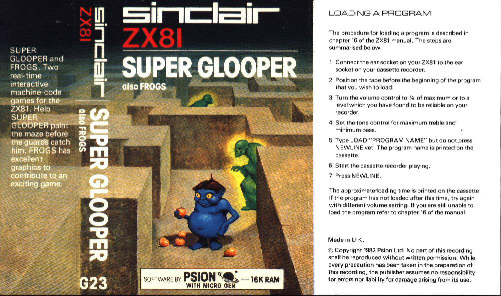
Super Glooper
Arcade Game: Maze · ZX81 16K · 1 players
Sinclair Research Ltd · 1982
Also known as Super Glooper also FROGS (English)
_Scan.jpg)
Discussion
Nobody has started a thread about this yet.
Play
- SuperGlooperAlsoFROGS.p.zipTape image English2 KB
- SuperGlooperAlsoFROGS_2.p.zipTape image English2 KB
Files and rights
Distribution permission is on record, granted to another archive rather than to this one. Screens and pictures are copied here; everything else links to the archive that holds it.
- AllowedSinclair Research Ltd → WorldOfSpectrum
Credits
- Steve Kellycredited
- Psion Software Ltdcredited
- Mikro-Gen Ltdcredited
Sign in to credit somebody, or say what these people did.
In the magazines 8
C&VG (Computer & Video Games) #19May 1983 · p.968/109/109/10
Getting Started 8/10
Value 9/10
Playability 9/10
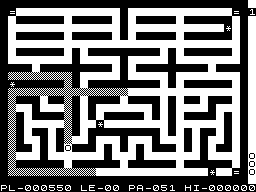
GIVE THESE GUARDS THE BRUSH OFF! Paint the numerous corridors of a maze and dodge the aliens. This is the challenge you face in the new ZX81 game from Psion called Super Glooper. There are five different mazes to choose from, and unlike the numerous Pacman-type games now on sale, you do not have to gobble dots, but colour the maze in as you move the Glooper around. To make things a little bit more difficult there are four guards, represented by inverse 'A's, who try to catch you. To help you deal with the guards there are four shields - represented as ':'s the lour corners of the maze. When you paint over these they turn the guards into inverse 'X's and you can then kill them off. On the B-side of Super Glooper is a bonus game based on the popular arcade game Frogger. Frogs is based on the second stage of the arcade version in which you must get your frog across a river by hopping from log to log. There are nine levels of play. Super Glooper and Frogs are available from most large branches of W.H. Smith at £4.95, running on the ZX81 with 16K RAM. Two good quality machine code games have got to make this cassette another winner for Psion.
Sinclair User #13Apr 1983 · p.30
John Gilbert
LEADING THE PAC New and varied life-forms now inhabit the Pacman maze. John Gilbert investigates. Pacman is part of what the video historians like to call the arcade maze craze. The game is set in a maze where a hungry little round creature eats dots and power pills scattered through the corridors. The monsters are ghosts which hunt the little man and will eat him if he is not agile enough to escape. If, however, the Pacman eats a power pill it can chase and eat the ghosts. The original game was introduced to the home computer market by Atari, primarily on its VCS video system and then on the 400 and 800 computers. The first versions for other computers, variously called Puckman, Gobbleman and Scoffer, arrived shortly afterwards and since then new versions have been released almost every month. Not surprisingly, the ZX-81 did not escape the craze. The authors of Zuckman, from DJL Software, claim that it is the first version of Pacman for the ZX-81. The game runs in 16K and is written in machine code, which gives the scrolling routines and Pacman a smooth movement. That is something unusual on the ZX-81, as most games flicker slightly. The game adheres as closely as possible to the original and the limited graphics of the ZX-81 do not matter much. One snag with playing the game on the ZX-81 is the membrane keyboard. Moving a Pacman around the screen using it can be difficult but not impossible. At the beginning of Zuckman the ghosts speed on their victim and if you panic trying to find the keys and do not press them properly you are liable to lose a Pacman or crash the machine. Once you have a fair idea of the game, however, it is surprising how quickly you can move the Pacman around. Zuckman is available for £5.95 on the 16K ZX-81 and Spectrum. Super Glooper is a version of Pacman, also for the 16K ZX-81, which is retailed by Sinclair Research. Glooper's task is slightly different from normal. Instead of gorging himself with power pills he has to paint the maze. Obviously the ghosts will not tolerate Glooper's antics - perhaps they do not like the smell of paint. The ghosts will try to kill Glooper as usual but if he can get round the maze and paint all the walls you have won. The game is very amusing and is well worth £4.95. The program will load in less than two minutes, so you will not have to wait six minutes to play the game. The launch of the Spectrum provided software houses with an excuse to try to produce the perfect Pacman which simulated the Atari version as closely as possible but Atari guards its rights over products jealously and investigated the products of several firms in the ZX industry. The Abbex Spookyman game is the most famous of the Spectrum versions. It also looks most like the original. Most games, until now, have included only dots and power pills in the mazes. Abbex has included dots, power blobs, diamonds, hearts, clubs, mean-looking ghosts and a cute little Pacman which looks like a diamond turned on its side. The keyboard is divided into three sections with left control on the left, right on the right, and up and down in the centre. The controls are very difficult to master but, once you have done so, usually with the aid of both hands, you will be surprised at the agility you can attain. At times the game is almost impossibly fast but Abbex estimates that the highest score possible after every screen has been cleared is 22,400. If you manage to reach 10,000 points you will receive a bonus life. We managed to go that far only once. Spookyman can be played by one or two players. If two play they take turns to control the Pacman. Their individual scores and the highest score are included at the top of the screen. There are two unusual features in Spookyman. The first is that you can reset the high score at any time between games; the second is that you can use a joystick. The game is compatible with the KempSton joystick and once you have seen it in action it is almost a necessity. Spookyman is available from Abbex and costs £4.95. Gulpman is another variation on the Pacman theme. The round Pacman is replaced by a little man running round the maze and the ghosts become frowning faces which smile only when they have caught Gulpman. The game is very complex and you can switch to any of 15 mazes in which to play. It is also possible to change the tempo. At tempo one the speed is bearable but at tempo 10 life is not worth living. The little man can fight back slightly more easily than in other games as he approaches with a fully-loaded laser gun. If the ghosts get too close you can blast them away but only until your energy runs out. It seems as if the space age is over-running everything. Gulpman is available from Campbell Systems and costs £5.95. Hungry Horace, from Sinclair Research, has developed a reputation as a fun game; in fact Horace is almost a legend. The game is a great improvement on the original and has remained at the top of the software top ten for some time. Horace is a large purple blob which has sprouted arms and legs. He wanders around the maze which looks like a park, eating everything in his path and trying to avoid the guards who act like ghosts and try to capture him. He can scare away the guards by using the alarm bell situated somewhere in the maze. If Horace reaches the exit of one of the mazes he can enter the next maze and continue to the next exit. The mazes become more difficult as Horace proceeds further in his adventure and we managed to reach only the third maze. With a large amount of skill, however, it should be possible to go further. Hungry Horace, for the 16K Spectrum, is available from Sinclair Research and costs £5.95. Although the arcade industry in the States, and now in Britain, is declining it is good to see that games concepts like Pacman are being transferred to micros. Some of the Sinclair versions of Pacman seem as good as, if not better than, the original Atari version. Games such as Hungry Horace are setting-up an interesting mutation in the Pacman concept. They also seem more interesting than the original version because they have added to the idea of Pacman. So far as the consumer is concerned it is to be hoped that concepts such as Pacman will not be destroyed within the industry. DJL Software, [redacted]. Sinclair Research, [redacted]. Abbex Electronics Ltd, [redacted]. Campbell Systems. (Dept. SU), [redacted].
ZX Computing #6Apr 1983 · p.26
Nick Pearce
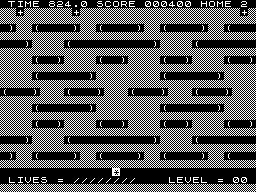
SINCLAIR SOFTWARE FOR YOUR '81 Our intrepid reviewer, Nick Pearce, inspects the new range of software from the Sinclair stable. SUPER GLOOPER - PSION I am sure readers will not need reminding that six Psion software cassettes were reviewed in the Oct/Nov 1982 issue of this magazine. Super Glooper is a cassette from the same stable, and like the other Psion software is also marketed by Sinclair. The cassette contains two games and on the A side is the title game, Super Glooper. It is, I suppose, really a 'Pac-Man' type game in reverse. Instead of rushing around a maze eating food pills or whatever, in this one you 'paint' each square of the maze as you go over it. There are, of course, four aliens who roam the maze, and the object is to paint the whole maze before they catch and destroy you. You have four lives per game. In each of the four corners of the maze is a shield, and if you can reach one of these you may catch one, or more, of the aliens. For each square in the maze that is painted, a score of 10 points is given, and for each shield you get 50 points. It is profitable to chase the aliens - once you have a shield, of course - since you get an incredible 1,600 points if you catch all four aliens with one shield. Of course, shields do not last for long, and catching more than even one alien is not an easy task. HANG ON... A nice feature of this game is a pause facility. If you get in a fluster - with an alien close by, you might suddenly be unable to find the right keys to get away from him - you can pause, or freeze, the game while you compose yourself. However, I found Psion's choice of control keys rather difficult to get used to. Keys 1 to 5 move you up, for example, whereas I would rather be able to use any of the keys in the top row for up. This is, of course, very much a matter of personal preference, other players might well by quite content with Psion's layout. If you manage to completely paint a maze, more difficult mazes appear. If you find the slowest speed to easy, there are five levels of play to choose from and these can be selected at the start of each game. Super Glooper is written in machine code. It is a short program and takes only 80 seconds to load. If you have already got one of the many versions of PacMan now on the market for your ZX81, you will probably not be very interested in this game. If not, you may well find it a useful addition to your library of games. Not a particularly inspired game, but competent and well-written, and quite good fun. JUMP TO IT I also found Frogs, on the B side, an enjoyable game. It is similar to 'Frogger', the basic idea being simple but quite effective. The screen displays a river with two banks, one at the top of the screen and the other at the bottom. On the river are nine lanes of boats, with boats in adjacent lanes travelling in opposite directions, left to right and right to left across the screen. (The screen looks rather like a bird's eye view down on a very busy motorway). Eight frogs wait on the lower bank and the object is to help them each in turn across the river to five jetties on the upper bank. They must jump from boat to boat, if any land in the river or miss a jetty they are lost. Points are scored for each frog that successfully crosses the river. Two factors make this game more difficult: there is a time limit for each game (100 seconds); and once a jetty has been reached by a frog, that jetty cannot be used again in that game. Whilst the jetties 'downstream' of the last lane of boats are relatively easy to reach, those farthest upstream are much more difficult to land on. As well as jumping forwards across the river, frogs can jump backwards and left and right along the top of the boats (although they cannot jump from the back of one boat to the front of another coming along behind). Apart from the last frogs, where some manoeuvering is sometimes necessary to get to a still vacant jetty, I found I tended to use the forward keys only. Again, this is a machine code game and the program is quite short taking about 1.5 minutes to load. Movement is smooth and the game is pretty well idiot proof. There are nine levels of play, harder games having faster moving boats, A league table that can record the scores of up to eight players is displayed at the end of each game, so a competition between players can be held. This is the sort of game that requires a lot of concentration. It would probably make a very good alternative to the breathaliser test - a drink or two and I would imagine that it would become well nigh impossible to get any frogs across as the moving boats just form a blur in front of your eyes. Frogs is not a complicated game, but it is well-written, works well and is enjoyable. At £4.95 for the two games, this cassette represents reasonable value for money. Reversi costs C 7.95 and Super Glooper costs £4.95. All the cassettes featured in this review are marketed by Sinclair Research and are available from: Sinclair Research Ltd, [redacted] and selected branches of WH Smith Ltd.
The score board for the Frogs game.
Sinclair User #12Mar 1983 · p.62
John Gilbert
SINCLAIR ACTS TO IMPROVE THE STANDARD OF ITS NAMED SOFTWARE John Gilbert looks at the latest group of cassettes issued by Sinclair and finds that it is now setting the standards. A new batch of Sinclair Research software for the ZX-81 and Spectrum shows a marked improvement in the quality of programs and a continuation of fine artwork on the cassette inserts. The reason is that the company is selling programs from other independent companies, such as Melbourne House and Artic, instead of continuing to rely on Psion, Mikro-Gen and ICL. The Hobbit which takes first place in the new releases for quality and value for money. This adventure game, which the makers claim uses artificial intelligence, is discussed in Mind Games on page 93. VU-3D, for the 48K Spectrum, is another good offering from Psion. It allows the user to create a three-dimensional representation of an object on the television screen. The object can then be rotated and viewed from any angle. The objects can be displayed as wirework figures or can be shaded. They can also be magnified and reduced. It is possible to store the figure on tape in a data file and re-load it to view again. The program costs £9.95 but even though it has some good features it still seems over-priced. Games feature strongly in the new tapes. Sinclair is selling the Artic range of adventures, A, C and D. Adventure A works on the 16K or 48K Spectrum and 16K ZX-81 and is called Planet of Death. You are stranded on a planet and must return to your spaceship. There is no guide to the keywords but with a little thought you can discover the help command. At times the suggestions can be very unhelpful and it is a good idea to construct a map, as some of the help suggestions may make you retrace your footsteps. The next adventure so far released is C, called Ship of Doom. It can be run on the 48K Spectrum and 16K ZX-81. Your ship is captured by aliens who are searching for humanoids to replace their brains with microchips. The object of the game is to escape from the alien craft by breaking the gravitational field. To do so you must find the control room of the alien ship. The help command is a little more useful in this game and it is easier to get further when playing the game. Adventure D, called Espionage island, can be used on the 48K Spectrum or 16K ZX-81. You must escape from an aircraft which is about to crash into the Atlantic. You must the reach the island safely, avoid capture, and try to discover the secret of the island. The game is more difficult than the others and many people have not managed to get out of the aircraft, even though there is a parachute. All the adventures cost £6.95. Leaving adventure games, Reversi, or Othello as it is sometimes called, can be played on the 16K Spectrum or 16K ZX-81. The game has nine levels, from novice to expert, and the computer is difficult to beat. The makers claim that Reversi reflects the strict contemporary morality of Victorian society but we believe that it can traced to Arabic origins. Reversi costs £7.95. An interesting addition to the range of software is the Artic 1K Chess. It takes some technical wizardry to squeeze this kind of game into the unexpanded ZX-81. The game can be played using one of two opening moves. Because of the lack of memory, castling, pawn promotion and capturing en passant are not allowed. The game loads in approximately 40 seconds and that is ideal for someone who wants a quick game of chess without having to load from a tape which takes several minutes. The computer also makes its moves very fast for the amount of memory available to it. 1K Chess costs £4.95. Super Glooper is an amusing game of Pac-man on the 16K ZX-81. Glooper must paint the maze before the aliens kill him. Unfortunately it is difficult to evade those aliens using the standard ZX-81 keyboard but it is not impossible. Glooper can also pick up one of the shields at the corners of the maze to protect himself and chase the aliens. On the other side of the tape is Frogs, a game of Frogger. You must get the frogs over the river via the moving boats to the jetties on the other bank. If froggie falls into the river, it drowns. You score points for each frog you get across the river and you can have eight frogs to send to their deaths. Super Glooper and Frogs cost £4.95. Another game with a familiar-sounding theme is Through the Wall. It is based on Breakout and is available for the 16K ZX-81. On the other side of the cassette is Scramble, also a familiar theme. Both games on one cassette represent good value at £4.95. A package for the 1K ZX-81, called 1K Games, has also been released. The games include Jackpot, in which you must try to win the 25 pence jackpot from a one-armed bandit; Etch and Sketch, where you can draw pictures on the screen; and Maze Game, where you must find your way out of the conventional maze. The release of this cassette, costing £4.95, is a good idea at a time when so many people are buying ZX-81s. A basic Toolkit is available for the 16K ZX-81. It provides a series of machine code routines to make the job of programming easier. It includes a re-number routine, a search and replace routine, a merge routine to put together two separate Basic programs, and a routine to put a Basic program above RAMTOP and out of the way of the NEW command. The Toolkit costs £5.95. Two database programs are available in the range for the 48K Spectrum. They are called Collector's Pack and Club Record Controller. Collector's Pack can be used to store information about coins, stamps or even records. The Club Record Controller will store information about people such as addresses and telephone numbers. It would be useful to schools or even someone who runs a private club. Both packages are easy to use and cost £9.95. Adventure B, Inca Curse, for the 48K Spectrum is an upgrade of an adventure which Artic wrote for the 16K ZX-81. The adventurer is exploring in the jungle when he finds an Incan Temple. The aim is to go in and drag out all the treasure, or as much a you can carry. It all seems so easy until you enter the game and step into the temple. The authors have managed to cram a good deal into this adventure and the Artic top score of 3,200 points will take some beating. We must admit that it is not one of the adventures in which we have made much progress. Adventure B costs £6.95. The latest release of tapes is certainly better than the previous one. The games, utility, and business areas have been covered well but there is still a lack of good educational software. The only tapes available tend to be multi-choice and question-and-answer sessions. The Psion tapes seem to be the best for quality at the moment and the ones with the most interesting concepts. None of the cassettes reviewed was bad but The Hobbit, Vu-3D, 1K Chess, and Super Glooper seem best.
C&VG (Computer & Video Games) #16Feb 1983 · p.19
DON'T GET CAUGHT ON THE HOP! Ribbit! Ribbit! Hi, my name is Frogs and I've just been hopped out of the arcades to become the latest game for the ZX81. You can find me on the B side of the latest Psion game called Super Glooper. Frogs is a version of the popular arcade game Frogger in which you have to hop our hero to the safety of the bank on the other side of the river. In Super Glooper you must paint in as much of the maze as possible before the guards catch you. Also new from Psion this month and bringing a touch of arcade action to your ZX81 is Thru the Wall and Scramble. Thru the Wall is a version of the early arcade hit Breakout. Super Glooper and Thru the Wall are available from W. H. Smith at £4.95.
Super Glooper carries this game and has 8 references of its own.
Feature2
- Sinclair User1984 · p.24
- Sinclair User #13Apr 1983 · p.30
News/Note1
- ACE (Advanced Computer Entertainment) #14Nov 1988 · p.9
Licensed from
- Pac-ManArcade coin-opunofficialAtari Games Ltd, Namco Ltd
Contains
Related
- Compilations
- Super Glooper
- Same entry at
- Spectrum ComputingZXInfo
Reviews from people here
Sign in to write about this, or make an account. It takes a minute and lets you correct the catalogue too.
No language, description, tag recorded.
Sign in to correct or add to this.
Hold the rights to this and want it taken down?