
Adventures of Barsak the Dwarf
Adventure Game: Text-Only · ZX-Spectrum 48K · 1 players · English
Gilsoft International · 1984 · Pound sterling 5.95
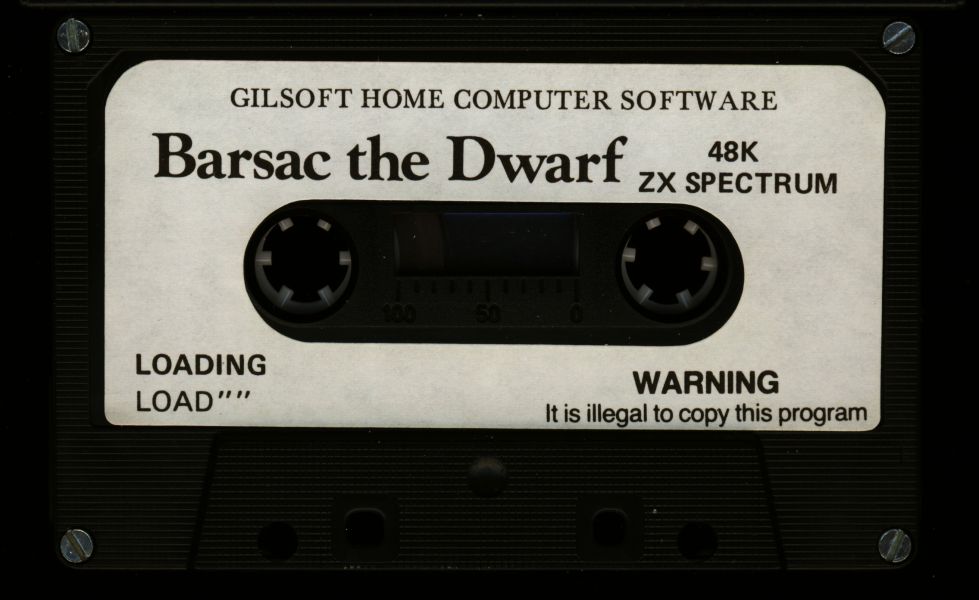
Also known as Barsac the Dwarf (English), The Adventures of Barsak the Dwarf (English)
Discussion
Nobody has started a thread about this yet.
Play
- AdventuresOfBarsakTheDwarf.tzx.zipTape image English15 KB
- AdventuresOfBarsakTheDwarf(different).tzx.zipTape image English13 KB
- AdventuresOfBarsakTheDwarf(different)_2.tzx.zipTape image English15 KB
- AdventuresOfBarsakTheDwarf(different)_3.tzx.zipTape image English15 KB
- AdventuresOfBarsakTheDwarf.tap.zipTape image English12 KB
Documents
- AdventuresOfBarsakTheDwarf(EN).txtInstructions English3 KB
Files and rights
Distribution permission is on record, granted to another archive rather than to this one. Screens and pictures are copied here; everything else links to the archive that holds it.
- AllowedGilsoft International → WorldOfSpectrum
Credits
- P. Napolitanocredited
- V. Napolitanocredited
- The Design Studiocredited
- Terry GreerInlay/Poster Art
Sign in to credit somebody, or say what these people did.
Scores
In the magazines
- Crash #41984 · Overall53%
- Big K #51984 · Overall1/3
Elsewhere on the web
- WorldOfSpectrum 2 votes4.50
In the magazines 35
Sinclair Programs #23Sep 1984 · p.33
June Mortimer
Gilsoft has demonstrated its faith in its adventure designer program, The Quill, by producing a series of adventures which have been written with its help. Each adventure is excellent and there is great variety in the series. Africa Gardens is set in a haunted hotel, where voices can be heard in the next room but people can never be seen. Each unnerving location is described in depth and certain sections are illustrated. It is largely an adventure of exploration in which objects found help with movement to other locations. Mindbender runs along very different lines. The player begins in an office notable only for its lack of interest. One movement, though, sends the bemused player into an intricate Welsh adventure. Barsak the Dwarf demonstrates the ability of The Quill to set a time limit on an action. Soon after the game begins the player becomes hungry and must find a jar of pickles before starving. Once that problem has been overcome, thirst rears its ugly bead. Again, it is a good adventure but it does not reach the standard of Castle Blackstar, to which it is remarkably similar. Diamond Trail is possibly the tightest-written adventure on the market. Every object has a use and every location must be visited at least once. Once again, hunger sets in early and there is also a homicidal maniac chasing you with a gun. Another problem is that taking certain objects results in your being arrested. Can you survive to eat the hamburger, let alone solve the quest? One difficulty occurs late in the game. The author has been unfairly sneaky inside the railway station and once you are there you have almost finished the adventure. Save the game before presenting your ticker or you may find yourself having to repeat the entire adventure. All in all, an excellent series of very different adventures, produced by Gilsoft, [redacted], price £5.95 each.
Micro Adventurer #10Aug 1984 · p.20
Tony Bridge
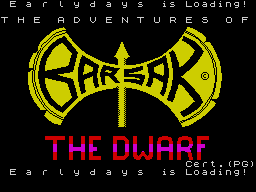
RIFLING RHE FEATHERS IN THE QUILL'S CAP Tony Bridge dips into adventure ink and Gilsoft Gold Gilsoft Gold Collection Spectrum 48K £5.95 each Gilsoft [redacted] I have been extolling the virtues of Gilsoft's Adventure Generator since the Quill was first released. Using this program, anyone with a Spectrum or a CBM64 can compose a machine-coded Adventure. There are a lot of people with the imagination to write absorbing scenarios, but coding these into a fully-fledged program usually proves too great a barrier. The Quill frees the user from the hard work of writing, debugging and so on, allowing full attention to be devoted to crafting the plot. There is, however, a drawback to all this: the structure of all these Quill'd programs will necessarily be the same. The general layout of the screen and many of the responses (for example, DO YOU WANT ANOTHER GAME?) are recognisably Quill and nobody seems to have found a way round the final "OK HAVE A NICE DAY. BYE" So, while The Quill allows the author's imagination full rein, the scenario really has to be special to stand out from the rest. This month, I am going to look at a new collection of adventures from Gilsoft, the publishers of The Quill, and see how different writers handle the generator. Other software houses have released Quill'd Adventures in the past couple of months - in fact a flood of them! Some of them have gone to great lengths to make their programs look less like the result of an adventure factory. How do Gilsoft's own attempts differ? Under the inclusive banner of The Gold Collection, the release consists of seven adventures, two of which, Magic Castle and Diamond Trail, have been with us for some while. CLIVE'S PROBLEM Diamond Trail is probably the very first Quill'd adventure, written by Tim Gilbert, one of the founders of Gilsoft. Released in 1983, it starts off with a nice title page, featuring a 3D Diamond (and Mr Gilbert's dog?), and then goes into the scenario. This consists of the usual groan-inducing play on poor old Sir Clive's name: "The Sinclive Diamond has been stolen from the Jewel Room of Spectraisia's Capital, Microdrivia. You must restore it in as short a time as possible, before the public begin to doubt its existence." Hello, a very subtle in-joke about the QL (and a year before its launch!). The instructions that follow this opening are repeated in a fairly similar form in many of the Gold Collection Adventures: the player is reminded of the Verb/Noun convention, and that the program will accept the first four letters of an object's name, thus saving the player's poor little digits! The screen layout in this Adventure is rather restrained - the default colours of white-on-blue are replaced by white text on black paper. The responses, as is usual with any Quill'd adventure, are immediate. Almost straight away, the player is told that he feels hungry. In just about every adventure, this means that you have only a very limited number of moves before you die, and this concentrates the mind wonderfully! If you find a way of staving off the hunger, a man appears at every move to shoot you (this will eventually prove fatal), or you may get run over by a car, while standing, meditating your next move, in the middle of a road. Try stealing the church collection (but you wouldn't think of that, would you?), and you will be unceremoniously dumped into jail, where the local police have a unique way of dealing with petty criminals! Diamond Trail is one of those adventures in which almost every move depends on what the player did in the previous move - be prepared to keep going back to the beginning time and again while finding the best route through the puzzles. CASTLING Magic Castle is written by Graeme Yeandle, and was the second Quill Adventure to be released. Oddly, there is no title screen, as with all the others in this collection. This adventure has a pretty succinct scenario - "You have to rescue the Princess who is imprisoned in the Magic. Castle". Not exactly atmospheric, is it? Then follow the same instructions as in Diamond Trail, highlighting the fact that many of the Quill'd adventures can appear the same - but this one doesn't hold the attention like its predecessor. The same sort of hazards abound (beware the booby traps and vampires, says the blurb): minefields can easily be stepped into, with fatal results, and this time, the player gets thirsty, rather than hungry. That takes care of the booby traps - I'm afraid that I can imagine the Vampires! It's a rather pedestrian adventure; that is, nothing really adventuresome happens (at least in the first stages - Gilsoft didn't supply any maps or playsequences with this collection), and the player will die of sheer boredom. Besides, who wants to rescue another Princess? Let them stew, says I! One of the newer programs in the Gold Collection is Devil's Island, (author: Colin Smith). After the title page (a lovingly-drawn skull set against a menacing prison block), we see again those instructions that we have come to know from the other Quill adventures - Verb/ Noun, first four letters of the Noun etc. Somewhere in the two or three pages of instructions, the program tells you to refer to the cassette inlay for further instructions; but the inlay only tells you how to load the program, and that has presumably been accomplished by this time. CRUEL "Briefly, your task is to escape from the infamous prison on Devil's Island... Then, if you survive the perils of the surrounding jungle, to reach the mainland and freedom!" The first location is "a grim prison cell." You can see a filthy bed, a barred window, and a closed door. The door can easily be opened, and then it is out into the corridor, at the end of which is a clutch of cruel guards. One of these will shoot you without the slightest provocation, as I found to my cost. There are one or two things to be found in the cell before you leave - these may or may not be of help to you later in your bid for freedom. The Guards will plague you at the start, as they are rather trigger-happy (although the Tasty Pie may keep their attention diverted for a moment!). Sound is also used in Devil's Island, even though it is the pitiful BEEP. Although I didn't get very far with this one, I have the feeling that the later stages will prove to be v-e-r-y interesting! Barsak The Dwarf seems to be suffering an identity crisis, with his name spelt in two different ways throughout the packaging. This adventure, Written by P & V Napolitana, seems to be the first part of a series. The title page announces "Earlydays loading," which would seem to point to a follow up. The scenario of this PG-rated adventure goes like this: "In ancient days of the mythological underworld, the dwarves held the Nine Treasures. Now Barsak seeks the lost Treasure again. To complete the Adventure you must wear or carry all nine of the Treasures and sign the book at the end." CONAN The design of the screen is rather nice - bright white text on a blue paper for the location descriptions, and dull white for WHAT NOW and the player's commands. Responses are in various hues, which all makes for a rather colourful display. Again, the player will start to feel hungry after a few moves, but it is a fairly simple task to find food to allay this feeling. Once hunger is overcome, thirst almost immediately becomes a problem, and one that is not quite so easy to overcome (well, I haven't managed it yet). There is a lot of tramping around the castle to do, and many of the objects lying around will put you in mind of a Conan-style novel - in fact, the player starts off with a broadsword. The descriptions are fairly sparse, which makes it difficult for the player to feel involved - and when hunger or thirst set in for the umpteenth time, it's easy just to give up. As in all Quill'd adventures, of course, there is a SAVE-game feature, which may come in handy, just this week, I received a letter which relates to this very adventure: "Dear Sirs, Here is a cryptic clue for those of you still pulling your hair out trying to find the water: Light will be needed and bones be heeded, to succeed you find what you keep delving in the deep, Pray tell Charon's river is the spell to change bones to treasures. Thank the Gods for the pleasures! After this part, the Adventure is quite pleasurable to play, with some both funny and hard puzzles to solve. I can't get past the Zombie yet, But I will, given time! Count your steps carefully, the path is a narrow one! A Dungeon Delver, Barsak the Dwarf PS Try entering these commands: Elves, Dwarves and Barsak" Thank you for the inside information, Barsak. I haven't worked out the clues yet, but it is quite amusing to enter those commands - this is the sign of a caring author! CRAZY Mindbender, by Paul Styles, is a very stylish adventure, written with a great deal of panache, and belying the underlying "sameness" of Quill'd adventures. Sitting peacefully in your office one day, you hear the phone ring. This starts you off on another escapade through a prison complex. There are a lot of humorous remarks made by the computer, and the player will end up in a lot of crazy situations. Again, one of those adventures which require careful planning, and one through which you will have to plot every step on the way to the finish. Spyplane (David Brammer) is a brave attempt to apply the Quill system to a different scenario. Spyplane is not a regular adventure - in contrast to the others in this review, it is more of a strategy game than a traditional adventure. You are the captain of a Long Range Maritime Aircraft flying at 15000 feet over the Arzelean Sea. "You are on patrol, with the objective of obtaining as much intelligence as you can about Turyan military equipment. The main objective revolves around either photographing naval vessels or recording other items encountered during the flight." So runs the scenario - a map is supplied, which is a bit of a change for an adventure game! Another surprise is the inventory, which takes the form of a detailed list of electronic equipment, the uses of which you will have to discover. For one thing, injudicious use of the radio will alert the enemy to your presence, and I haven't worked out how to use it to full advantage. This does mean, though, that not only the usual N, S, E, W and so on are recognised as direction commands, but also compass bearings, to be found from the radio. The plane that you are controlling can easily, it seems, get lost in the cloud, although it is possible to descend to a lower height. Too much of this, of course, and your plane attempts to become a metal raft - not recommended! A long list of words is given in the documentation, so the novice is not completely in the dark, but there are many more to be discovered during the course of the "adventure". As pilot of the plane, you may land the aircraft, but it is rather difficult (you wouldn't want it easy, would you?), as the enemy is on the alert. The puzzles in this adventure would seem to consist of how to avoid the enemy's unwanted attentions, how to land, and how to find the submarines which are skulking about as they tend to do! Finally, to Africa Gardens, by T. Davids (or Davis - again, both spellings are included for luck!). Right from the title screens (the majority of title screen in this collection are by Terry Green, who also designed the cover artwork) the player is plunged into a very atmospheric game. Of all these adventures, only Mindbender approaches Africa Gardens in evoking a believable and tension-ridden atmosphere. This is achieved through descriptive passages filled with "soft chimes" and "whispering voices" and so on. Africa Gardens is an hotel - but, of course, no ordinary hotel! The program starts with: "A MESSAGE FROM THE MANAGEMENT. WELCOME TO Africa Gardens, I DO HOPE YOU ENJOY YOUR STAY. MR ROBINSON INSISTS ON YOUR EVERY COMFORT IN THE HOPE THAT YOU EXTEND YOUR VISIT. INDEED, MR ROBINSON HOPES THAT YOU MAY BE AMONGST HIS MANY GUESTS WHO NEVER FEEL THAT THEY CAN LEAVE!"" What a way to instill confidence! There is treasure to be found in the old Hotel, but it is well hidden - there is even a Book of Spells, which, when found and used, will give you magic powers. The screen display is very colourful, with text and responses being given multi-coloured boxes, though the over-use of BRIGHT and FLASH becomes a bit wearing on the eyes. Unusually for a Quill'd program, graphics, albeit very simple block graphics, are used in many locations (they are very quickly drawn), and these serve to heighten the atmosphere. The puzzles contained in Africa Gardens are difficult, though logical enough, to hold the attention throughout the course of the game. Which one would I recommend? Well, I have always believed that a good adventure relies more on atmosphere than on tough puzzles - though if it can combine the two, so much the better. It is difficult to convey atmosphere at the best of times, but an Adventure Generator can be an insurmountable barrier; once a couple of programs written with The Quill have been seen, others become instantly recognisable, and then the program has to deliver a little bit more. It's almost as if the player says to himself: "If the author had to sit down and write all the code, as well as the plot, I could forgive him the occasional lapse in tension and storyline. With the help of THE QUILL, however, he ought to be producing perfect stories!". Of the present batch, I would not, condemn any out of hand - Barsak, for example, will appeal to the bodybuilders amongst us, and the players who like a good Sword-and-Sorcery romp. Spyplane will be the choice of Flight Simulator fans (though, be warned, there are no on-screen instruments!). Mindbender is, as its title suggests, full of tough puzzles and humour and is probably the best "straight" adventure here - this is my joint favourite with Africa Gardens; the latter for sheer atmosphere, which makes up for slightly less troublesome puzzles. COFFIN The price of £5.95 is about the most that anyone could charge for these rather mainstream programs - 50p less would be better! None of them live up to the standard of presentation set by, for example, Nosferatu from Omni, with its superb documentation and packaging, including a page from a Diary, an old theatre ticket and so on, in the tradition of the best from Infocom. The cassette of this last adventure even comes nestling in a coffin! Now that's the way to make a Quill-written adventure a little different!
Howard Gill of Gilsoft - giving you the opportunity to design your own adventures.
Big K #5Aug 1984 · p.431/33/3
Overall 1/3
Steve Keaton 3/3
QUILL AT THE SHARP END Some months ago, the appearance of The Quill adventure-writing tool threatened to revolutionise this arcane skill. The first 'official' batch of Quill-generated progs has just arrived - the Quill Gold collection. our Man Keaton gives them the twice-over... MAKER: Gilsoft MACHINE: 48K Spectrum PRICE: £5.95 It was with a disgruntled grimace that I finally admitted defeat. I'd tried until my paws were numb and my eyes radish-red, but all to no avail. The Gold collection remained intact. An arrogant pile of unyielding plastic. Quietly I wished a plague of German tourists would descend upon Gilsoft's Glamorgan H.Q. I'd fully intended to fly through the first official (sic) collection of Quill adventures, despatching both praise and potatoes to all in equal amounts, but t'was not to be. Your humble adventurer (I use the term loosely) was soon bogged down in mire of mystery. Defeat was inevitable. I went down smiling. The Quill is clearly the single most useful utility currently available for the potential Spectrum games designer (although with both Scope2 and The Dungeon Creator awaiting appraisal company could be on the way). Almost single-handedly it's rescued would-be authors from the rigours of stone and chisel programming and delivered unto them a remarkable writing tool. Its creative potential is enormous. The CBM 64 version, to be available shortly, is even more exciting as it offers greater use of colour and sound as well as some much needed access to the interpreter (what I wouldn't do to dump that 'Have a nice day!' tag line). Interestingly while the entire collection has been compiled on The Quill, none look alike. They're all infuriatingly individual. All run on the 48K Spectrum. The Adventures Of Barsak The Dwarf is probably the least interesting of the bunch. Assuming the role of a squat, axewielding dwarf (no great stretch of the imagination needed there. eh Burton?) you must attempt to recover some fabled treasures of the underworld. Original indeed! The treatment is generally lacklustre and the gameplay dull. Even worse there's the dreaded 'starvation' routine to contend with. You can barely open a door before being confronted by some dumb "I'm awful hungry! (rumble)" message. Fail to find some eats by the 17th turn and you unceremoniously kick the can. This exact same routine is detailed in the Quill tutorial which can only indicate an immense lack of imagination on the part of the authors. It bodes ill for the rest of the piece. Devil's Island also appears to crib heavily from the Quill manual. Indeed the first location almost duplicates the utility's built in example! However such cheek is forgiven as it quickly becomes obvious that author Colin Smith has crafted an ingenious and devious adventure here. You begin incarcerated in some dark dank cell on the legendary penal colony and must gamely break jail and bid for freedom through the treacherous tropical rain forest. Neatly scripted with some humorous asides and ferocious puzzles, Island threatens to become a major headache. It appears to be the toughest adventure in the collection. Mindbender is another riot in cell block 11 opus. Having been warped through a telephone wire by a unintelligible Welshman (painful), you're casually entombed in an underground prison complex, captive of a dastardly bunch intent on world domination. Streaked with humour and free sudden death routines and cheap-shot mazes, Mindbender is quite a lark. For example those that dare ask for help are chastised with a terse: "What do think this is The Hobbit?" message. Expect more info as I wade deeper. OLDER GOLD An older program now repackaged in the distinctive Gold livery is Magic Castle. The title of course promises all manner of hackneyed cliches. You load up expecting the usual potpourri of trolls, demi-demons, monsters and maidens but (surprise) find only exploding footballs, grouchy coppers and obstinate suitcases. It's hardly a serious affair. There's a certain amount of sudden death involved and not one but two exasperating mazes so to avoid total frustration save your position frequently. Something of a dark horse I'd say. Another elder relative is Diamond Trail, in which you hunt down the missing Sinclive diamond. Like Castle it's a little quirky and only really distinguished by a puritanical swear routine. All in all overtly zany and unremarkable. Africa Gardens on the other hand is something of a gem. Ignore the breezy summer hols cover artwork and prepare yourself for an excellent old dark house mystery, full of creaking doors and reeking cobwebs. Beautifully written and garishly coloured it's to my mind the best game in the collection. Indeed it looks set to be fave of the year, which is no mean feat considering the competition. Author Tom Davies has even used the Quill to build up some quite respectable graphics! Yes, it can be done folks! Trapped inside an old dark hotel you must solve the mystery of the missing guests before joining their forgotten ranks! While creeping tremulously about the ground floor I fully expected to bump into a deranged Norman Bates and his flock of screeching violinists! I dread to think what waits upstairs once I light the candle... Spyplane is another remarkable effort. This time the adventure system has been used to create, of all things, a flight simulator! In it you become captain of a long range reconnaissance plane intent on gathering information on an enemy battle fleet bobbing about some 15000 feet below. On hand there's a brace of equipment to help including sonar, radar, camera and ionisation detectors. Thankfully there's an accompanying leaflet detailing the use of this hi-tech junk. You even get a map although this proved of little use - I spend the majority of my air time careering in to fog enshrouded mountains. It's all incredibly inventive and rather puzzling. Which I guess is the idea. And so goes Gilsoft's Volume one. A truly creditable collection of pure text adventures which'll no doubt see me pulling out nostril hairs for many months to come.
Sinclair User #28Jul 1984 · p.127
Quentin Heath
IMAGINATION UNLIMITED Is Gilsoft weak Quilled? Quentin Heath thinks not. The Quill, an adventure game generator from Gilsoft, has evoked a mixed reaction from critics. The technical excellence of the program is not disputed but its spawn, the games compiled using it, have been treated with suspicion by both seasoned adventure players and critics. The critics have been quick to say that the plethora of games generated by The Quill, and released by Gilsoft and others, are almost identical in structure and, in many cases, futile and uninventive. The argument is that anything which has been cloned from another program will be inferior to a program which has been handwritten from beginning to end. Rather than taking the well-worn path and examining The Quill again, I decided to look at the final products from that program which Gilsoft has called the Gold Collection. The adventures in the Gold series are varied in content and complexity. The six titles are Spyplane, a story of espionage; Magic Castle and Barsak the Dwarf, which lie in the Dungeons and Dragons field; Mindbender, for science fiction enthusiasts, African Gardens, an adventure for lovers of mystery; and Diamond Trail, for the specialist in detection and whodunnits. Most of the adventures are easy to play but in an irritating way. A case in point is Barsak the Dwarf. You play Barsak, who must search an ancient castle for nine treasures and a visitors' book which you must sign to leave alive. According to the critics the game would be simply a case of wandering round a maze of locations, built around a standard structure, but The Quill is so versatile that it allows a designer to build extra facilities into an adventure. For instance, in Barsak the author has created a sttuat ion where the main character will die unless he can find food within 17 moves. Once food has been found, in a lar of pickles, a quest for water must begin. Barsak contains a quest within a quest. The dwarf must look continually for food while searching for treasure. There is no end, except for the limitations of memory space, to the number of quests which can be built into one package. One criticism of The Quill which can be sustained is that the program has to put some restrictions on the way in which an adventure runs so that it can operate. The Quill limits input to a compiled program to one line at a time. For most entries needing one verb and a noun, that would be sufficient but if, for instance, you want to pick up more than two objects you must select the first two and press 'ENTER', then the second two, and follow the same process until all the objects have been collected. That seems to be the only instance in which The Quill affects an adventure in an adverse way. To show the types of adventure The Quill can produce I compared Barsak to another adventure from the Gold series, Spyplane. The plot is certainly different and concerns a search for submarines which you see from your aircraft. By comparing the HELP and INVENTORY functions with those of Barsak you can see the differences between the two programs instantly. Spyplane is more developed as an adventure. The descriptions are lengthy and the INVENTORY has been used more as an additional HELP sheet than as a list of equipment. For instance, you are told about the state of the instruments on that page. The author has also built in an instructions option which gives hints on how to play a particular part of the game. With HELP you must take pot luck on a reply but INSTRUCTIONS is more informative. Spyplane is more difficult to play than Barsak as you find yourself in an aircraft and are told very little about what you have to do. By using the instruments you will learn more about your task but at the risk of alerting the enemy. The descriptions of the terrain are evocative but not over-long. There are no spelling mistakes in the text, which is more than can be said for some handwritten textual adventures. Spyplane is also supplied with a leaflet showing a map of the area in which your aircraft is flying. That is a necessity, as you cannot use graphics, a growing area in adventure games, with The Quill. No doubt some people would find the lack of graphics, where necessary, a fault with the program. It could, however, be argued that setting-up graphics occupies much space within memory which could be used for more text and locations. The lack of graphics facilities in The Quill is therefore, a benefit to users in the long run. Looking at The Quill it may be possible to see the way in which an adventure is fitted over a pre-defined grid of locations each time a game is created but the games produced by it hide the mechanical creation process well. It is a case of not being able to see the seams of an adventure, because of the way the author has the imagination to create something different. It is, after all, the programmer and not the program which controls the way a game progresses. The limitations of The Quill are only those of formatting the screen and the way responses are put into the computer. The Quill is adaptable enough to cope with new ideas of the programmer, such as an instruction function in Spylane or the continual quests for food and drink in Barsak the Dwarf. Neither are there restrictions on the storyline. Games could be set in fictional or realistic surroundings - the program does not differentiate. Essentially The Quill offers the programmer a new high-level language rather like Basic. Although Basic has only a set number of statements, the number of applications to which you can apply the language are endless and restricted only imagination. In the proper hands, The Quill produces programs on a par with handwritten commercial programs and it is that qualification which has to be made clear. The Quill is a tool, just as is Basic. With skilled use it can do wonders.
Crash #4May 1984 · p.5178%43%54%42%48%53%
Use of Computer 78%
Playability 43%
Getting Started 54%
Addictive Qualities 42%
Value For Money 48%
Overall 53%
Unknown
Unknown
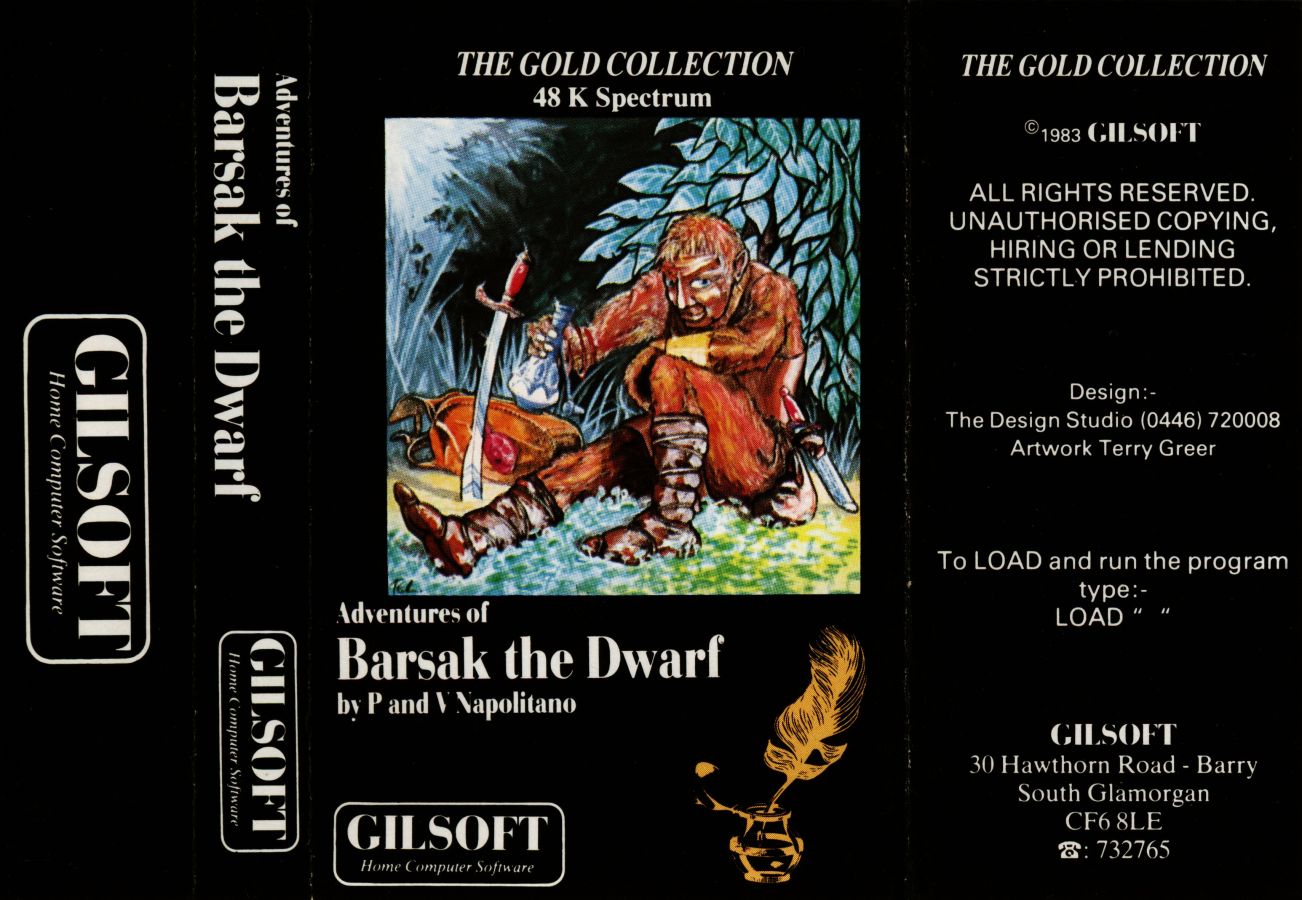
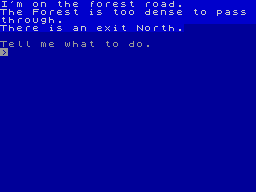
Producer: Gilsoft Memory Required: 48K Retail Price: £5.95 Language: Machine code Author: P & V Napolitano Barsak is another Quilled adventure in Gilsoft's Gold Collection. During and after loading it says behind the title 'The Early Days' - does this imply it's only the first of a series? Barsak takes us back to the heartland of traditional adventures, the ancient days of the mythological underworld where the dwarves held the Nine Treasures. They have been lost, and now Barsak seeks to recover them. To complete the game it is necessary to wear or carry all nine treasures and sign the book at the end. Short instructions inform you of some basic facts about Quill adventures, the use of verb nouns format and the fact that the computer only examines the first four letters of a work, so that there is no need to type beyond that number, also that the adventure can be SAVED at any point. Barsak commences his adventure in a dense forest with only one exit North. This leads to a clearing in which stands a large and rather run down castle. Exits to the north-east and north-west end up leading right round the castle in a circle. Leaving the clearing northwards takes you into the castle itself with its numerous locations in the curtain walls, barracks and keep. Useful objects in this text-only adventure are shown in a darker blue. The first major problem is to find some food - you only have 17 turns before death sets in through starvation. COMMENTS Response: instant Graphics: text only
Advert27
- Your Spectrum #8Oct 1984 · p.46
- Popular Computing Weekly #39Sep 1984 · p.59
- Your Spectrum #7Sep 1984 · p.32
- Micro Adventurer #11Sep 1984 · p.12
- Micro Adventurer #10Aug 1984 · p.17
- Crash #7Aug 1984 · p.68
- Micro Adventurer #9Jul 1984 · p.26
- Your Spectrum #5Jul 1984 · p.20
- Crash #6Jul 1984 · p.46
- Micro Adventurer #8Jun 1984 · p.6
- Crash #5Jun 1984 · p.118
- Sinclair User #26May 1984 · p.92
- Your Computer #5May 1984 · p.124
- Your Spectrum #3May 1984 · p.4
- Sinclair Programs #19May 1984 · p.4
- Computer Answers #16May 1984 · p.54
- C&VG (Computer & Video Games) #31May 1984 · p.39
- Crash #4May 1984 · p.63
- Micro Adventurer #7May 1984 · p.4
- Crash #3Apr 1984 · p.60
- Computer Answers #15Apr 1984 · p.104
- Popular Computing Weekly #15Apr 1984 · p.50
- Popular Computing Weekly #17Apr 1984 · p.4
- Micro Adventurer #6Apr 1984 · p.16
- Home Computing Weekly #54Mar 1984 · p.4
News/Note2
- Popular Computing Weekly #45Nov 1985 · p.30
- Crash #2Mar 1984 · p.22
Feature1
- Micro Adventurer #10Aug 1984 · p.20
Related
- Versions
- The Quill Adventure System (Authored with)
- Ports
- (Commodore 64)
- Tags
- Gold Collection
- Elsewhere
- CASAMobyGamesThe TipshopUVL
- Same entry at
- Spectrum ComputingZXInfo
Reviews from people here
Sign in to write about this, or make an account. It takes a minute and lets you correct the catalogue too.
No description recorded.
Sign in to correct or add to this.
Hold the rights to this and want it taken down?