
The Key to Time
Adventure Game: Text-Only · ZX-Spectrum 48K · 1 players · English
Lumpsoft · 1984
Also known as Doctor Who and the Key to Time (English)
_Front.jpg)
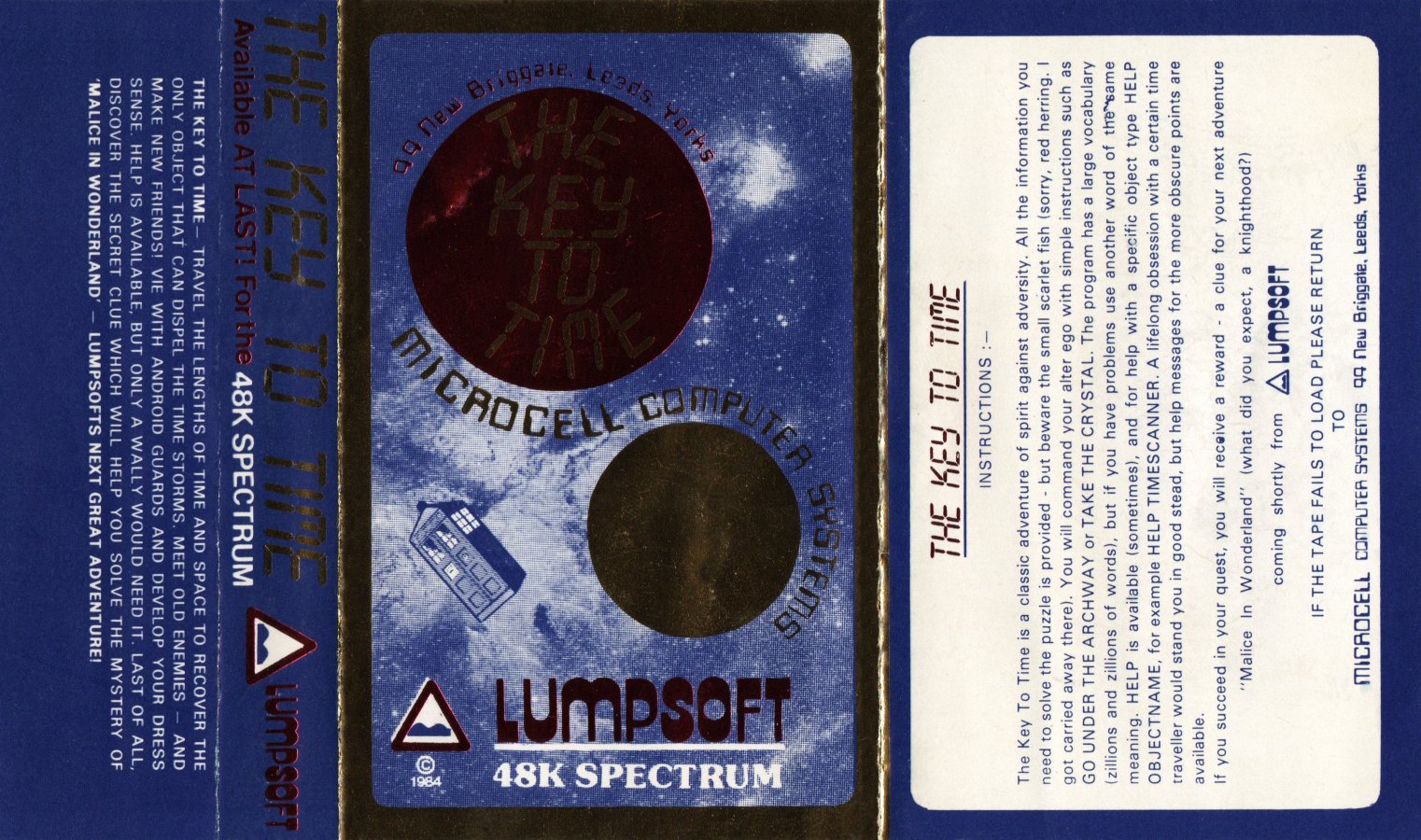
_SideA.jpg)
_SideB.jpg)
Discussion
Nobody has started a thread about this yet.
Releases
- 1984Lumpsoft Sold as Doctor Who and the Key to Time
- 1984Sentient Software Ltd
Play
- KeyToTimeThe(SentientSoftwareLtd).z80.zipSnapshot image English18 KB
- KeyToTimeThe.tzx.zipTape image English18 KB
- KeyToTimeThe(SentientSoftwareLtd).tzx.zipTape image English21 KB
Files and rights
Distribution permission is on record, granted to another archive rather than to this one. Screens and pictures are copied here; everything else links to the archive that holds it.
- AllowedLumpsoft → WorldOfSpectrum
- AllowedSentient Software Ltd → WorldOfSpectrum
Credits
- P.J.R. Harkincredited
Sign in to credit somebody, or say what these people did.
Scores
In the magazines
- Sinclair User #331984 · Gilbert Factor7/10
- Crash #121985 · Overall Value7/10
- C&VG (Computer & Video Games) #421985 · Personal Rating7/10
Elsewhere on the web
- WorldOfSpectrum 6 votes7.33
In the magazines 9
C&VG (Computer & Video Games) #42Apr 1985 · p.997/107/10
Personal Rating 7/10
Keith Campbell 7/10
The Key to Time, dedicated to the memory of William Hartnell, is a Dr Who game that should please all fans of the series. Looking very Quilled, but a worthwhile game for all that, it comes from Lumpsoft and runs on a Spectrum. You will first have to learn to operate the Tardis, and a few devices within it, and then you can begin to explore in search of the pieces of the lost key to time. What endeared the game to me was the response when I typed WAIT: Time passes. The infinite sounds of time trickle through the cosmic hourglass. I can't keep this up all night. I never wanted to be an Adventure game. I wanted to be an arcade game. I wanted to be... A Lumberjack! (music starts!)
Crash #12Jan 1985 · p.1207/107/108/1010/107/107/10
Atmosphere 7/10
Vocabulary 7/10
Logic 8/10
Debugging 10/10
Overall Value 7/10
Derek Brewster 7/10
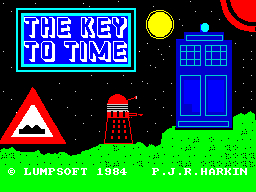
DEREK BREWSTER'S ADVENTURE TRAIL Our Adventure Trail columnist, DEREK BREWSTER, sums up his feelings about the state of Spectrum adventures as we prepare to enter a new year... THE VICTORIAN CHIP Adventuring, as so many have come to know it, began with a mainframe and a copy of Colossal Cavern which even now is available for the home micro. Why should this be so when the technical improvements in the writing and implementation of adventure has increased markedly since that time? The reason gives a due to the special attributes every popular adventure possesses, namely, a plot in which an adventurer can lose himself. The problems must be pitched somewhere in that narrow band where they are difficult and thought-provoking but, hopefully, entirely logical. But where an adventure really shows its class is when it often has the explorer preoccupied with two or more problems at the same time and can enable progress by more than one solution. In an editorial some months ago I commented on how it is unwise for a company to release too many games on a modular basis. It would seem this advice to some extent is unnecessary as market forces have forced more selective releases from both adventure and arcade camps alike. Crash was criticised some time ago for reviewing all games released instead of just those that merit distinction and yet the irony is, of the plethora of publications that line the newsagents' shelves, Crash is now the one, with its CRASH SMASH awards, to distinguish and more overtly praise those games of the highest calibre every month. These pick of the bunch, considering how far software has come in the last year, are great games indeed - a trip to the arcades is positively dull when compared to the choice and quality now available in millions of homes. Games playing has come a long way and will go much further. People's expectations of game software is much higher than when microcomputing was a fresh and novel pastime. Everyone tried their hand at programming because they thought that's what micros were for - to learn all about programming, and the standard of software was initially low enough to encourage imitation and even improvement. However, people were soon glad to see their computers do anything following their own fruitless struggles. Now the scene is different: many see their computers for what they are - games machines. Take the Spectrums main rival, the Commodore 64. When first marketed, it was as a business computer to the incredible extent that it was only to be had in business shops. The inference was you couldn't have it for anything as frivolous as playing games. Hindsight, and in particular two important factors, made things clearer. One, the arrival of a small business computer on the scene with the likes of the Advance lined up with the Spectrum and the C64, which gave the lie to the idea that a business system could cost anything less than £1000. Two, playing games isn't quite the frivolous nonentity some might have had us to believe. At a time when enforced leisure is the order of the day, playing computer games is a much better recreation than watching feeble-minded quiz shows on TV (Channel 4 made a brave attempt to keep television alive but alas their resolve faded with their fortunes). Computer games are sophisticated enough to be intellectually demanding; adventures are used in education as they are better, certainly more entertaining, than the prescribed medicine while the arcade side has given birth to genuinely instructive simulation programs. Speaking as one who is suspicious of the very word education, I think it unlikely that much good will come of educational software marketed as such; better for games to become more entertaining, thought-provoking and informative. A return to Victorian Values is one thing, being bored to brain-death is quite another. Colossal Cavern spawned many text-only adventures in the early days of home computing but some luminaries of the computing press fall woefully short of their roles to inform of the differences between a knocked-off job and the program of several months incubation. This puzzled me enough (brought to a head having read a guide-book to adventures which was the most partisan load of drivel) to encourage my own entry onto the scene and the views which follow. The modern equivalent of the original, good, mostly Basic, text-only adventure is the Ket Trilogy, a series of adventures marked by their sensibly cheap price, super atmosphere, easy and logical problems, and user-friendliness. A company that had machine code games right from the start was Artic Computing, who produced highly competent adventures with problems that lent themselves well to a new magazine phenomenon, the adventure help page, since they were very difficult and had but one solution. The early games were clinical by today's standards, needing the methodical approach of the crossword devotee with little attention paid to building up a consistent atmosphere. The early Artic software clearly had some appeal beyond that of its competitors but had one distinction which was to prove decisive in the struggle for survival in a very competitive market - the software was in your local computer shop and you could actually hand over your money and buy it. Graphics were the next obvious improvement but alas many early efforts resulted in poor graphics or slow response times. However, one game stood out like no other. Based upon one of the most famous works of fantasy fiction, it marked a new era in book/computer program tie-ins, but more tellingly, in big finance and high pressure salesmanship. A cottage industry now seemed on the brink of renting out office space throughout the land but no one was complaining over the new commercialism because it had produced a computer program every bit as good as the advertisment suggested. It was, of course, The Hobbit from Melbourne House. Years ahead of its time with super graphics and the first game to attempt true character interaction. Later a similar game to The Hobbit provided an option for those who had mastered its complexity. Fantasia Diamond from Hewson Consultants had an interesting storyline and endearing characters. Character interaction was visibly demonstrated in another megagame of 1983, Valhalla, which introduced animation to adventuring, but Basic was too slow for the project and it is doubtful whether the interactions were ever truly intelligent. Unlike The Hobbit, the game didn't quite live up to the adverts. Animation may well prove a redundant offshoot for the unmodified Spectrum since it adds little to the intelligence of an adventure but consumes a vast amount of memory - memory better used increasing interaction with the computer. Character interaction has recently reached a new level of intelligence with a further breakthrough from Melbourne House. The worthy successor to The Hobbit, Sherlock in the end proved too ambitious but nonetheless is a significant milestone on the road to intelligent characters. Perhaps with the removal of the inadequate graphics (a concession to market forces) the game could have struck out more decisively along the path of meaningful character interaction with this becoming the sole selling point. Whatever, Sherlock will become a memorable milestone. The Quill has given the chance to many who haven't got the time or inclination to program a machine code game from scratch, and who can blame them, it is debatable whether any 40K adventure needs to be 100% machine code. Gilsoft's creation has lead to a great surge of adventure releases but most, sadly, do not acknowledge the need to give the customer a much greater depth in theme and plot in return for the limitations imposed by The Quill. However, notable exceptions are classics in their own right: Denis Through the Drinking Glass, Hampstead and Tower of Despair. The Quill is just the most public face of a good number of utilities employed by many adventure software houses. Level 9 make no secret of their own 'a code' used to devise Snowball and boast an ever-increasing library of compression techniques used to instigate the likes of Return to Eden. These games are twice the length you might expect of a well-written game and are, in addition, user-friendly, highly intelligent and imaginative, with good descriptions producing a rich atmosphere. Just as some people look with suspicion toward a Quilled game (has it just been knocked-off?) s o they might well be wary of the five or six part megagame, Domark's Eureka! is composed of many parts, like Mastervision's Wrath of Magra, but it is my view that such games are overly involved and convoluted, and this apparent complexity is to smokescreen what is a shortfall in programming skills; size is simply not an important factor, anyone can write 200K of gobbledegook. Some journalists are forever going on about the great American Software invasion from across the Atlantic but perhaps it has dissipated against our shores and I am sure even a flight out to the States would only confirm that which I have long suspected - there's precious little to shout about above the razzmatazz. One game released this summer was so original and outstandingly brilliant it caught many on the hop just as they were about to forget of software innovation until the autumn. Lords of Midnight represented a significant leap in programming skills used to develop an entirely new theme. The Land of Midnight is an extraordinary invention and anyone who has not yet seen it has not seen half of what the Spectrum has to offer. The game is the crowning jewel in microcomputer games respectability. So what can we expect from the future? Well, graphics of a consistently high standard are on the menu, but more than this, they will become an integral part of the adventure and not just a decorative appendage tacked on to brighten up proceedings. Graphics will broaden out from just pictures to diagrams, charts and even to the map that at the moment is painstakingly committed to paper. The pictures will carry clues and figures showing which characters are present. These characters will be larger than life as they realistically go about their everyday lives cementing a greater belief in the whole adventure. The microdrive will finally be exploited for what it is, a refined fast storage device with immense possibilities, and the days of solitary computing may seem a thing of the past as the Spectrums networking capabilities string along the thoughts of many minds. THE KEY TO TIME Producer: Lumpsoft Memory Required: 48K Retail Price: £5.95 Language: Quill Author: The Key To Time is Lumpsoft's first adventure and is all about a time traveller who was all the rage when people used to watch television. The loading screen shows a picture of a police box and funny little robots with a bad case of metallic pimples and tunnel vision compounded by the position of their only eye on the end of a stalk. Apparently it is a bad time for time travellers what with time storms distorting travel coordinates which might lead anywhere and it proves imperative that someone recovers the object that can dispel the storms for good. At a meeting of the High Council of Time Lords one senior member asked, 'Who can dispel the' time storms?' But this was taken as a command by the others and so you, The Doctor, ended up with the job. On your first attempt at the game it's better to ask for HELP rather than STARTing straight off so you can gather some useful information. 'In this adventure you must guide your earlier persona by sending him messages through this Time Lord telepathic controller, cunningly disguised as a Sinclair Spectrum.' Here you are told of the game's intricacies including a timely list of recommended verbs including a general HELP, a more specific HELP (TIMESCANNER) and WAIT. The HELP is not as useful as it could be because it only results in a random selection from three or four phrases, one of which reads 'Never eat anything bigger than your head,' a saying reminiscent of the work parodied by Lumpsoft's next program to be released, Malice in Wonderland. The other, more specific help command is very useful in that constructions like HELP (DALEK) give encyclopaedic information information concerning a certain object or creature, eg. cybermen are allergic to gold. I really do like this kind of encyclopaedic reference material as it was what we all thought computers were about, indeed what they are good at, until the limitations of micro memory become apparent. In this respect, I can't wait to see what adventure games the QL can produce. The WAIT command begins mimicking The Hobbit but soon departs with an amusingly prolonged diversion. The vocabulary is very friendly with constructions such as GO (TARDIS) and ENTER (CRACK) equally helpful and the plot is similarly responsive; everything can be examined and if you look at the screen you find 'The Tardis materialised. Atmosphere: breathable.' Swearing will bring the wrath of Mary Whitehouse down upon your head leaving you to regenerate into your next persona, perhaps this time the chap who is a trifle absent-minded and plays a pipe. Time travel is the core of the game and if you find play relatively easy as I did, then you will proceed quite quickly through the five time zones, although you may well use up a few of the Doctor's characters. Moving through the likes of Daleks and Cybermen you arrive at Gallifrey where you enter, presumably, the final stages around the president's office. If the game's tricky moments hinder progress then you may have time to ponder on the difficulty of getting any score higher than 0 or how to travel from one time zone to another in the Tardis, an operation which involves a tricky combination of lever pulling and button pressing. The Key To Time is a very worthy effort from Lumpsoft combining a friendly response with an interesting plot and amusing interludes. A text-only Quilled game with a familiar theme but very well executed. COMMENTS Difficulty: mostly easy Graphics: none Presentation: very good Input facility: verb/noun, pretends to be more complex but other words are ignored Response: very fast
Sinclair User #33Dec 1984 · p.387/107/10
Gilbert Factor 7/10
Richard Price 7/10
HAVE TARDIS WILL TRAVEL Memory: 48K Price: £5.95 Knock, knock, Who's here. The Doctor's back, in search of The Key to Time. This new text adventure from Lumpsoft features the veteran time traveller and many of his oldest enemies, battling it out through time and space. Davros, Daleks, Cybermen and fellow time-lords all show up as you steer your Tardis through the ages. With the aid of a timescanner you must discover the scattered pieces of the great key and presumably save the universe into the bargain. Before you can begin the quest you will have to learn how to operate the Tardis. Addicts of the TV series will find themselves in a well-known environment but the program is very friendly and will give considerable help to those who are less familiar with the bumbling doctor. The program is responsive and versatile whilst the riddles are by no means obvious. It will get you zipping back and forth through time like nobody's business. The Key to Time is good-humoured, well written and a joy to play.
Your Computer #12Dec 1984 · p.63
Hugo North
48K Spectrum £5.95 Lumpsoft Dr. Who addicts will welcome this Quilled adventure from quirkily named Lumpsoft - the logo is the 'uneven road ahead' sign. This textual quest centres around the popular television series and features characters that will be welt familiar to all Tardis watchers. The Doctor must seek out the parts of the Key To Time and save the universe - a trivial task, eh? There are plenty of puzzles and the adventure has a good cohesive feel to it. The vocabulary is quite comprehensive and response time is fast. Hint facilities are built into the program - typing "Help object" may reveal a clue for that specific item. Good humoured and attractively presented, TKTT is certainly worth your consideration. Their next release sounds even more interesting - it's called Malice in Wonderland!
Personal Computer News #84Oct 1984 · p.20
Bob Chappell
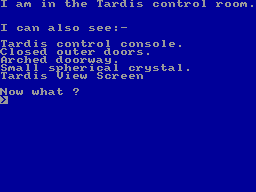
KEY ISSUES A triple-decker of adventures is sampled by this week's Master of the Dungeon, Bob Chappell. Although one of the most popular science fiction characters on TV, Doctor Who has not so far featured in a text adventure to my knowledge. So if Daleks, Cybermen and things Galifreyean are your cup of Saurean Brandy, you're in for a treat. Lumpsoft, an oddly-named Leeds company and new to me, has released a Spectrum adventure called The Key To Time and jolly good it is too. The program is dedicated to the memory of William Hartnell who played the very first Doctor Who. In the adventure, you have to guide the original Doctor by sending him messages through the Time Lords' telepathic controller (which has been cunningly disguised as a Spectrum). Without knowing what your mission is, you start out, of course, in the Tardis control room. Once you've managed to get a nearby hologram player going, you'll discover that your task is to recover the five fragments of TheKey To Time. The next thing to do is find out how to get the Tardis moving. There are several places to visit, including Regents Park Zoo and, more exotically, Gallifrey itself. The program appears to have a comprehensive vocabulary - but not the 'zillions and zillions of words' claimed on the inlay. There are plenty of objects to examine, collect and think about, as well as a pretty good set of testing puzzles. It has a sense of humour too. As a sample, should you type WAIT, you'll be on the receiving end of a batch of purple prose - 'the infinite sands of time trickle through the cosmic hourglass'. Then it turns Pythonesque - 'I never wanted to be an adventure game, I wanted to be a Lumberjack'. Python fans will immediately recognise the tune that follows. None of this sits too comfortably with the theme of the adventure but it comes as a pleasant surprise all the same. Definitely one worth having in the collection for both Dr Who followers and non-believers, ILL-MANORED No so hot is Mystery of Munroe Manor, a text and graphics adventure for the Commodore 64 from Severn Software. The game starts in fine style. The background to the adventure in the form of newspaper clippings is followed by a scene of Munroe Manor where a silhouetted figure moves slowly past a window. To the accompaniment of suitably spooky music, the front door swings open to permit your entrance but suddenly closes with a bang. Then the first disappointment - you've now got to load the main program, a wait of 12 minutes before you even begin. Once that's over, you find yourself in the hallway of the manor. Each location is depicted in simple but colourful style. At the base of the screen, an area is reserved for a description of the location and any objects therein. Disappointment number two - the descriptions are extremely terse thus depriving the game of any much-needed atmosphere. The same area is used for your input and the program's response, the latter remaining on screen for several seconds before the text area is wiped clean. Until this wipe is done, you can't enter any further commands. This really puts the brakes on. Particularly so since the game's vocabulary is very limited and you're continually being told that your command has not been understood - very frustrating. There are some depressing idiosyncracies in the game, too. Although you can read a book in the library, you can't take it because you're not strong enough. One such book refers to consulting a 'physicatrist'. Really! A shame, as the game is not without merit. The graphics are drawn instantly and the puzzles appear tough - or are they merely obscure? If you're prepared to put up with the flaws, you might actually enjoy Munroe Manor. Me? I've got better things to spend my screen time on. RANDOM INTERFERENCE The Code from Soft Concern of Warwick is a text-only Spectrum adventure with a £2,500 prize for the first one to solve it. The game takes place on four levels deep within a KGB stronghold. The idea is to progress until you reach the Code Room where the instructions become suitably enigmatic. Like many text adventures for the Spectrum, the text appears in white against a blue background. However, the presentation is slightly odd - there are no prompts or cursor to indicate that the program is awaiting your input. You begin in a security room and it's quite obvious you're going to need a pass before long. The reason for this is that a guard appears at random who, if you're not carrying the correct means of identification, will haul you back to the security room. That, unfortunately, is not the only random event. Another such is an enemy agent who keeps popping up to take potshots at you. You can usually dispose of him for the time being with your own gun, but sometimes you miss. Then you have to keep defusing a bomb by pulling out one of four wires it's pure luck whether you select the right one or get blown to bits. A further bit of silliness is that the lights keep going off. All you have to do is wait long enough and they come back on again. You may have gathered from this that I'm no fan of adventures which contain random elements - and you'd be dead right. I can't stand them. The Code has some pretty interesting puzzles - although the topography is quite barmy - and it's a shame it's spoiled by these unnecessary random interventions.
Mystery Of Munroe Manor
The Key To Time
Review2
- Popular Computing Weekly #40Oct 1984 · p.68
- Popular Computing Weekly #41Oct 1984 · p.46
News/Note1
- ZX Computing #21Oct 1985 · p.12
Letters1
- Sinclair User #38May 1985 · p.17
Licensed from
- Doctor WhoTV showunofficialBBC Enterprises Ltd
Related
- Versions
- The Quill Adventure System (Authored with)
- Ports
- (Amstrad CPC), (Commodore 64)
- Elsewhere
- CASAThe TipshopUVL
- Same entry at
- Spectrum ComputingZXInfo
Reviews from people here
Sign in to write about this, or make an account. It takes a minute and lets you correct the catalogue too.
No description, tag recorded.
Sign in to correct or add to this.
Hold the rights to this and want it taken down?