
Seabase Delta
Adventure Game: Text/Illustrated · ZX-Spectrum 48K · 1 players · English
Firebird Software Ltd · 1985 · Pound sterling 1.99
Subsunk, 2 of 2
← Subsunk
Discussion
Nobody has started a thread about this yet.
Play
- seabase.rzxRZX playback file
- SeabaseDelta.tzx.zipTape image English28 KB
- SeabaseDelta(different).tzx.zipTape image English28 KB
- SeabaseDelta(different)_2.tzx.zipTape image English28 KB
- SeabaseDelta.tap.zipTape image English30 KB
Documents
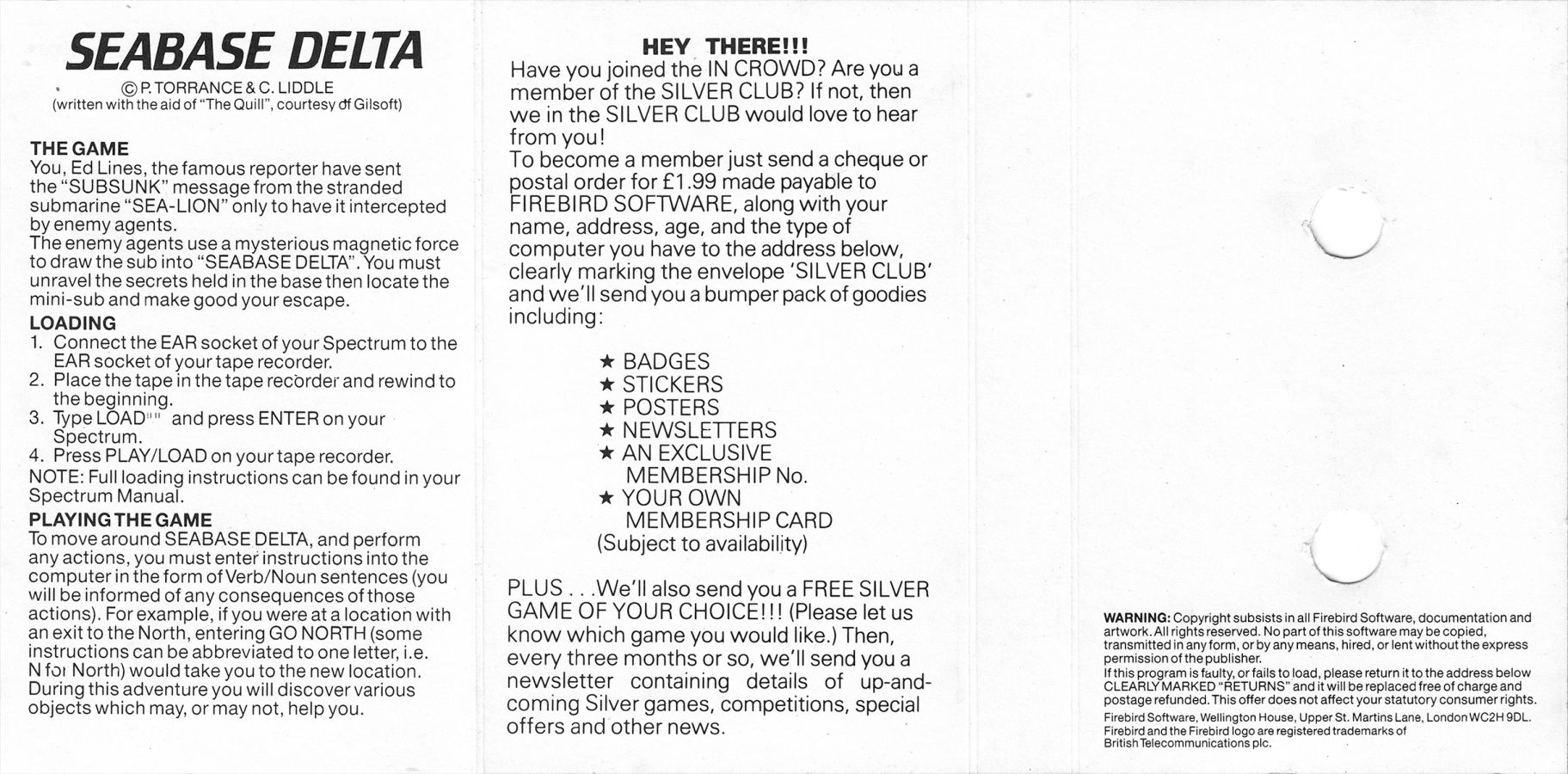
- SeabaseDelta.txtInstructions English1 KB
Files and rights
Distribution permission is on record, granted to another archive rather than to this one. Screens and pictures are copied here; everything else links to the archive that holds it.
- AllowedFirebird Software Ltd → WorldOfSpectrum
Credits
- Colin Liddlecredited
- Peter Torrancecredited
Sign in to credit somebody, or say what these people did.
Awards
Scores
In the magazines
- Sinclair User #521986 · Overall5/5
- ZX Computing #281986 · OverallGood
- Crash #301986 · Overall74%
Elsewhere on the web
- WorldOfSpectrum 34 votes7.94
In the magazines 47
C&VG (Computer & Video Games) #58Aug 1986 · p.764/105/104/109/104/10
Vocabulary 4/10
Atmosphere 5/10
Personal 4/10
Value 9/10
Keith Campbell 4/10
SUPPLIER: Firebird MACHINE: Commodore 64, Amstrad, Spectrum 48K PRICE: £1.99 You're Ed Lines again, that punny reporter, who having completed Subsunk by sending the message, had it intercepted by enemy agents. Using a mysterious magnetic force, they have dragged the sub into an undersea base. You must locate a mini-sub to escape, but also unravel the secrets down below. Will you ever get back to file your story? Right at the start you are standing by a corpse with a briefcase - shades of Mission Impossible! No tape recorder here, though, but a quick frisk does no harm, and soon you learn of a plot involving a missile to be fired from the base. Time to explore, now, and you soon discover how to operate a railway linking different parts of the base. Travelling is a rather laborious affair, involving fastening and unfastening your seatbelt, with an enforced delay whilst a commentary on the tourney is displayed. This is a time waster, and as visits to a number of stations are involved, becomes very tedious. The technique of delayed response is used quite often, and is even more annoying when you are trying to reach a table over a slippery floor. This problem calls for many attempts, both by way of vocabulary and ideas, and becomes very frustrating. The vocabulary is sparse and, in particular, I had great problems in operating a switch, positioned to the right, and clearly marked LEFT and RIGHT. Eventually PUSH SWITCH turned out to be the clue to operating it. There is plenty to explore, for apart from station platforms that have no exits, and seem to exist solely for the purpose of housing an object, there is a complex of passages and rooms on a number of levels, at the end of the journey. But can you get back! This is a graphic adventure. Most locations are preceded by a full screen picture, quite detailed and colourful, and reasonably fast to draw. These are only displayed at the first entry to a location, unless you LOOK. Quite a reasonable little adventure, a bit of fun, albeit rather lacking in atmosphere appropriate to the situation. A snip at £1.99.
ZX Computing #28Aug 1986 · p.39ZX Computing GlobertGoodGood
ZX ComputingZX Computing Globert
Overall Good
Peter Sweasy Good
Firebird £1.99 "Ontvlucht de vijandelikje Zeebasis" commands the inlay in one of six different languages; in English, that means escape from the enemy's seabase. This is the sequel to popular budget game Subsunk, and again you play wittily named reporter Ed Lines. The brief instructions tell you little more than the sentence given above; if you had never played an adventure before this would be very confusing. The game has some fairly attractive full screen graphics, drawn with The Illustrator; and reasonably descriptive, though not really Booker Prize winning, text. Vocabulary is very friendly for a Quilled game; in particular EXAMINE is surprisingly responsive, and often gives somewhat blatant clues (for example, examine the dead man and you're told "No sign of life sign - perhaps his pockets...") These contribute to making Seabase apparently fairly easy: my initial impression is that it won't provide much challenge to the experienced adventurer. The puzzles are entertaining enough though, and mostly logical. It's a very nicely constructed game and you feel a real sense of progress as you play. As well as the friendly vocabulary there is a good range of messages as a result of various actions. Unfortunately though, there are some unnecessary, lengthy pauses when messages are revealed, which the player cannot speed up. Also presentation could have been improved, perhaps with a redesigned character set. Generally though, good fun to play and worth the asking price. It's particularly good for the novice adventurer. I hope to see more cheapo adventures of this quality in the future from Firebird.
Crash #30Jul 1986 · p.7868%80%76%75%74%74%
Atmosphere 68%
Vocabulary 80%
Logic 76%
Addictive Quality 75%
Overall 74%
Derek Brewster 74%
DEREK BREWSTER'S ADVENTURE TRAIL INDEPENDENTS' DAYS Clive Sinclair bows out of computing for the moment and Crash magazine announces startlingly high circulation figures, higher than any other computing title. Could there possibly be any connection between these two facts? I will endeavour to find out in my own inimitable way, concentrating on the notion of Crash being an independent, in a home games world dominated by Spectrum computers whose very existence can only be attributed to the dedicated band of independents who whole-heartedly backed the machine. As I've said before, I have owned at one time or another most of the home computers released in the UK, the ZX80 being the only one to escape my curiosity and to achieve mass circulation. Of all these computers, the Spectrum holds a special place in my affections. It was this computer, in the early days as much as now, which encouraged and fostered a wide band of dedicated programmers who were out to squeeze every byte of code until it paid dividends. All the credit cannot be given to Sinclair himself for the Spectrum phenomenon. It often seemed to programmers slaving over a hot heat sink that the boffin was determined to wreck the software market by a whole catalogue of hotchpotches and own-goals. These were: Interface 2, the Microdrives, and early (thankfully fruitless) attempts to corner the software market for himself, when profits from hardware were being cut to the bone under increasing competition from the UK and America. Interface 2 was a debacle of the highest ineptitude. For a price, it enabled the games player to connect a joystick (something which could be done without add-ons to competitor machines) and gave access to a glossy catalogue of ROM cartridge releases which only remained impressive so long as the reader was unaware of a major restriction: they were 16K programs only. This at a time when the 16K machines were sampling their last bytes as they were overtaken by the much more popular 48K computers. The irony is that 16K programs take little time to load in any case - it is the 48K programs which require the bonus of instant loading. As it was, the cartridges were a flop. Had they been aimed at 48K machines, the Interface 2 would have been an undoubted success; people were certainly prepared to pay an extra £2 for each faster, more reliably-loading program. But this was not the only faux pas to this interface, as its purchasers soon discovered to their undying chagrin. In the world of games joysticks Sinclair took on the Kempston system with his Interface 2 when the Kempston protocol had already become the standard. By breaking with this standard Sinclair created havoc with programmers and public alike. Many of the top games deemed the Kempston system as the only real must as an option for joystick control. Microdrives are now infamously known as unreliable and infuriatingly fickle. The Microdrive tapes wear quickly and are regularly munched up by the drive mechanism. More fundamentally, the drives do not offer what is implied is their reason for being: they are slow and require several revolutions of the tape loop before the drive warms up sufficiently to load the program. For those who haven't heard enough, the consequences of running out of memory are not good. When a program is too long the computer crashes and the Microdrive spins on - wiping everything from its tape. It's not hard to see that the Microdrive cannot be put to serious use and is a commercial non-starter, explaining the conspicuous lack of Microdrive software. If all the technical shortcomings of the micro passed largely unnoticed by the Spectrum latecomers, the lack of a proper keyboard was plain to all and sundry. In my opinion, the first rubber keyboard was better than the later intended improvement. Clive Sinclair single-handedly created the mass home computer market, and all the above criticism isn't much more than nit-picking in the light of his major achievement. The ZX81 first popularised the notion of affordable home computing in the UK. Owing to Clive Sinclair's brainchild, the UK has more computers per capita than any other country in the entire world. But of all the good and bad of Sinclair's reign, the one thing he did not attempt was publishing his own 'official' magazine, and for this he can only be congratulated. Unlike Acorn, Amstrad and Commodore who did try, he was alone in letting the independents do what they do best - reporting the facts enthusiastically, without fear or trepidation, and with a desire to do what's best for the entire Sinclair phenomenon, and not just the central nominal company. What I hope Alan Sugar realises about the company he has taken over is the role that independents played in making the Spectrum. The quality of their add-ons for the computer was very high and exceptionally good value for money. For example, Sinclair could only offer a 30 day waiting list and an inflated price for the 16 to 48K upgrade, while small workshops performed the service more rapidly and at less cost. I think that the Spectrum phenomenon, and the important role of independents in the computer's success is not only a lesson for microcomputing, but for the whole British economy. SEABASE DELTA Producer: Firebird Retail Price: £1.99 Author: C Liddle, P Torrance If I give you the story for this one you might just twig what it is a follow up to. You are Ed Lines the famous reporter who has sent the "SUBSUNK" message from the stranded submarine Sea Lion, only to have it intercepted by enemy agents. The agents use a mysterious magnetic force to draw the sub into Seabase Delta. You must unravel the secrets held in the base then locate a mini-sub and make good your escape. You begin in a large tubular walkway (with a picture which looks like a large pencil) and through its transparent walls you can see the murky depths of the ocean. As is so often the case in adventures there is a dead body. By the body is a briefcase which mysteriously has to be re-picked up if it is opened to examine its contents. Presumably the program assumes you must lay it down to open it. Examining the body doesn't reveal anything in the first instance but does give a useful prompt to action - always a good sign of a helpful program. What isn't so helpful is the strange delay in the program when it tells you 'I see something!'. It would have been courteous to allow the player to press a button to skip over this delay; as it is, the game slows and the player becomes bored and irritated. Overall the game has a sluggish feel, what with its slowly-drawn graphics, but this must be taken as just one of the drawbacks inherent in a £1.99 adventure. In the briefcase are documents, one of which is a telex message which runs like this, 'We have captured another sub but all other personnel have had to evacuate the base due to a wildfire epidemic. I have managed to arrest the symptoms of the virus but I am still very ill. I have left the computer in control of the base in case I do not survive. The missile targeted on the British base will launch as planned'. If you've been following the story up to now you'll realise this is an enemy message and so it looks as if Ed Lines also has to deal with the enemy computer and stop the launch of the missile. To the east of the first location is a food farm with a really messy floor, covered in very slippy seaweed, whose slimy composition has you sliding right round the place. You whizz past the table too fast to quite make out what object lies upon it. To the south is a metallic platform in a large dome which turns out to be a futuristic tube station with a tube car which can whip you off to many small locations strung out down the line. At each of these tube stops only one or two tasks have to be performed and, say, one item picked up. This area, for me, was one of the few boring ones; the constant need to fasten and unfasten the seat belt became irksome very quickly. Seabase Delta is another good cheapie from the authors of Sub-sunk. As with that game, some of the pictures are rudimentary while others, especially some of the later ones, are quite evocative. The game is well-designed and has had a fair amount of imagination pumped into it. There are plenty of problems and a good number of objects to collect. In contrast to Subsunk this game has a very friendly vocabulary; getting things done is straightforward and there is space for witty comments: GET TORCH gives 'Well, every adventure's got to have one of these hasn't it?'. Seabase merrily flows along and can't be bad at the asking price. COMMENTS Difficulty: moderate Graphics: good in places Presentation: average Input facility: v/n Response: Quill
Sinclair User #52Jul 1986 · p.595/55/5
Overall 5/5
Richard Price 5/5
Label: Firebird Price: £1.99 Memory: 48K Reviewer: Richard Price Firebird's adventures in its Silver range started off well with The Helm and Subsunk - both Quilled and both nice and cheap at £1.99. The latter, if the contents of the Gordo Helpline is anything to go by, has been quite a success. I certainly thought it was fairly complex. No doubt heartened by all this consumer approval, Firebird has now issued the follow-up to Subsunk in the shape of Seabase Delta. Like its predecessor it's written on the Quill and continues the story where Subsunk left off. Ace cub reporter Ed Lines - I groaned last time so I'll groan again - managed to send off the 'Mayday' message from the stranded nuclear sub Sea-Lion. Regrettably, instead of winging its electronic way to Admiralty Arch, the message has been intercepted by the unspecified enemy. Their agents have now used some weird and wonderful tractor beam to pull the long-suffering Sea-Lion into their Delta base. Sighing at his bad luck and no doubt aware that his editor will never give him the overtime he's earned, our Ed climbs out of the sub's main hatch into the tubular walkway of Seabase Delta. There is an eerie silence and at the end of the walkway a dead enemy agent and a briefcase. A search of the case quickly reveals that a strange and virulent virus has destroyed the personnel in the base. Villainous to the end the enemy have targeted one of their missiles on a suitable British base and left the computer in control of the base. Ed's task is to get the computer off-line and de-activate whatever mechanisms control the missile. The game is very open - most of the base is accessible right from the beginning, apart from the places where the games' deepest secrets are hidden. There are vast numbers of objects to puzzle over and many cryptic clues. The object collection is very varied, ranging from the mundane day-to-day necessities like flour and video-game machines to the components of a diving suit. Just as in Sunsunk many of these will need to be combines or used in specific ways to resolve particular tasks. The base itself has a fairly complicated internal geography, consisting mainly of a series of circular towers connected by a motorised tubeway. Each tower has its function - crew quarters, computer centre and weapons control area - and there are a number of floors to each unit, connected by regularly malfunctioning lifts. There are also conveyor belts that rarely travel in the direction you want unless you do risky repair jobs, as well as an occasional chute to slide down. There's loads of business to do and plenty of things to fool around with. You will need a plastic card to authorise your travel on the tubes, you can try and make pancakes in the mess or find a token to play the video machine. Alternatively you can drown yourself in the airlock by accident - this place is underwater, remember? Surprisingly, the graphics are full-screen and do take a while to draw. It's hard to see why the authors didn't use The Patch to make faster half-screen pictures. However, there aren't too many anyway so the intrusion is kept to a minimum. The text itself is at a fairly basic level but the structure of the base, the travel system and the many messages and objects provide an atmosphere in their own right. The jokey approach also helps to keep your spirits up and you will find yourself quickly caught up in the game.
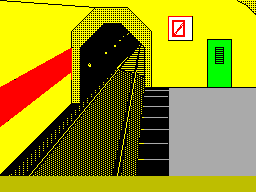
A base corridor.
The document found on the dead scientist.
The tubeway platform, familiar to all who've waited in vain on the Northern Line.
Tips38
- Your Sinclair #69Sep 1991 · p.30
- Your Sinclair #64Apr 1991 · p.51
- C&VG (Computer & Video Games) #88Feb 1989 · p.80
- The Games Machine #11Oct 1988 · p.88
- ACE (Advanced Computer Entertainment) #7Apr 1988 · p.92
- Your Sinclair #24Dec 1987 · p.109
- Sinclair User #69Dec 1987 · p.128
- Crash #46Nov 1987 · p.109
- ACE (Advanced Computer Entertainment) #2Nov 1987 · p.92
- Crash #45Oct 1987 · p.94
- Crash #44Sep 1987 · p.70
- Your Sinclair #20Aug 1987 · p.80
- Crash #42Jul 1987 · p.64
- Crash #42Jul 1987 · p.63
- Crash #41Jun 1987 · p.68
- Crash #40May 1987 · p.58
- Sinclair User #62May 1987 · p.82
- C&VG (Computer & Video Games) #67May 1987 · p.63
- ZX Computing #36Apr 1987 · p.85
- C&VG (Computer & Video Games) #66Apr 1987 · p.64
- Sinclair User #61Apr 1987 · p.81
- Your Sinclair #15Mar 1987 · p.56
- Your Sinclair #15Mar 1987 · p.54
- Popular Computing Weekly #8Feb 1987 · p.23
- Sinclair User #58Jan 1987 · p.94
Review2
- Popular Computing Weekly #23Jun 1986 · p.21
- Popular Computing Weekly #19May 1986 · p.37
Solution1
- MicroHobby #188May 1989 · p.56
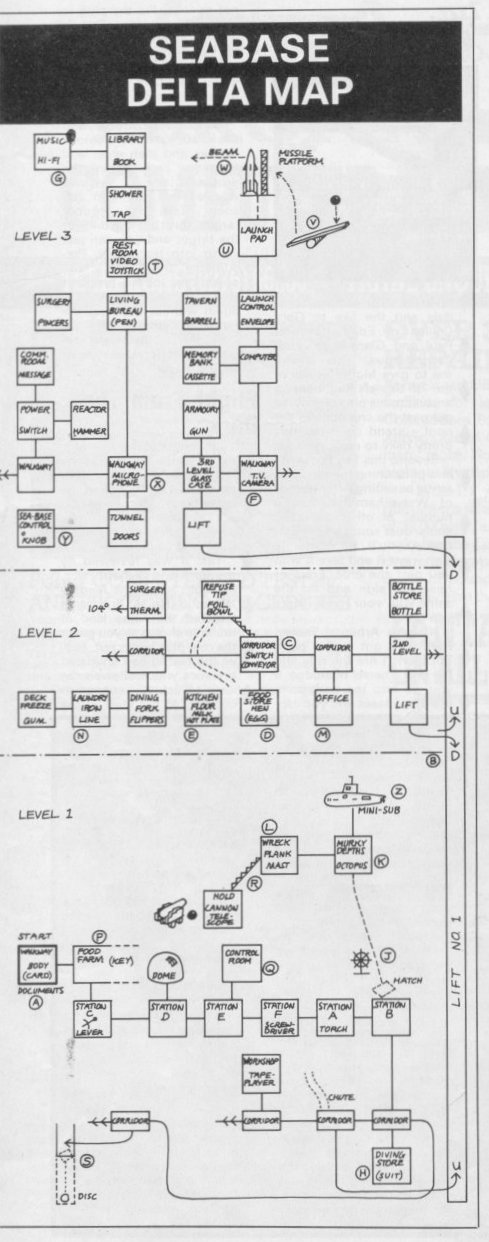
Map1
- Sinclair User #62May 1987 · p.82
News/Note1
- Your Sinclair #8Aug 1986 · p.73
Related
- Versions
- The Quill Adventure System (Authored with)
- Compilations
- Action Pack
- Ports
- (Amstrad CPC), (Commodore 64)
- Elsewhere
- WikipediaCASAMobyGamesRZX ArchiveThe TipshopUVLSpectrum Computing RZX - YouTubeRZX Archive - YouTube
- Same entry at
- Spectrum ComputingZXInfo
Reviews from people here
Sign in to write about this, or make an account. It takes a minute and lets you correct the catalogue too.
No description recorded.
Sign in to correct or add to this.
Hold the rights to this and want it taken down?