
The Staff of Zaranol
Adventure Game: Text-Only · ZX-Spectrum 48K · 1 players · English
CCS · 1984 · Pound sterling 5.95
Also known as The Staff of Zarenol (English)
Discussion
Nobody has started a thread about this yet.
Play
- staffofzaranol.rzxRZX playback file
- StaffOfZaranolThe.z80.zipSnapshot image English19 KB
- StaffOfZaranolThe.tzx.zipTape image English18 KB
- StaffOfZaranolThe(different).tzx.zipTape image English19 KB
Documents
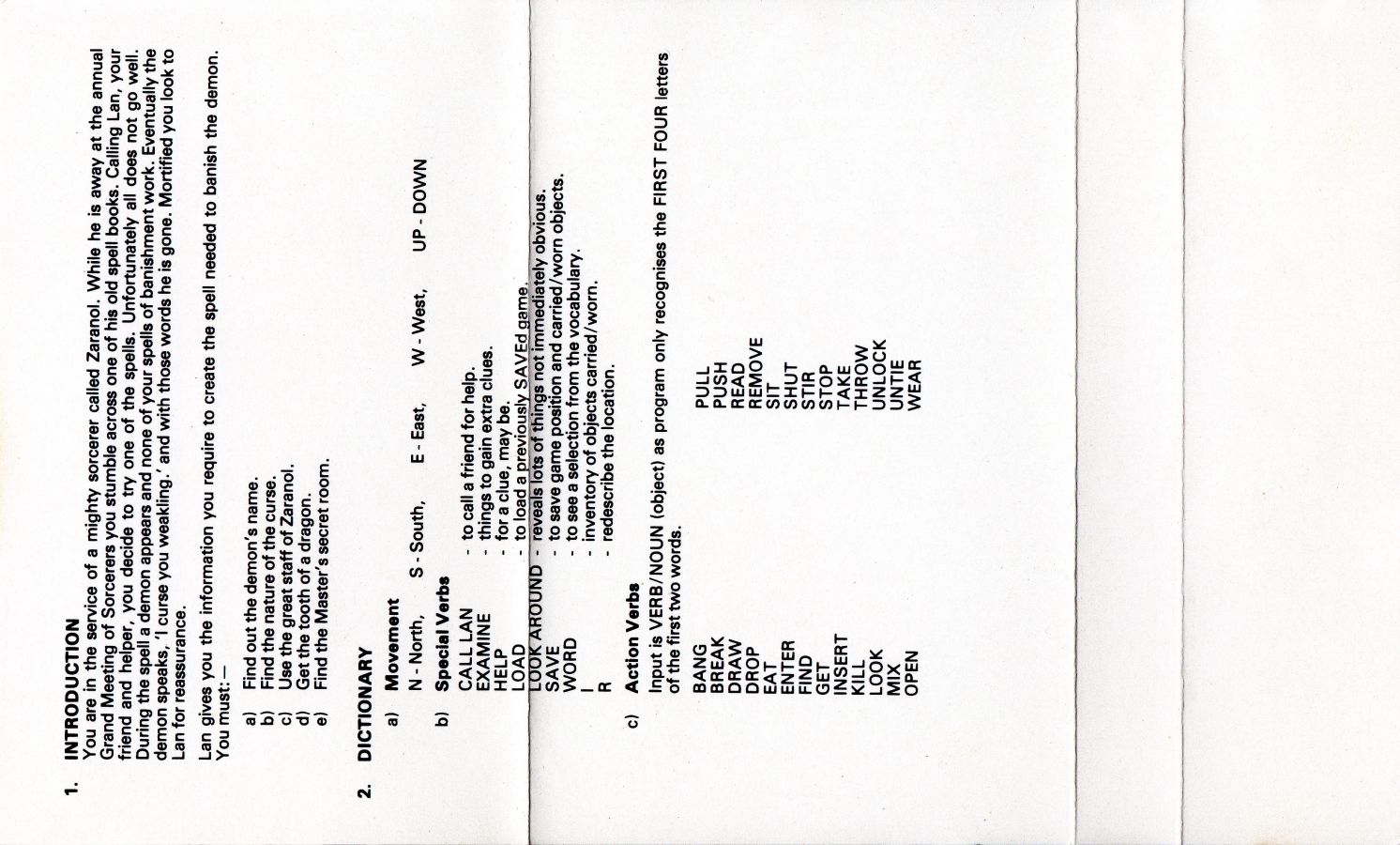
- StaffOfZaranolThe.pdfInstructions English15 KB
Files and rights
Distribution permission is on record, granted to another archive rather than to this one. Screens and pictures are copied here; everything else links to the archive that holds it.
- AllowedCCS → WorldOfSpectrum
Credits
- M.J. Gearingcredited
Sign in to credit somebody, or say what these people did.
Scores
In the magazines
- Crash #121985 · Overall Value6/10
- Big K #111985 · Overall2/3
Elsewhere on the web
- WorldOfSpectrum 3 votes6.33
In the magazines 8
Your Computer #4Apr 1985 · p.53
Hugo North
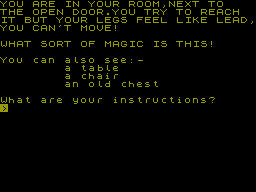
48K Spectrum £5.95 CCS (Cases Computer Simulations) In this Quilled text adventure, you play the part of a junior wizard. While your mentor is away attending the Sorcerer's annual binge, you meddle with his spells and inadvertently conjure up a demon. All your efforts at banishing the creature fail. Happily, the demon decides of his own accord to push off - less happily, he curses you as he evaporates. You've got it all to do now. Here's the shopping list: discover the demon's name, find out the nature of the curse, seek out the Master's secret room, and finally banish the demon by using a dragon's tooth and The Staff of Zaranol. Tall order, eh? Serves you right for messing around with the sorcerer's spell books. As if you hadn't enough woes, although your brain is telling you to get cracking, your legs have turned to lead. There you are in your own room, an open door and an interesting chest beckoning, yet your walking gear has gone on strike. At this point you'll probably be wishing you'd taken up banking, instead of wizardry, as a career. Don't despair, help is nor far away. A necromancer called Lan will appear whenever you call. Try summoning him to open the chest. He will do so, remove a knife from therein and advance towards your paralysed self... You begin to think this is going to be one of those days. The adventure is atmospheric, there are plenty of puzzles and objects to savour and the plot is engrossing. Staff of Zaranol should keep you enjoyably engaged.
Micro Adventurer #17Mar 1985 · p.38
Sally Glover
SKELETON STAFF MICRO: Spectrum 48K PRICE: £5.95 FORMAT: Cassette SUPPLIER: Cases Computer Simulations, [redacted] The Staff of Zaranol is a fascinating new Quilled adventure from CCS. At first sight it appears to have the usual boring "you are the wizard's apprentice" plot - in fact this is far from the truth. In your master's absence you have stumbled on an old spell book and, a little too eagerly, have summoned an entity who seems more than a tiny bit miffed at being disturbed and curses you to die within one pass of the moon. As part of the game is to discover the demon's name, I'll only mention that you couldn't have picked a nastier opponent if you'd tried! Fortunately, you are not alone; your friend, Lan, will come whenever called to give what help he can. He even tells you the five steps you must make to banish the demon - it's performing them that's the problem! Lan doesn't seem to share your view of the seriousness of your predicament and his wry chuckles become a bit tiresome after a while - he's too useful to be dispensed with though. The adventure is not too large, with just over forty locations - but time is short and there are plenty of puzzles to keep you absorbed. HELP works sometimes and your reference book seems essential at all times. The game is mainly concerned with obtaining and working out the clues scattered throughout the adventure, which makes it different enough to be very enjoyable. There are plenty of objects to manipulate and a few other characters to 'interact' with. This is aided by an extensive dictionary of special and 'action' verbs printed on the cassette inlay which helps the flow of play and prevents a lot of lost time in searching for the correct word - more manufacturers could learn from CCS here. From the first move of the game you are beset with problems, not the least of which is moving from the first location! Once this is achieved, you can explore something like half the locations, picking up clues to the remaining steps required in banishing the demon. Among the challenges you'll encounter are a deadly torture chamber, a rather intolerant bat, a greedy trader with an item you need desperately and an altar with a certain fatal attraction. In summary, The Staff of Zaranol is a good, reasonably priced adventure providing plenty of puzzles and an interesting plot. A pleasantly different challenge for adventurers of every skill level.
Big K #11Feb 1985 · p.170/33/32/32/32/3
Graphics 0/3
Playability 3/3
Addictiveness 2/3
Overall 2/3
John Conquest 2/3
IT'S NICE TO HAVE FRIENDS MAKER: CCS FORMAT: cassette PRICE: £5.95 Friends of CCS's excellent text adventures with all the advantages and disadvantages of Quill generation. As apprentice to the might Zaranol - who's off at a sorcerer' convention - you find yourself in dire straits, cursed by a demon, and must round up five items to get out from under. There are only 45 locations, but the puzzles, if not the most difficult around, are well conceived and fairly unusual. One radical departure is that the two different Help functions (one summons a friend, the other is a straightforward appeal) both work quite often. Just as well, because a mere novice like yourself isn't too hip to the high level magic that's going down. Crisp, clear and fun.
Crash #12Jan 1985 · p.1226/106/107/1010/106/106/10
Atmosphere 6/10
Vocabulary 6/10
Logic 7/10
Debugging 10/10
Overall Value 6/10
Derek Brewster 6/10
DEREK BREWSTER'S ADVENTURE TRAIL Our Adventure Trail columnist, DEREK BREWSTER, sums up his feelings about the state of Spectrum adventures as we prepare to enter a new year... THE VICTORIAN CHIP Adventuring, as so many have come to know it, began with a mainframe and a copy of Colossal Cavern which even now is available for the home micro. Why should this be so when the technical improvements in the writing and implementation of adventure has increased markedly since that time? The reason gives a due to the special attributes every popular adventure possesses, namely, a plot in which an adventurer can lose himself. The problems must be pitched somewhere in that narrow band where they are difficult and thought-provoking but, hopefully, entirely logical. But where an adventure really shows its class is when it often has the explorer preoccupied with two or more problems at the same time and can enable progress by more than one solution. In an editorial some months ago I commented on how it is unwise for a company to release too many games on a modular basis. It would seem this advice to some extent is unnecessary as market forces have forced more selective releases from both adventure and arcade camps alike. Crash was criticised some time ago for reviewing all games released instead of just those that merit distinction and yet the irony is, of the plethora of publications that line the newsagents' shelves, Crash is now the one, with its CRASH SMASH awards, to distinguish and more overtly praise those games of the highest calibre every month. These pick of the bunch, considering how far software has come in the last year, are great games indeed - a trip to the arcades is positively dull when compared to the choice and quality now available in millions of homes. Games playing has come a long way and will go much further. People's expectations of game software is much higher than when microcomputing was a fresh and novel pastime. Everyone tried their hand at programming because they thought that's what micros were for - to learn all about programming, and the standard of software was initially low enough to encourage imitation and even improvement. However, people were soon glad to see their computers do anything following their own fruitless struggles. Now the scene is different: many see their computers for what they are - games machines. Take the Spectrums main rival, the Commodore 64. When first marketed, it was as a business computer to the incredible extent that it was only to be had in business shops. The inference was you couldn't have it for anything as frivolous as playing games. Hindsight, and in particular two important factors, made things clearer. One, the arrival of a small business computer on the scene with the likes of the Advance lined up with the Spectrum and the C64, which gave the lie to the idea that a business system could cost anything less than £1000. Two, playing games isn't quite the frivolous nonentity some might have had us to believe. At a time when enforced leisure is the order of the day, playing computer games is a much better recreation than watching feeble-minded quiz shows on TV (Channel 4 made a brave attempt to keep television alive but alas their resolve faded with their fortunes). Computer games are sophisticated enough to be intellectually demanding; adventures are used in education as they are better, certainly more entertaining, than the prescribed medicine while the arcade side has given birth to genuinely instructive simulation programs. Speaking as one who is suspicious of the very word education, I think it unlikely that much good will come of educational software marketed as such; better for games to become more entertaining, thought-provoking and informative. A return to Victorian Values is one thing, being bored to brain-death is quite another. Colossal Cavern spawned many text-only adventures in the early days of home computing but some luminaries of the computing press fall woefully short of their roles to inform of the differences between a knocked-off job and the program of several months incubation. This puzzled me enough (brought to a head having read a guide-book to adventures which was the most partisan load of drivel) to encourage my own entry onto the scene and the views which follow. The modern equivalent of the original, good, mostly Basic, text-only adventure is the Ket Trilogy, a series of adventures marked by their sensibly cheap price, super atmosphere, easy and logical problems, and user-friendliness. A company that had machine code games right from the start was Artic Computing, who produced highly competent adventures with problems that lent themselves well to a new magazine phenomenon, the adventure help page, since they were very difficult and had but one solution. The early games were clinical by today's standards, needing the methodical approach of the crossword devotee with little attention paid to building up a consistent atmosphere. The early Artic software clearly had some appeal beyond that of its competitors but had one distinction which was to prove decisive in the struggle for survival in a very competitive market - the software was in your local computer shop and you could actually hand over your money and buy it. Graphics were the next obvious improvement but alas many early efforts resulted in poor graphics or slow response times. However, one game stood out like no other. Based upon one of the most famous works of fantasy fiction, it marked a new era in book/computer program tie-ins, but more tellingly, in big finance and high pressure salesmanship. A cottage industry now seemed on the brink of renting out office space throughout the land but no one was complaining over the new commercialism because it had produced a computer program every bit as good as the advertisment suggested. It was, of course, The Hobbit from Melbourne House. Years ahead of its time with super graphics and the first game to attempt true character interaction. Later a similar game to The Hobbit provided an option for those who had mastered its complexity. Fantasia Diamond from Hewson Consultants had an interesting storyline and endearing characters. Character interaction was visibly demonstrated in another megagame of 1983, Valhalla, which introduced animation to adventuring, but Basic was too slow for the project and it is doubtful whether the interactions were ever truly intelligent. Unlike The Hobbit, the game didn't quite live up to the adverts. Animation may well prove a redundant offshoot for the unmodified Spectrum since it adds little to the intelligence of an adventure but consumes a vast amount of memory - memory better used increasing interaction with the computer. Character interaction has recently reached a new level of intelligence with a further breakthrough from Melbourne House. The worthy successor to The Hobbit, Sherlock in the end proved too ambitious but nonetheless is a significant milestone on the road to intelligent characters. Perhaps with the removal of the inadequate graphics (a concession to market forces) the game could have struck out more decisively along the path of meaningful character interaction with this becoming the sole selling point. Whatever, Sherlock will become a memorable milestone. The Quill has given the chance to many who haven't got the time or inclination to program a machine code game from scratch, and who can blame them, it is debatable whether any 40K adventure needs to be 100% machine code. Gilsoft's creation has lead to a great surge of adventure releases but most, sadly, do not acknowledge the need to give the customer a much greater depth in theme and plot in return for the limitations imposed by The Quill. However, notable exceptions are classics in their own right: Denis Through the Drinking Glass, Hampstead and Tower of Despair. The Quill is just the most public face of a good number of utilities employed by many adventure software houses. Level 9 make no secret of their own 'a code' used to devise Snowball and boast an ever-increasing library of compression techniques used to instigate the likes of Return to Eden. These games are twice the length you might expect of a well-written game and are, in addition, user-friendly, highly intelligent and imaginative, with good descriptions producing a rich atmosphere. Just as some people look with suspicion toward a Quilled game (has it just been knocked-off?) s o they might well be wary of the five or six part megagame, Domark's Eureka! is composed of many parts, like Mastervision's Wrath of Magra, but it is my view that such games are overly involved and convoluted, and this apparent complexity is to smokescreen what is a shortfall in programming skills; size is simply not an important factor, anyone can write 200K of gobbledegook. Some journalists are forever going on about the great American Software invasion from across the Atlantic but perhaps it has dissipated against our shores and I am sure even a flight out to the States would only confirm that which I have long suspected - there's precious little to shout about above the razzmatazz. One game released this summer was so original and outstandingly brilliant it caught many on the hop just as they were about to forget of software innovation until the autumn. Lords of Midnight represented a significant leap in programming skills used to develop an entirely new theme. The Land of Midnight is an extraordinary invention and anyone who has not yet seen it has not seen half of what the Spectrum has to offer. The game is the crowning jewel in microcomputer games respectability. So what can we expect from the future? Well, graphics of a consistently high standard are on the menu, but more than this, they will become an integral part of the adventure and not just a decorative appendage tacked on to brighten up proceedings. Graphics will broaden out from just pictures to diagrams, charts and even to the map that at the moment is painstakingly committed to paper. The pictures will carry clues and figures showing which characters are present. These characters will be larger than life as they realistically go about their everyday lives cementing a greater belief in the whole adventure. The microdrive will finally be exploited for what it is, a refined fast storage device with immense possibilities, and the days of solitary computing may seem a thing of the past as the Spectrums networking capabilities string along the thoughts of many minds. THE STAFF OF ZARANOL Producer: C.C.S. Memory Required: 48K Retail Price: £5.95 Language: Quill Author: M.J. Gearing You are the apprentice of Zaranol, the Master Wizard, who stumbles upon one of the old Master's spell books while he is away at an annual general meeting. Calling Lan, your friend and helper, you decide to try one of the spells. Unfortunately all does not go well. During the spell a demon appears and none of your spells of banishment work. Eventually it speaks, 'I curse you weakling,' and with those few words it is gone. Mortified, you look to Lan for reassurance. Lan chuckles and says first you must find the demon's name and the nature of the curse. Then in order to banish the demon you must use the great staff of Zaranol and the tooth of a dragon. Finally, and most difficult of all, find the Master's secret room because only there can you create the spell needed. Promising to help if called, Lan disappears. The challenge of this game does not lie in the small number of locations (45) but in the complexity of interpreting the trail of the various dues available. It is well worth setting off with I for Inventory as you will find the object that gets you out of your first predicament does not lie in or about the table, chair or old chest. As is suggested in the blurb it will pay to call Lan to help when your own attempts come to nought. If you are doing well you should soon be greeted with the 'Arthame... with this safely in your hand, draw a circle where 'er you stand!' And you would be wise to do exactly as instructed. Hence, 'the room shudders, your vision wavers...' and it's by way of magic and not by stealth as such that you escape the confines of the first location. This method of advance is repeated often throughout the adventure, magic used with craft imparted by the books, scrolls, robes and staffs providing your means of progress and thereby reducing the parts played by lengthy, involved reasoning which is typical of, say, an Artic adventure. Indeed it is difficult to recall any great number of real problems posed throughout the entire adventure; progress is mostly assured by simple exploration and examination of everything about you. The Staff of Zaranol is easily mapped, has magical problems that are quite easy and creates a good atmosphere as you move around the Master's Castle. The dictionary of recommended verbs and special verbs provided at the very beginning are very useful and this along with the game's fundamental simplicity will introduce a beginner to the delights of adventuring and perhaps show, once again, just what a great program The Quill has turned out to be. COMMENTS Difficulty: quite easy Graphics: none Presentation: location descriptions in capitals and a little difficult to read Input facility: as all Quill games
News/Note2
- Crash #12Jan 1985 · p.173
- Micro Adventurer #14Dec 1984 · p.6
Tips1
- Your Sinclair #43Jul 1989 · p.64
Review1
- Home Computing Weekly #91Dec 1984 · p.16
Related
- Versions
- The Quill Adventure System (Authored with)
- Elsewhere
- CASARZX ArchiveThe TipshopUVL
- Same entry at
- Spectrum ComputingZXInfo
Reviews from people here
Sign in to write about this, or make an account. It takes a minute and lets you correct the catalogue too.
No description, tag recorded.
Sign in to correct or add to this.
Hold the rights to this and want it taken down?