
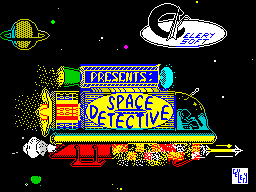
Space Detective
Adventure Game: Text/Illustrated · ZX-Spectrum 48K · 1 players · English
Celerysoft · 1986 · Pound sterling 2.00
SpaceDetective, 1 of 2
Discussion
Nobody has started a thread about this yet.
Play
- spacedetective.rzxRZX playback file
- SpaceDetective.tzx.zipTape image English24 KB
Files and rights
No permission is on record either way. Screens and pictures are copied here on a take-down basis: if you hold the rights and want something removed, say so and it goes.
Credits
- Jasper Sharpcredited
Sign in to credit somebody, or say what these people did.
Scores
In the magazines
- Crash #301986 · Overall43%
- Sinclair User #631987 · Overall4/5
Elsewhere on the web
- WorldOfSpectrum 6 votes6.83
In the magazines 2
Sinclair User #63Jun 1987 · p.544/54/5
Overall 4/5
Gary Rook 4/5
Label: Celerysoft Price: £2.00 Memory: 48K/128K Reviewer: Gary Rook Celerysoft is a new company and a bit weird. Included with the game there's a recipe for Celery Gratin. Pretty odd really, when you think about it. Don't let it put you off... Space Detective is written using the Quill, Patch and illustrator, like many a budget title these days. The plot is simple enough. Your bosses - the Galactic Federation or whoever - have lost contact with one of their scout ships, sent to investigate the planet Krepten. What has happened to the crew? Why haven't they reported? How come it's always you that gets volunteered for these assignments? You begin the game standing by the scout ship's airlock. Northwards, you will find various rooms, some with obvious functions, others not so easy to understand. A swift wander round the ship indicates that there has been some major problem. First off, you can't find the crew anywhere, although there are a couple of titanium doors that you can't open if they're behind them, then it's likely they're dead. The ship's main reactor seems to have been cut off, and, you'll obviously need to find something to refuel it with before you can get power to the ship's controls. The transporter apparatus has been wrecked, so it might be good to mend it. The question is where are the crew? Are they dead or alive? If alive then either they are hiding, or they have teleported down to the planet's surface. The graphics work well, and use has been made of the Illustrator's ability to get things to flash on screen. The plot may be hackneyed, but it works well enough and there should be enough meat here to keep any adventurer happy for quite a while.
Crash #30Jul 1986 · p.7730%50%65%45%43%43%
Atmosphere 30%
Vocabulary 50%
Logic 65%
Addictive Quality 45%
Overall 43%
Derek Brewster 43%
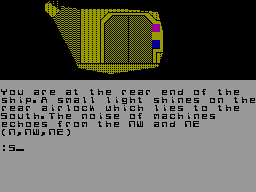
DEREK BREWSTER'S ADVENTURE TRAIL INDEPENDENTS' DAYS Clive Sinclair bows out of computing for the moment and Crash magazine announces startlingly high circulation figures, higher than any other computing title. Could there possibly be any connection between these two facts? I will endeavour to find out in my own inimitable way, concentrating on the notion of Crash being an independent, in a home games world dominated by Spectrum computers whose very existence can only be attributed to the dedicated band of independents who whole-heartedly backed the machine. As I've said before, I have owned at one time or another most of the home computers released in the UK, the ZX80 being the only one to escape my curiosity and to achieve mass circulation. Of all these computers, the Spectrum holds a special place in my affections. It was this computer, in the early days as much as now, which encouraged and fostered a wide band of dedicated programmers who were out to squeeze every byte of code until it paid dividends. All the credit cannot be given to Sinclair himself for the Spectrum phenomenon. It often seemed to programmers slaving over a hot heat sink that the boffin was determined to wreck the software market by a whole catalogue of hotchpotches and own-goals. These were: Interface 2, the Microdrives, and early (thankfully fruitless) attempts to corner the software market for himself, when profits from hardware were being cut to the bone under increasing competition from the UK and America. Interface 2 was a debacle of the highest ineptitude. For a price, it enabled the games player to connect a joystick (something which could be done without add-ons to competitor machines) and gave access to a glossy catalogue of ROM cartridge releases which only remained impressive so long as the reader was unaware of a major restriction: they were 16K programs only. This at a time when the 16K machines were sampling their last bytes as they were overtaken by the much more popular 48K computers. The irony is that 16K programs take little time to load in any case - it is the 48K programs which require the bonus of instant loading. As it was, the cartridges were a flop. Had they been aimed at 48K machines, the Interface 2 would have been an undoubted success; people were certainly prepared to pay an extra £2 for each faster, more reliably-loading program. But this was not the only faux pas to this interface, as its purchasers soon discovered to their undying chagrin. In the world of games joysticks Sinclair took on the Kempston system with his Interface 2 when the Kempston protocol had already become the standard. By breaking with this standard Sinclair created havoc with programmers and public alike. Many of the top games deemed the Kempston system as the only real must as an option for joystick control. Microdrives are now infamously known as unreliable and infuriatingly fickle. The Microdrive tapes wear quickly and are regularly munched up by the drive mechanism. More fundamentally, the drives do not offer what is implied is their reason for being: they are slow and require several revolutions of the tape loop before the drive warms up sufficiently to load the program. For those who haven't heard enough, the consequences of running out of memory are not good. When a program is too long the computer crashes and the Microdrive spins on - wiping everything from its tape. It's not hard to see that the Microdrive cannot be put to serious use and is a commercial non-starter, explaining the conspicuous lack of Microdrive software. If all the technical shortcomings of the micro passed largely unnoticed by the Spectrum latecomers, the lack of a proper keyboard was plain to all and sundry. In my opinion, the first rubber keyboard was better than the later intended improvement. Clive Sinclair single-handedly created the mass home computer market, and all the above criticism isn't much more than nit-picking in the light of his major achievement. The ZX81 first popularised the notion of affordable home computing in the UK. Owing to Clive Sinclair's brainchild, the UK has more computers per capita than any other country in the entire world. But of all the good and bad of Sinclair's reign, the one thing he did not attempt was publishing his own 'official' magazine, and for this he can only be congratulated. Unlike Acorn, Amstrad and Commodore who did try, he was alone in letting the independents do what they do best - reporting the facts enthusiastically, without fear or trepidation, and with a desire to do what's best for the entire Sinclair phenomenon, and not just the central nominal company. What I hope Alan Sugar realises about the company he has taken over is the role that independents played in making the Spectrum. The quality of their add-ons for the computer was very high and exceptionally good value for money. For example, Sinclair could only offer a 30 day waiting list and an inflated price for the 16 to 48K upgrade, while small workshops performed the service more rapidly and at less cost. I think that the Spectrum phenomenon, and the important role of independents in the computer's success is not only a lesson for microcomputing, but for the whole British economy. SPACE DETECTIVE Producer: Celerysoft Retail Price: £2.00 Author: Sharp With a name like Celerysoft these guys must have a sense of humour (they even enclosed a menu for celery au gratin which begins with the celery being boiled in a little salted water for 20-30 minutes). The F19 scout ship hangs limply in orbit over the planet Krepton on its mission to detect life on the barren surface (see what I mean, gave me a fit of the giggles, I can tell you). Yesterday all communications with the ship ceased and you are 'injected' into the back of the ship to find out what's up. You must return to the Inter-Galactic Control Base with the case solved. And why must you do these things? Because you are none other than the great SPACE DETECTIVE, that's why. The crew onboard consists of Tobor Xod, captain of the F19, Astrid Tam, scientist, Ojo Ojomoh, engineer, and Klepton Kyle, medical officer. The game makes use of the Quill, Illustratorand Patch and it is The Patch's sound effect (the one of the train) that is encountered in the engine room NE and NW of the start location. You begin at the rear end of the ship where a small light shines on the rear airlock. The picture above the text rather neatly depicts the scene and there's even some flashing indicator lights to liven things up a bit. To the north, along a gleaming white connecting corridor, is the dining room which has a large table, four chairs, and a food dispenser which is battered and out of action. It is here you get your first taste of the unimaginative plot behind this one: both GET SEAT and GET TABLE elicit 'You cannot do that' with no further elaboration. Now, I think it quite reasonable to assume the author must have expected the player to attempt to get these items and it wouldn't be expecting too much to have a more imaginative reply to the one given. In general, there are very few occasions where comments are received unless they're along the lines of the solution to the game. When authors do not predict and think through how a game might be played, atmosphere is lost and the player settles down to a linear game characterised by a feeling of passive disinterest. In the Navigational Room, where there is a display screen, EXAM SCREE brings out one of the drawbacks to The Quilt the program assumes you are referring to something else when it comments 'The screwdriver is very small but will undo any screw'. A grill, a little distance away, is secured by screws and, what do you know, around the corner is a screwdriver to deal with them. Not so quick though, the grill is eight feet up and out of reach. But remember, the solution does not lie in getting the table or the seats! Space Detective is a very run-of- the-mill adventure. Owing to its linear plot and solution pathway it lacks atmosphere. When a game is unresponsive it fails to keep the player enthralled. There is little story here, just a set of preset problems and solutions, which is a little disappointing when you consider storytelling is what adventuring is all about. COMMENTS Difficulty: not difficult Graphics: average Presentation: Spectrum character set Input facility: verb/noun Response: Quill
Related
- Versions
- The Quill Adventure System (Authored with)
- Elsewhere
- CASARZX ArchiveThe TipshopUVL
- Same entry at
- Spectrum ComputingZXInfo
Reviews from people here
Sign in to write about this, or make an account. It takes a minute and lets you correct the catalogue too.
No description recorded.
Sign in to correct or add to this.
Hold the rights to this and want it taken down?